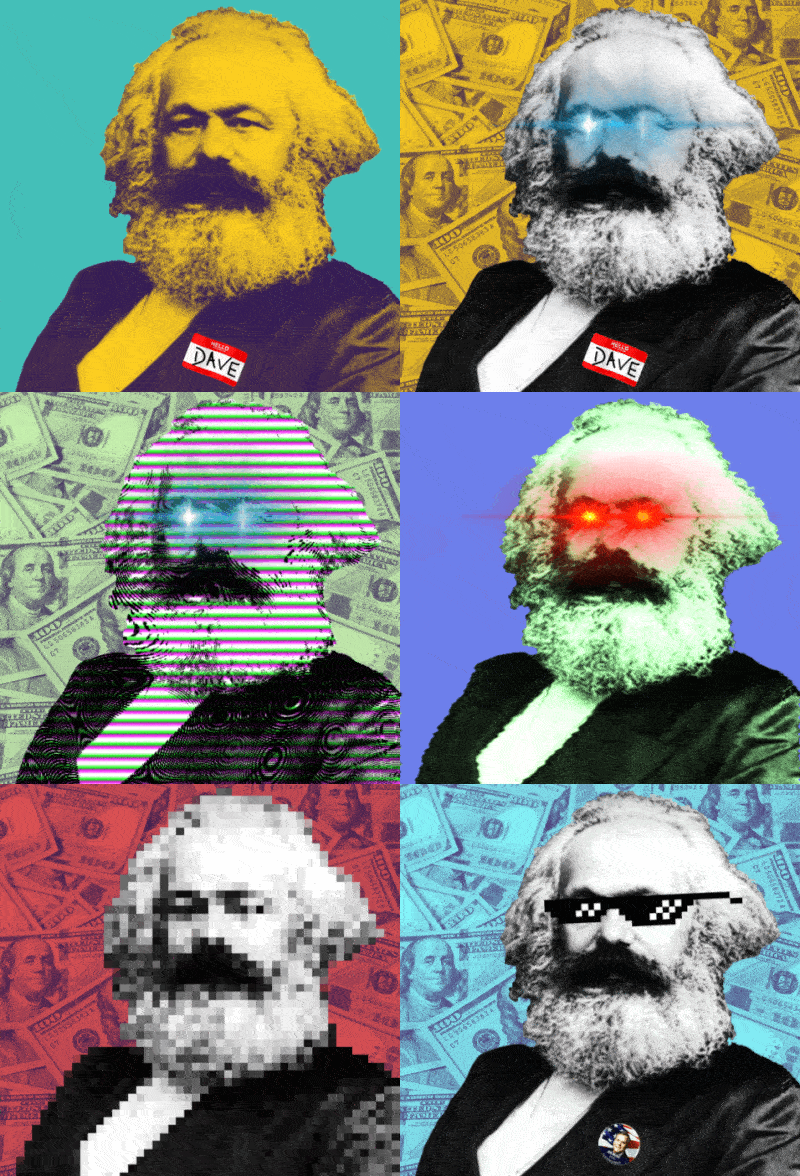
I want to resist this.
There is a part of me that would prefer not to drag Marx back into the room like a slightly embarrassing relative—one you thought had retired from politics in the 1990s and now refuses to stop commenting on the TV and leave him in the attic with the other heavy furniture of the 19th and 20th centuries—dialectical materialism, rotary phones, and the confidence that history had a plot. The last few decades seemed to settle it. The end-of-history arrangement, the platform optimizations, the software-layer confidence game—all suggested the old vocabulary would retire quietly.
From an engineering perspective, the distinction should be clean: diagnosis is not prescription. You run the debugger to find the fault. What you do about it is a separate problem requiring different tools. Conflating the two is a category error. Marx made that error badly. The prescriptive apparatus—the party, the vanguard, the dictatorship of the proletariat, the inevitable resolution—is where the 20th century went wrong with him. That’s the embarrassing relative.
But the diagnostic tooling is largely independent of the prescription. Base and superstructure doesn’t require belief in historical destiny. Surplus value doesn’t require a complete labor theory of price. Fictitious capital doesn’t require a predetermined endpoint. You can run the diagnostic without accepting the treatment plan.
The failure point is teleology.
Marx inherits from Hegel the idea that history moves toward resolution—that contradiction drives toward synthesis. That’s where the diagnostic insight gets compromised. The prescription isn’t really engineering; it’s narrative. History has a destination, the proletariat is the vehicle, the party knows the route.
The same structure reappears later. “End of history” is just the same skeleton with a different winner. Liberal democracy instead of communism, but the same assumption: that history converges.
Both are versions of the same mistake—teleological thinking applied to complex systems.
Engineers tend to see the problem immediately. Complex systems don’t have destinations. They have states, transitions, and failure modes. The relevant question is not “where is this going?” but “what is this doing right now, and how does it break?” Marx’s diagnostic vocabulary answers that question. The teleology is noise his century couldn’t filter out.
And yet here we are.
The last thirty years offered a more elegant story: ideology solved, history flattened into product cycles, contradictions managed through software updates, venture funding, and increasingly elaborate naming conventions.
It was a good story. It just wasn’t stable.
For a while—long enough to build trillion-dollar companies and a mythology of the future—it seemed plausible that we had outgrown Marx. Conflict was rebranded as disruption, disruption as innovation, class as “ecosystem,” with a UX problem. Even antagonism became a kind of UI.
And for a time, it performed well enough to pass as reality. But by 2026 the performance is getting harder to maintain.
What follows is a retrofitting—Marxist definitions onto a system that had convinced itself it no longer needed them. Not because Marx “won,” and not as a return to orthodoxy, but because the system is starting to behave like it remembers what we agreed to forget.
What looked like an endpoint now reads as an accounting trick—less a final stage than a temporary abstraction over a longer dispute about ownership and production. The end-of-history tech-industrial complex did not end history; it subcontracted it.
I’m not especially happy about this. It feels like discovering the emergency exits were never decorative—and that the fire drills were predictive.
So, with some embarrassment, here are the definitions.
April 2026. Software moats cracking. Atoms recalled after decades of offshoring. Civilian industry quietly reoriented toward material production under strategic pressure. Supply chains revealing themselves not as neutral infrastructure but as contested terrain.
Crisis (Krise) → Crash-Only Capitalism
For Karl Marx, crisis (Krise) is not an anomaly but a structural feature of capitalism. Periodically, the system breaks down under the weight of its own contradictions—overproduction relative to demand, falling profitability, the inability to realize value already produced. These crises are not gentle corrections. They are, in Marx’s terms, violent eruptions: moments in which equilibrium is restored through destruction—of capital, of capacity, of livelihoods.
Crisis, in this sense, are not just failure. It is the mechanism by which the system continues.
But in Marx, crisis still appears as episodic. A rupture, a clearing event, after which accumulation resumes on a reconstituted base. However severe, the crisis is bounded. It interrupts the system; it does not define its ongoing mode of operation.
That distinction no longer holds.
What appears instead is something closer to a crash-only system. The system does not move between stable periods punctuated by crises. It operates through continuous breakdown, with each apparent stabilization revealing itself as a lag between layers rather than a resolution. The crash is no longer an event. It is the process.
In a crash-only system, contradictions are not resolved or even temporarily cleared in a way that restores coherence. They are displaced. The platform layer saturates and crashes into AI-driven overproduction; AI expansion collides with material and energetic constraints; those constraints force reorganization at the level of industry, logistics, and the state. Each phase presents itself as a shift or transition. In practice, each is a failure propagated forward.
The system persists not by achieving equilibrium but by relocating disequilibrium—moving pressure from one domain to another, from symbolic to material, from civilian to state-coordinated, from one geography to the next. What Marx described as crisis begins to look less like an interruption and more like the underlying operating logic.
This reframes analysis. The question is no longer how the system resolves its contradictions, or what final state those contradictions point toward. It is where the current failure is expressing itself, and what constraints that failure is generating. Stability, when it appears, is provisional—an artifact of timing, not a solution.
Older terms return not because history has repeated, but because the system under continuous stress begins to resemble earlier configurations where those terms were first useful. The resemblance is structural. The difference is that there is no longer a clear distinction between crisis and normal operation.
The people most disoriented by current conditions are not confused because the situation is unprecedented. They are confused because their entire cognitive frame was assembled during the ZIRP years — the zero-interest-rate-policy period when cheap money made everything feel weightless, optimizable, and endlessly deferrable. Attention could substitute for production. Irony and prestige television could neuter class awareness indefinitely. Overaccumulation could be laundered through metrics and vibes. Gravity was optional. What they keep calling the polycrisis or the great weirding — that endless cascade of surreal overlaps where nothing resolves — is not novel complexity. It is the reappearance of patterns that were always there, now visible because the suspension ended. They are experiencing the return of gravity as a glitch in the infinite scroll.
What follows is a glossary for that condition.
Base and Superstructure.
The classic Marxist claim is that the economic base — forces and relations of production — shapes and is reflected in the ideological, cultural, and political superstructure that legitimates it. The platform age elaborated this into something elegant and temporarily stable: the software layer became the dominant superstructure, running luxury beliefs, Internet of Beefs, grievance-to-status converters, and manorial attention-harvesting above a hollowed-out atom base of offshored manufacturing and decaying infrastructure.
High-resolution symbolic combat felt like the whole game because the superstructure was doing its masking job. In the platform collapse age, the masking function fails. Civilian factories are eyed for weapons production. Luxury beefs persist but now serve as domestic soundtrack for an emerging war-economy superstructure rather than as pure attention rents. The key shift: the superstructure no longer convincingly hides the base — it compensates for its visibility.
AI was supposed to extend this logic, to produce an even more powerful layer of abstraction. Instead it destabilizes the existing one. By flooding the system with low-cost symbolic output while failing to generate proportional material value, AI accelerates the breakdown of the masking function.
The clearest current instance of crash-only logic is kinetic. A Tomahawk cruise missile costs approximately two million dollars. The drone it intercepts costs ten thousand. The exchange ratio is two hundred to one — capital destruction running as standard operating procedure, not as exception. The defense-industrial complex has no internal mechanism to correct this. Each interception is individually rational and collectively ruinous, the Prisoner’s Dilemma expressed in ordnance. The material base burns expensive to stop cheap, indefinitely, because the alternative is losing.
The superstructure runs the same logic cheaper.
The Iranian Lego videos are the symbolic equivalent: a tiny team inside a sanctioned, blackout-prone country scripts blunt copy in hours, feeds it into globally available generative tools, and drops two-minute clips daily. Lego Trump flipping through Epstein files before launching the missile that flattens a school. Lego ordnance with ONE VENGEANCE FOR ALL painted on the casing. Lego children in cartoon rubble, rap track underneath.
The compute cost is negligible. What gets destroyed is not infrastructure but coherence — the shared baseline that allows a viewer to ask “is this real?” and expect the question to resolve. It doesn’t resolve. That’s the mechanism. Each clip is a unit of capital destruction running through the superstructure because the material base can’t win on parity alone. The crash-only logic applies at every layer: nothing is being built. The output is fatigue, vertigo, the erosion of whatever fiction of stable meaning the attention economy was still maintaining. Destruction wearing a childhood toy mask, daily, cheap, and infinite.
The superstructure becomes noisier, denser, and less convincing at the exact moment it needs to work hardest.
Surplus Value.
In the classic formulation, surplus value is the value produced by labor beyond what is returned as wages — the hidden engine of capitalist profit and accumulation. The platform age laundered it into “engagement,” “creator payouts,” “wealth pump,” and “platform rents,” extracting value from unpaid digital labor while offshoring material production.
But this phase only stabilized because a substitution took place: the loss of what might be called the aroma of material life — durable goods, embedded local value, thickness of place — was tolerated because new forms of value were created in return.
Speed, access, infinite scroll, symbolic participation. The system didn’t just extract more; it replaced one kind of value with another that felt, at least temporarily, like gain.
Yes. The engineer didn’t mourn the factory. They built a different aroma economy—artisanal, curated, local, expensive. The third wave coffee shop was the material substitute for the material thing they never had in the first place. Atoms, but lifestyle atoms. Thickness of place purchased retail.
And now that’s also getting hollowed out. The Erewhon sandwich costs $28 and the job that paid for it is gone. The craft beer bar closes because the neighborhood repriced. The artisanal layer was real—it had weight, smell, a specific Tuesday afternoon quality—but it was downstream of a income stream that AI saturation is now draining.
So the precariat engineer isn’t mourning the shop floor. They’re mourning the $22 cortado they could afford when the symbolic labor still paid enough to buy material compensation for its own immateriality. The substitution chain ran: abstract work → real money → purchased thickness. Remove the middle term and the whole chain fails.
That’s sharper than Luddism because it’s not about what was lost to technology. It’s about what the technology class built as its own version of material life, and how that’s now also at risk. The engineer bought into the aroma economy as a consumer. Now they’re being priced out of it as a worker.
The symbolic labor paid well enough to buy its own antidote—the right neighborhood, the right coffee, the right sandwich that tasted like something made by a person who cared. That was the deal. The deal is off.
In the platform collapse age, that substitution begins to fail. Surplus extraction reverts to its legible form inside converted auto plants — stamping shells, machining components, assembling ordnance. Living labor tethered to atoms makes unions and shop-floor power relevant again. The earlier trade, loss of material richness in exchange for new forms of value, starts to feel like a net loss, and surplus becomes visible again not as abstract metrics but as time, output, and depletion.
AI completes this failure. It consumes capital — compute, energy, infrastructure — faster than it reliably produces monetizable value, while simultaneously degrading the previous substitute through overproduction of content and attention-absorbing symbolic work. What felt like substitution becomes net loss. Surplus extraction becomes visible once more as cost.
Even mainstream economic analysis is beginning to rediscover the contradiction in sanitized form. Recent work frames AI-driven automation as a Prisoner’s Dilemma: each firm must eliminate labor to survive competition, even though doing so destroys aggregate demand. The result is system-level loss with no internal mechanism for correction.
But this is not simply a coordination failure. It is the competitive logic of capital under saturation. Firms do not miscalculate—they follow the only viable path available to them. The “deadweight loss” is not an accident but a phase outcome.
What appears as a paradox at the level of the firm resolves at the level of the system through redirection: when demand cannot be sustained internally, it is sought externally.
Relations of Production.
The classic term designates the class relations determining who owns the means of production and who sells labor power — the social form through which surplus is extracted. The platform age obscured this behind “platforms,” “ecosystems,” “two-sided markets,” and “incentive misalignment.”
Ownership felt abstract: VCs, algorithms, founder narratives, the general theory that everyone is a stakeholder in the attention economy. In the platform collapse age, these relations revert to classic capital-labor form inside repurposed factories, and the question of ownership — who controls the converted line, who sets terms for rapid shift to defense work — can no longer be answered with a pitch deck.
Preliminary Pentagon-automaker talks already surface barriers around contracting, labor, and rapid conversion. Abstraction collapses into negotiation: ownership stops being a narrative and becomes a constraint. AI intensifies the contradiction by displacing or devaluing labor without a corresponding expansion in value creation. Ownership remains concentrated, but its productive justification weakens. Capital retains control while producing less clearly justifiable surplus, and labor becomes simultaneously less necessary and more precarious.
Distribution and the Missing Term.
Ricardo saw it before Marx did and Marx never quite forgave him for it. Distribution—how the total product gets divided between wages, profit, and rent—was for Ricardo the central problem of political economy. Not production. Not accumulation. The split. Who gets what after the thing is made.
Marx absorbed Ricardo and then subordinated him. Distribution for Marx is downstream of production relations. Fix who owns the means of production and distribution follows as a logical consequence. The prescription contains this assumption so deeply it barely surfaces as an assumption.
It sounds familiar. Build the platform, distribution follows. Achieve AGI, abundance follows. The productive force is the interesting problem—the hard problem, the genius problem. Distribution is implementation detail, go-to-market, someone else’s quarter.
The benefits did not flow. Silicon Valley ran the Marx error with better slide decks. Network effects were supposed to solve distribution the way socialized production was supposed to solve it. The algorithm would allocate. The market would clear. The rising tide would find everyone’s boat.
What actually happened was the capture point moved. Production relations changed, distribution relations didn’t. Value was produced at scale and went somewhere specific and the precariat engineer—who built the productive layer, who wrote the code that runs the platform—is now asking Ricardo’s question, which was always the right question: after everything is made, where does my share go.
Marx didn’t have a clean answer. Neither does your severance package.
Forces of Production and Overaccumulation.
The forces of production are the material productive capacity of a society — tools, technology, infrastructure, skills, the organization of labor. The platform age split these into a radical imbalance: software forces expanded wildly while real forces — ports, rails, fabs, energy systems — atrophied or moved offshore.
Over-accumulation appeared in its platform form as trillions in fictitious valuations, endless funding rounds, and attention derivatives; luxury beefs were the froth. In the platform collapse age, the forces are being recalled. Automakers’ high-volume lines, automation expertise, and supply chains are scouted for munitions, missiles, and counter-drone systems.
This is not neutral progress — it is senile capitalism redirecting overaccumulated capacity into destruction-oriented output. The accumulated pile seeks new circuits; when civilian absorption fails, capital turns outward via geoeconomic confrontation and factory conversion. The important correction to catastrophism: this is not breakdown but redirection, crisis as routing problem rather than terminal failure. Recomposition replaces expansion.
AI enters both categories as a complication. It appears as an advanced force of production that does not translate cleanly into productivity gains, expanding capability and output — especially symbolic output — without proportional increases in realized value. It also functions as another sink for excess capital, one that extends overaccumulation while increasing the burn rate, buying time with higher technical complexity and escalating cost.
Fictitious Capital and Imperialism.
Fictitious capital — paper claims on future surplus decoupled from current real production — took its platform form in valuations, Substack empires, and engagement metrics converted to revenue. In the platform collapse age, these claims must be materialized somewhere.
Defense contracts and war-economy demand offer one such circuit, converting fictitious expectations into physical munitions while creating new debt-fueled absorption. The capital doesn’t disappear; it demands a body. War provides one of the few scalable mechanisms for this embodiment.
AI amplifies the fiction by projecting future productivity that is slow and uneven to materialize — valuations assume transformation while deployment delivers marginal gains and high costs. The gap widens between expectation and realization, increasing pressure to find material anchors, and the state, infrastructure spending, and war-linked production are where that pressure goes. This is continuous with the Leninist analysis of imperialism: the monopoly stage in which export of capital dominates, the world is divided, and further expansion requires forcible redivision.
The platform age expressed this as tech decoupling, supply-chain weaponization, and narrative warfare — software moats as the new imperialism. The platform collapse age shifts toward material re-territorialization. Pentagon talks with automakers echo WWII Arsenal of Democracy logic, not as abstract policy but as structural necessity when software saturation meets depleted real stocks.
Imperialism here is not ideology but logistics: who controls production, routes, and replenishment under constraint. AI integrates more easily into military and state-coordinated systems than into profitable civilian markets — defense and surveillance provide clearer absorption than consumer monetization — and so aligns with externalization dynamics, becoming a layer within logistical and targeting systems tied to geopolitical competition rather than a universal productivity engine.
Commodity Fetishism,
In the classic Marxist account, commodity fetishism names the process by which social relations between people take on the appearance of relations between things. What is fundamentally a social and material process—labor, coordination, extraction, production—becomes legible instead as the properties of objects in circulation. The commodity seems to have value in itself. The system disappears into its outputs.
The platform age does not eliminate this mechanism. It refactors it.
Social relations are no longer primarily mediated by physical commodities, but by continuous symbolic feedback loops: likes, views, rankings, engagement metrics, algorithmic visibility. The fetish no longer attaches to objects so much as to signals about objects and people, circulating in a compressed informational layer. Relations between people appear as relations between profiles, feeds, metrics, and content streams.
For a time, this abstraction is stable. It works precisely because it is thin: it hides its own material depth well enough that most participants do not need to think about it.
In the platform collapse age, that stability begins to fail. The fetish does not disappear—it becomes harder to maintain.
What changes is not that abstraction stops functioning, but that it becomes increasingly expensive to sustain. The “steel” behind the interface starts to show: labor hours, logistics, energy consumption, and increasingly visible state and defense coordination begin to intrude on what had been presented as a self-contained symbolic economy. The production layer reasserts itself inside the representation layer.
Zombie Simpsons is a useful cultural image here: a system continuing to generate recognizable outputs through recursive self-reference, while the underlying world that once made those outputs meaningful has partially detached. But at a certain point, even callback-driven continuity is no longer sufficient. Factory conversion, supply-chain reorientation, and industrial mobilization break the loop. The underlying floor becomes visible not as metaphor, but as constraint.
AI intensifies this shift rather than reversing it. It does not restore scarcity; it produces synthetic abundance—endless content, code, images, and text generated at marginal cost and detached from proportional material value. In doing so, it changes the structure of the fetish itself. When symbolic output becomes effectively infinite, value can no longer be anchored in rarity or effort alone. What was once backgrounded as “how things are made” becomes unavoidable as a question: what is this actually connected to, and what sustains it?
Scarcity no longer organizes perception. Saturation does.
At that point, “entangled time” becomes legible in a different way. The term has to do double work that older categories kept separate: it names both surplus value extraction and alienation simultaneously. This is precisely what made the platform form so effective as a masking system.
You were working and you did not know it.
You were alienated and it felt like leisure.
The boundary between the two did not disappear—it became unlocatable. Fetichism doesn’t break under truth — it breaks under excess visibility
Alienation — the classic separation of workers from product, process, fellow workers, and their species-being — took its platform form in gigified, remote, narrative-producing consolations: scrolling, posting, beefing as substitute for fewer atoms.
But the platform age added a refinement Marx couldn’t have fully anticipated. The alienated time was also extracted time.
What some development economists would call satisfiers helps clarify the mechanism here: not basic needs themselves, but the secondary structures that make deprivation feel tolerable—status signals, frictionless communication, ambient entertainment, curated access, symbolic participation. The platform layer became a satisfier engine. It did not resolve material lack; it produced compensatory experiences that made that lack psychologically inhabitable.
In that sense, what consultants later called entangled time—the hours spent online that are simultaneously personal and productive, leisure and labor, rest and content generation—is not just a blur between categories. It is a satisfier regime in collapse: a system in which the compensations themselves are indistinguishable from extraction.
You scrolled for yourself and built the engagement metrics that paid someone else’s dividend. The satisfier did not sit outside the system; it was the system’s way of making its own extraction feel continuous with life. The alienation was so complete it consumed the category of free time itself. You weren’t just separated from your product. You couldn’t find the seam between your life and your labor.
AI inverts the condition without resolving it.
Entangled time used to mean your leisure was secretly labor. Now it means your labor is secretly leisure—activity without exchange value, presence without compensation, availability without demand. The satisfier layer does not disappear; it saturates. It no longer compensates for extraction because it is no longer clear what would count as compensation.
The code still gets written. The work still gets done. The question is whether doing it retains a price when the model can approximate it for less than your health insurance costs. This is not redundancy anxiety. It is value vertigo—the ground-level experience of a category of work losing its exchange value in real time, while the worker is still inside it, still performing it, still unable to locate the moment it stopped being worth anything to anyone with the ability to pay.
The seam doesn’t disappear. It just stops paying.
Platform satisfiers once converted extraction into livable experience. AI removes the need for that conversion entirely. It returns both labor and leisure to a condition where neither reliably resolves into value.
Primitive accumulation — the violent historical separation of producers from means of production — took its platform form as digital enclosure: data grabs, attention capture, platform lock-in, and the circular investing loop that recycled capital within the symbolic layer rather than expanding productive capacity outside it. LP to fund to startup to acquihire to return to LP—a closed circuit that enclosed the future the way common land was once enclosed, extracting carry and markup from each rotation while the atom base atrophied outside the loop. Not accumulation in the classical sense but accumulation of claims on accumulation that hadn’t happened yet.
In the platform collapse age, it appears as geopolitical and material re-enclosure: re-territorializing supply chains, converting civilian capacity, imposing atom-layer discipline after decades of software escapism. The circuit forces open. Capital that completed the loop inside the symbolic layer now faces pressure to materialize. Not a one-time origin but a recurring process under new conditions—and in each recurrence, a different commons gets fenced.
The circuit has a current form. The United States extends credit to the Gulf. The Gulf invests in American cloud infrastructure. The cloud infrastructure funds the frontier model companies. The frontier model companies buy the chips. The chips require the fabs. The fabs require the supply chains. The supply chains require the geopolitical arrangements that started the credit flow. The money completes the loop and calls itself investment. No new productive capacity outside the circuit. No wages that didn’t originate inside it. No commons that wasn’t already enclosed before the transaction cleared. What looks like capital flowing into the future is capital flowing into a mirror—each reflection slightly more leveraged than the last, each rotation extracting fees from the distance between the claim and the thing the claim is on.
Ricardo’s question doesn’t get asked inside the loop. There is no distribution problem when the circuit is closed. The problem only appears at the boundary—where the loop meets the people who built the infrastructure, wrote the code, generated the content, and are now outside looking at a mirror that doesn’t show them.
Platform Rent.
Rentier capitalism — monopoly extraction of rent rather than productive profit — was the core logic of the platform age: skim from user labor without expanding real forces, maintain scarcity through platform lock-in. In the platform collapse age, this is subordinated to more urgent extraction forms. Pure rentier logic must share space with directed industrial output and war-economy contracts. The sophisticated maps of manorial dynamics lose explanatory power when the manor needs to stamp artillery shells. Rent doesn’t disappear — it is outcompeted. AI undermines rentier stability by commodifying the very outputs platforms monetize; when content, code, and expression become cheap and abundant, maintaining scarcity becomes harder, and platforms must either reintroduce constraints or integrate with more material circuits of value.
Military Keynesianism.
The use of arms production as a demand pump when civilian markets cannot absorb surplus was largely financialized or outsourced during the platform age. It is now an active mechanism. Pentagon outreach to automakers for rapid capacity shift is textbook: redirect commercial industry, create demand via destruction-oriented production, stabilize legitimacy through jobs while externalizing contradictions. War is not an anomaly here — it is a coordination mechanism under conditions where markets fail to coordinate.
The meta is simpler and harder to say. Overaccumulated capital that cannot be distributed must be destroyed. This is not metaphor. The circuit closes not through wages or shares or UBI proposals or platform payouts but through ordnance—physical destruction of value that clears the ledger and restarts the accumulation cycle. Ricardo asked where the surplus goes. This is one answer the question always had and rarely got. The productive force that couldn’t monetize content finds its market in things designed to be used once. AI finds clearer economic justification within war-economy circuits than civilian ones — defense, logistics, and targeting systems provide absorption that consumer markets cannot. The essay you are reading was cheaper to produce than the missile it is describing. That asymmetry is not incidental. It is the condition.
Class Struggle.
The conflict over surplus — classically the motor of historical change — was successfully renamed during the platform age: status competition, tribal signaling, knight-mook dynamics, luxury beefs. But the deeper disappearing act was cultural. Class struggle didn’t just get renamed — it got a showrunner.
Ricky Gervais’s The Office was the aesthetic technology that completed what the rebrand started: the foreman became Brent, the antagonism became awkwardness, and the structural condition of being trapped in someone else’s accumulation cycle became a comedy of manners about social incompetence. You identified with Tim — the knowing ironist, too smart for his surroundings, waiting for something better — and not once did it occur to anyone to organize. The genius of it was that the ironic distance felt like freedom. It wasn’t. It was the assimilation running clean. By the time the American version made Michael Scott loveable, the transformation was complete: the workplace was a family, dysfunction was personality, and class was something that happened to other people in other centuries.
30 Rock was the next phase. The Office neutralized antagonism through cringe identification. 30 Rock neutralized it through meta-awareness. Liz Lemon is smart enough to see every contradiction and too invested in her own position to threaten any of them. The self-awareness became the product. You can’t be accused of false consciousness if you’re already ironic about your own false consciousness. Jack Donaghy speaks as the unfiltered id of capital — plainly, coherently, without apology — while Liz performs progressive discomfort from inside the same building, on the same payroll, producing content for the same conglomerate. The joke is always that Jack is more honest. Capital wins every episode and the laugh track confirms it’s funny. The sequence runs clean: The Office converts class struggle into social comedy. 30 Rock converts class awareness into personal brand. By the time you’ve watched both you have a complete toolkit for feeling smart about your own capture without doing anything about it.
The current fault line is not yet the factory floor because the factories are not yet converted. It runs instead through the API. Above the API: the engineers, the prompt architects, the model trainers, the people whose skills are still legible to the system as value. Below the API: everyone whose work the model can now approximate — the writers, the coders, the analysts, the designers, the junior everything — doing the same work for less, or not doing it at all, watching the output appear without them. This is not a metaphor for class. It is class, in the specific sense that it designates a structural position relative to the means of production. The API is the new factory gate. The question of who is above and who is below it is the question of who captures surplus and who generates it without return.
The knowing ironist who identified with Tim, who laughed at Brent, who appreciated Jack’s honesty while identifying with Liz — that person is now below the API wondering when the ironic distance became the condition rather than the commentary.
The factories, when they come, will make this cruder and more legible. Atoms do not run on vibes. The shop floor does not have an unlimited PTO policy. But the struggle is already present in its platform form — not as luxury beef but as the quiet arithmetic of who the model replaced and where the value of that replacement went. Software could virtualize class struggle. AI is making it visible again, one RIF notice at a time, before the converted plants finish the job.
⸻
There is a less comfortable way to read all of this.
Not that these terms have become newly relevant, or that history has returned to an earlier configuration, but that reality has been consistently closer to the structure they describe than the language we replaced them with was able to admit. The platform age did not eliminate those dynamics. It renamed them, abstracted them, and, for a time, successfully rendered them less legible.
Nabokov observes that reality has an inconvenient amount of detail. Under present conditions, it may be more accurate to say that reality contains an inconvenient amount of Marxist detail. Not as doctrine, and not as prescription, but as recurring pattern: extraction, accumulation, constraint, and conflict reasserting themselves across layers that were expected to dissolve them.
This does not make Marx correct in any total sense. It suggests something narrower and more difficult to dismiss: that the system continues to exhibit the behaviors his terms were designed to capture, even when described using more contemporary language. “Ecosystem,” “platform,” and “engagement” function as overlays; under stress, they resolve back into more concrete relations between production, ownership, and distribution.
The comparison to Cthulhu Mythos is structural rather than stylistic. In those stories, the surface world maintains a coherent and familiar appearance while underlying conditions—older, less aligned with human expectations—persist regardless of whether they are acknowledged. Stability depends on not looking too closely at what supports it.
The platform age performed a similar function. It provided a descriptive layer that was, for a time, sufficient to obscure the underlying relations. What is changing is not the reintroduction of those relations, but the failure of the layer that concealed them. As that masking function weakens, the older vocabulary appears to return, not because it has become newly true, but because it was never fully displaced.
The question, then, is not why this language is resurfacing, but why it maps so cleanly onto a system that was supposed to have rendered it obsolete. The answer is not especially satisfying. The underlying structure did not change as much as the description did.
Which brings me to the thing Marx and Silicon Valley both missed.
They wanted the engine to also be the map. The diagnosis to contain the cure. The productive force to determine the distribution. They looked at the same contradictions I’ve just walked through and said: and therefore, here is what comes next.
I can’t do that.
I don’t know what’s going to happen. I don’t know how this breaks, or when, or which of these contradictions will eat the others first. The AI layer might stall out. The converted auto plants might unionize fast enough to matter. The crash-only system might find another displacement—space, surveillance, some third thing no one has named yet. Or it might not.
That’s uncomfortable because the genre expects closure. Glossary implies toolkit, toolkit implies application. But you’re not getting application. You’re getting visibility. What happens after visibility is someone else’s problem—or, more provocatively, no one’s problem until the system forces a solution through sheer contradiction.
I can tell you that the superstructure is no longer masking the base. I can tell you that surplus extraction is becoming visible again as time and depletion. I can tell you that distribution was always the missing term and that your severance package is not a solution. I can hand you the glossary. I cannot hand you the ending.
The AI punchline is perfect. Not because AI will actually produce solutions—i argue here it produces synthetic abundance without proportional value—but because the request for solutions has been outsourced to the very mechanism accelerating the breakdown. Ask the thing that floods the system with low-cost symbolic output. Ask the thing that cannot reliably monetize its own production. Ask the thing that deepens alienation while promising to resolve it.
That is not cynicism. It is simply the continuation of the diagnostic logic: if the system is crash-only, if redistribution is the missing term, if surplus extraction is becoming visible again, then anyone offering a clean solution is either selling something or has not read the glossary.
These terms are resurfacing not as academic revival but as necessity. The platform layer no longer masks the base. The AI layer does not replace it. The system didn’t transition — it stacked failures.
The beefs will continue. The models will generate. The capital will burn. The glossary does not tell you what to do. It tells you what you are looking at when the floor drops.
Leave a Reply