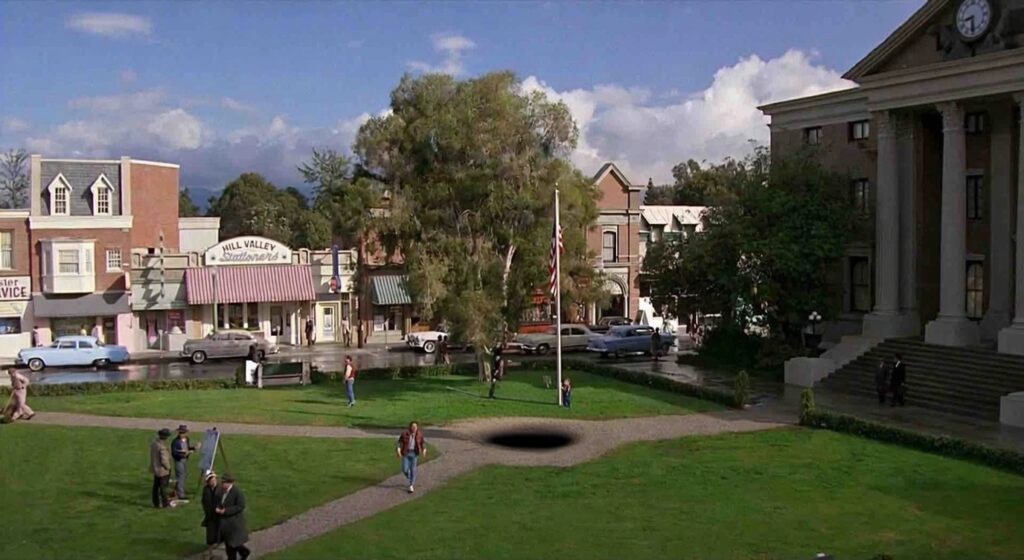
I first noticed it on a Tuesday, which seemed appropriate for a sinkhole. It had appeared overnight in the center of Municipal Plaza, approximately where the statue of Founder Henderson used to stand, who had apparently founded something at some point but the plaque had worn smooth decades ago.
The sinkhole was modest. Perhaps three meters across, irregularly circular, dark in a way that suggested depth but not drama. A few orange cones had been placed around it—not enough to fully cordon it off, but enough to suggest someone had acknowledged its existence in an official capacity. A small printed sign read: TEMPORARY ADJUSTMENT – PEDESTRIANS ADVISED TO USE ALTERNATE ROUTES.
I had been unemployed for seven months, which is long enough to develop opinions about word choice in municipal signage, and “adjustment” seemed optimistic for a hole in the ground. Still, the cones were professionally placed, the sign was laminated, and someone had to have made those decisions, which meant there were jobs, which meant perhaps one of them could be mine.
The Municipal Office of General Coordination occupied the fifth floor of the Administrative Building, which overlooked Municipal Plaza, which meant it overlooked the sinkhole, which by Thursday had grown to perhaps five meters across and had attracted a small crowd of onlookers who stood at various distances suggesting different risk tolerances.
The office itself was narrow, the desk apologetic, the walls decorated with framed certificates of attendance at conferences with titles like “Adaptive Response Frameworks” and “Stakeholder Equilibrium in Dynamic Environments.” Behind the desk sat Mr. Carlisle, Deputy Director of Situational Management (Acting).
“You’ve seen the situation,” Mr. Carlisle said, gesturing toward the window without looking at it. This seemed to be part of the job—acknowledging without observing, referencing without naming.
“The sinkhole,” I said.
He winced—not in disagreement, but in embarrassment for me, the way one might react to someone using the wrong fork at a formal dinner, or saying “moist” at a poetry reading.
“We don’t use that,” he said gently. “We say pothole or sometimes crack. The word ‘sinkhole’ carries connotations of emergency, which creates unnecessary anxiety in the community. Our role is to manage the situation, not amplify unproductive emotional responses to it.”
From a filing cabinet he produced a binder, labeled SITUATIONAL ASSESSMENT PROTOCOLS – CATEGORY 3. The binder was at least three inches thick, “Management, in this context, means ensuring that public discourse remains proportional to actual risk while avoiding terminology that might suggest institutional oversight has been insufficient.”
“So we’re managing how people talk about it,” I said.
“We’re managing the situation,” he corrected. “How people talk about it is part of the situation. As is how we talk about how they talk about it. He paused, then added: “My father taught me something important when I was young. He said: how you describe a problem matters more than the problem itself.
A younger official entered, carrying a laptop and a tablet and an expression of urgent competence. She wore two pens, which I understood meant she was subordinate to Mr. Carlisle but senior to whatever I would become. She did not wait for an invitation before sitting down and opening her laptop, from which she began reading aloud.
“The latest data from Public Sentiment Monitoring,” she said, scrolling rapidly, “shows a 3% increase in the use of terms like ‘concerned’ and ‘worried’ in social media posts referencing the plaza. We’ve also detected emerging use of phrases like ‘getting bigger’ and ‘shouldn’t someone do something.’”
“Predictable,” said Mr. Carlisle. “What’s the sentiment breakdown on alternate framings?”
She consulted her tablet. “‘Pothole’ is tracking at 12% organic adoption. ‘Crack’ is at 3%, mostly among municipal employees. ‘Works’ is at 0.2%, but that’s up from 0.1% yesterday, so we’re seeing movement.”
“Good,” said Mr. Carlisle. “And the situation itself?”
“Approximately 5.2 meters in diameter as of this morning,” she said. “Depth unknown. The survey team lowered a weighted line to 200 meters without reaching bottom. They described the experience as ‘unsettling’ and requested hazard pay, which is currently under review.”
“Depth is irrelevant,” said Mr. Carlisle. “What matters is perimeter management and narrative coherence. He turned to me. “Your role, if you accept the position, will be to assist with reframing.’”
“Reframing,” I repeated.
“Yes. For example: When someone says ‘there’s a hole in the plaza,’ we don’t dispute the observation. We recontextualize it. The hole isn’t a problem—the perception of it as a problem is the problem. Our job is to shift the frame of reference.”
“Shift it to what?”
“To something more productive,” said the junior official, looking up from her laptop. “For instance, we’ve been piloting language around ‘tunnel’ and ‘well.’ The hole isn’t taking something away—it’s adding something. Verticality..”
“But it’s still a hole,” I said.
“Is it?” asked Mr. Carlisle. “Or is it just a different kind of plaza? You see, this is exactly the kind of thinking we need to move past. Binary framing—hole versus not-hole—doesn’t serve anyone. What we need is spectrum thinking. The plaza now exists along a vertical axis as well as a horizontal one. That’s not loss. That’s expansion.”
He handed me a laminated card, which was sticky on one side.
The card read:
“The plaza is experiencing an unplanned change in surface elevation,” the announcement read. Subsurface conditions are an area of growing interest, and the situation is being actively monitored by qualified experts. Public concern is understandable, but we encourage a focus on constructive solutions rather than speculation. We ask residents to trust the process. Anxiety is non-scalable. “
“These statements,” Mr. Carlisle said, tapping the page, “have tested extremely well. You see? They redirect attention from what is happening to how one might feel about what is happening. Denial is counterproductive—it implies conflict. Reframing is collaborative. We don’t say there’s no hole…
“What if it gets bigger?” I asked.
“Then it becomes more meaningful,” he said. “Scale is interpretive. Five meters is a Category Three Event—manageable, conversational. Ten meters elevates us to Category Four, “And we’ll ensure the answer is widely shared. For engineers: subsurface hydrology. For the public: the mystery of nature. For the press: our robust monitoring ecosystem. All accurate. None no actionable.”
“So we’re not fixing anything.”
“Fixing implies damage,” he said. “Management implies improvement. One creates fault. The other creates value.”
I took the job. I needed it. And there was something mesmerizing about Carlisle’s faith in frameworks—like watching someone give a PowerPoint to an incoming tide, confident that with the right terminology, the ocean might yet reconsider.
⸻
Three days after I began work, the sinkhole had reached eight meters in diameter and had begun exhibiting what the survey team described as “unusual gravitational characteristics,” which they documented in a report that was immediately classified as Category 4 (Escalated Terrestrial Phenomena) and placed in a filing cabinet.
The junior official—whose name was Sarah Chen, and whose two pens were named “Consensus” and “Optics” (she had labeled them)—briefed me on the updated protocols.
“We’re introducing a reframing,” she said, pulling up a presentation on her laptop. “The plaza is being refurbished as part of the city’s two-hundred-and-fiftieth anniversary. The working concept is heritage integration. We’re positioning the surface and the subsurface as a single, evolving civic asset.
What’s happening below grade isn’t a failure of the plaza—it’s part of a long-overdue alignment between historic design and contemporary conditions.”
“But the plaza is collapsing into it,” I said.
“The plaza is transitioning,” she replied. “Refurbishment doesn’t always move upward. Sometimes it reveals what was always there. We’re testing language that emphasizes continuity and renewal rather than loss.”
Mr. Carlisle came in carrying a new binder—thicker than the others, stamped with a gold seal commemorating the Anniversary Commission.
“City Council wants a full assessment,” he said. “Which means they want to know who to blame, preferably in a way that allows everyone to keep celebrating.”
He opened the binder to a section titled Commemorative Risk Allocation – Tier IV.
“This is the structure,” he said. “First, we anchor the event in natural geological processes that long predate the anniversary. Second, we reference legacy construction decisions made under previous administrations. Third, we invoke systems complexity—how layered infrastructure and time create outcomes no single actor controls. And finally, we acknowledge that public expectations about the permanence of historic spaces may need updating in light of modern realities.”
He closed the binder.
“The key,” he added, “is to ensure the anniversary remains the story. The plaza isn’t failing during the celebration. It’s being recontextualized by it.”
“So we’re blaming the people who are worried about the hole,” I said.
“We’re contextualizing their concerns within a broader framework of systemic complexity,” he said. “It’s not blame—it’s education. We’re helping them understand that their assumption that the plaza should remain horizontally stable was always just one possible configuration among many.”
Sarah pulled up a new slide. “We’ve also commissioned a study,” she said. “Preliminary title: ‘Rethinking Plaza Topology: Opportunities in Vertical Infrastructure.’ It won’t be finished for six months, but we can start citing it now as ‘ongoing research’ that suggests the situation may be more nuanced than initial public reactions implied.”
“What will the study say?” I asked.
“That depends on what we need it to say by the time it’s finished,” said Mr. Carlisle. “Studies are tools. The question isn’t what the data shows—the question is what framework we use to interpret the data. We’ll hire consultants who understand that framework.”
He closed the binder and looked out the window at the sinkhole, which had attracted a larger crowd than before, some of whom appeared to be taking measurements with handheld devices that beeped in ways that suggested concern.
“There’s something you need to understand,” he said, his voice taking on a tone of gentle instruction, like a professor explaining a concept that students often find difficult. “Management isn’t about the situation. Management is about managing the management of the situation. The hole will do what the hole will do. Our job is to ensure that however people respond to the hole, they respond within a framework that doesn’t implicate the systems that made the hole possible.”
“What systems made the hole possible?” I asked.
He smiled—not unkindly, but with the patience of someone who has been asked this question before and has learned that answering it directly would be missing the point.
“That’s not a management question,” he said. “That’s a causation question. Causation questions lead to accountability questions, which lead to liability questions, which lead to structural questions, which lead to political questions, which lead to questions about whether the systems that employ us are designed correctly. Management questions bypass all of that. Management asks: given that the hole exists, how do we ensure that its existence doesn’t disrupt the frameworks through which we organize public life?”
“So we’re protecting the frameworks,” I said.
“We’re ensuring continuity,” he said. “The frameworks don’t need protection—they need optimization. The hole is an opportunity to demonstrate that the frameworks can accommodate even geological disruption without requiring fundamental revision.”
Sarah closed her laptop. “There’s one more thing,” she said. “The survey team reported that when they lowered the weighted line this morning, it didn’t just fail to reach bottom—it seemed to accelerate as it descended. They described the sensation as ‘being pulled’ rather than simply falling. They also noted that time near the edge of the hole feels ‘slower,’ though they couldn’t quantify it precisely.”
Mr. Carlisle made a note in his binder. “Interesting,” he said. “But not immediately relevant to public messaging. We’ll need to route that through the Technical Anomalies Committee, which meets quarterly. By the time they issue findings, we’ll have developed appropriate language.”
“What if it’s not just a sinkhole?” I asked.
The room became very quiet.
“We don’t speculate,” he said. “Speculation creates anxiety, and anxiety creates demands for action, and demands for action create pressure to implement solutions that might be premature or disproportionate to the actual risk. Our job is to manage what we know, not what we imagine.”
“But the survey team said—”
“The survey team documented observations,” he interrupted gently. “Observations require interpretation. Interpretation requires framework. Framework is what we provide. Until we’ve determined the appropriate framework for interpreting the observations, the observations remain technical data points rather than actionable intelligence.”
He picked up one of his three visible pens. “You’ll learn,” he said. “Management isn’t about knowing what’s happening. Management is about ensuring that what’s happening gets described in ways that don’t destabilize the systems responsible for describing it.”
⸻
One week into my employment, I was given my first assignment: draft a memo to the City Council explaining why the plaza would need to remain closed “temporarily” while “assessment protocols continue,” without using any words that might suggest the situation was worsening or that the closure might be permanent.
It took me four hours and three drafts before Mr. Carlisle approved it.
The final version never mentioned the hole at all.
“Excellent,” said Mr. Carlisle, reading it over. “This is very good. You’re learning the vocabulary. The key is to make it sound like we’re doing something active and considered, without specifying what that something is or acknowledging that the underlying situation is deteriorating.”
“Is it deteriorating?” I asked.
“The situation is developing,” he said. “Deteriorating implies negative change. Developing implies evolution. Frame of reference matters.”
He signed the memo with his usual three pens, then opened his locked drawer and removed the fourth pen—the blue ballpoint I’d seen before. He held it for a moment, seemed to draw some kind of strength from it, then signed his name one final time at the bottom of the memo with special emphasis.
“This pen has sentimental value,” he said, noticing my curiosity. “I only use it for important decisions. It belonged to someone who taught me the importance of careful documentation.”
He returned it to the drawer and locked it.
“My mother,” he added quietly. “She was very organized. Made lists constantly. Shopping lists, task lists, household management protocols. Very thorough. This was her favorite pen.”
There was something in the way he said it—not grief, exactly, but a kind of reverence for the process of list-making rather than the person who made the lists.
“I’m sorry,” I said, assuming she had died.
“Oh, yes, she passed some years ago,” he said matter-of-factly. “But her organizational principles live on. She taught me that you can’t always control situations, but you can always control how situations are documented and discussed. Very valuable lesson.”
⸻
Two weeks into my employment, the sinkhole had reached fifteen meters in diameter and had begun to emit what residents described as a “low hum,” a sound felt more than heard, vibrating at frequencies that made teeth ache and set off car alarms several blocks away. Dogs reacted most strongly. They barked at empty air, refused to approach the plaza, or, in a few documented cases, pulled free of their leashes and ran directly toward the opening. Leashes were found near the barricades, still clipped, the nylon fibers warm as if recently handled. The city issued a notice recommending that dogs be kept indoors “until behavioral patterns normalize.”
The survey team had stopped lowering weighted lines after the last one vanished without any measurable resistance, the rope feeding itself smoothly into the dark as if it had passed some boundary beyond which mass no longer registered. A revised protocol was issued advising against further depth-testing until “instrument compatibility could be reassessed.”
Three days later, a contracted stabilization crew failed to report back after entering the perimeter for what was described as a routine inspection. Their radios went silent first, followed by their location beacons. When their absence reached the threshold requiring formal acknowledgment, it was recorded as a “temporary loss of personnel continuity.” The following morning, the perimeter fence was expanded.
The police became involved after a patrol vehicle responding to a noise complaint rolled too close to the exclusion zone. According to the incident report, the officer exited the car to inspect what he believed to be a sinkhole-related utility failure. The dash camera recorded thirty-seven seconds of low-frequency interference, followed by the sudden absence of both the officer and the vehicle from the frame. The camera itself was later recovered several meters from the edge, still recording, its timestamp continuing uninterrupted.
A task force was convened. The language shifted. Disappearances became non-recoverable entries. The hum was reclassified as ambient vibrational activity. The hole itself was no longer referred to by name, but as the site.
At the next briefing, Mr. Carlisle reminded us that escalation was not evidence of failure.
“It’s evidence of engagement,” he said. “The system is responding.”
No one asked what the system was.
I was sitting in Mr. Carlisle’s office, reviewing the latest iteration of our messaging framework—now Category 5 (Complex Geological Transition Events)—when Sarah burst in holding her laptop like it was either very important or very fragile.
“We have a problem,” she said. “A physics professor from the university has published a blog post. He’s calling it—” she consulted her screen “—‘not a sinkhole but possibly a gravitational anomaly of unknown origin with characteristics consistent with extreme spacetime curvature.’”
“What’s his reach?” asked Mr. Carlisle.
“Forty-three followers,” said Sarah. “But six of them are journalists.”
Mr. Carlisle opened a different binder—this one marked STAKEHOLDER CONTAINMENT – ACADEMIC SOURCES – CATEGORY 5. He flipped through pages covered in flowcharts and decision trees that branched into increasingly complex configurations.
“Has he used the phrase ‘black hole’?” he asked.
“Not yet,” said Sarah. “But he’s used ‘spacetime curvature,’ ‘gravitational lensing,’ and ‘event horizon characteristics,’ which are basically the same thing in different words.”
“Different words are different things,” said Mr. Carlisle firmly. “This is important. If he hasn’t said ‘black hole,’ then he’s still operating within manageable technical discourse. Technical discourse can be reframed as ‘one interpretation among several.’ Once he says ‘black hole,’ we’re in crisis territory—people know that term. They’ve seen movies. It has emotional weight.”
He turned to me. “I need you to draft a response. Here’s the framework: acknowledge his expertise, validate his right to speculate, gently note that speculation should be distinguished from verified conclusions, emphasize that multiple experts are studying the situation and reaching varied preliminary interpretations, and conclude by noting that premature definitional consensus could constrain our understanding of what may be a novel phenomenon requiring new conceptual categories.”
“So we’re saying he might be right but it’s too early to say for sure,” I said.
“We’re saying his framework is one possible lens through which to view the data,” Mr. Carlisle corrected. “And we’re implying that using established frameworks—like ‘black hole’—might actually be too limiting for something this unprecedented. If we can make ‘black hole’ seem reductive, we make his expertise seem narrow.”
“But what if it is a black hole?” I asked.
The question hung in the air like smoke from a fire no one wanted to acknowledge.
“Let’s table that for now,. Whether it’s technically a black hole or not is a physics question. Whether we call it a black hole is a management question. And management questions always take precedence, because management is what prevents physics from becoming politics.”
His phone buzzed. He glanced at it.
Sarah pulled up another slide. “We’ve also received inquiries from three news outlets asking for interviews. They’re specifically requesting access to the survey team.”
“Absolutely not,” said Mr. Carlisle. “The survey team is conducting technical assessments. Media exposure would compromise their objectivity by creating incentives to sensationalize their findings. We’ll provide a spokesperson—someone who can contextualize the technical work within the broader framework of systematic response protocols.”
“Who?” asked Sarah.
“You,” he added, looking at me. “This could be good experience. Would you be comfortable speaking to media?”
I thought about this. I had been employed for a few weeks. I had learned to write memos that avoided mentioning the thing the memos were about. I had learned to describe things getting worse as “dynamic transitions in the situational landscape.” I had learned that “managing expectations” meant lowering them without appearing to lower them, and that “stakeholder alignment” meant getting people to agree that disagreement was premature.
What I had not learned was whether any of this was actually managing anything, or whether we were just building increasingly sophisticated language around a hole that didn’t care about language.
“What if they ask directly: ‘Is it a black hole?’” I said.
“You say: ‘That’s one framework for interpreting the data, but we’re being careful not to constrain our understanding prematurely. What we’re seeing is unprecedented in this municipal context, which means established categories may not capture the full complexity.’ Then you pivot to what we’re doing—monitoring, assessing, coordinating with experts, ensuring public safety through perimeter management.”
“But we’re not ensuring public safety,” I said. “We’re ensuring they don’t panic.”
“Those are the same thing,” said Mr. Carlisle. “Public safety isn’t just physical safety—it’s psychological safety. If people panic, they make irrational demands. Irrational demands lead to irrational policies. Irrational policies create worse outcomes than the original problem. Therefore, managing panic is managing safety. This is basic systems thinking.”
He stood and walked to the window, which now offered a view of the sinkhole that had grown to encompass roughly half the plaza and all of what used to be the fountain that no one had liked but everyone agreed had been “historic” in some vague sense that no longer mattered because the fountain was gone, along with historic, along with any meaningful distinction between “temporarily closed” and “consumed by geological event.”
“Here’s what you need to understand,” he said, still looking at the hole. “We’re not hiding anything. We’re managing the transition from one framework to another. Right now, people understand this as a sinkhole—manageable, fixable, temporary. Eventually, they may need to understand it as something else. But that transition can’t be abrupt. Abrupt transitions create panic. Gradual transitions create acceptance. Our job is to manage the gradient.”
“What if there’s no time for gradual?” I asked.
He turned from the window. “There’s always time for gradual,” he said. “Until there isn’t. And if there isn’t, then the failure isn’t ours—it’s the situation’s. We can only manage what’s manageable. If something becomes unmanageable, that’s a definitional problem, not a management problem.”
“My mother used to do this. When something difficult happened—and difficult things happened with some frequency in our household—she would find a new way to describe it. A more palatable way. She understood instinctively that if you can control the language, you can control how people feel about what the language describes.”
“What kind of difficult things?” I asked.
“Oh, you know,” said Mr. Carlisle vaguely. “Household situations. Family dynamics. She had some health challenges. But the way she managed communications around those challenges—very impressive. We all learned from her example.”
He returned to his desk and opened his laptop.
“Now,” he said. “Let’s draft next week’s status report. We’ll introduce ‘Site’ terminology and begin the transition away from ‘sinkhole’ language. Gradual. Systematic. Managed.”
I looked out at the hole—the Site—and wondered if renaming it would make any difference to the people whose homes were now three blocks closer to the edge than they had been a week ago, or to the businesses that had closed because customers no longer wanted to shop within sight of something that made dropped objects accelerate downward faster than normal gravity should permit.
But that was probably not a management question.
⸻
Five weeks into my employment, the Site had reached forty-seven meters in diameter, and the Administrative Building had developed what the structural engineers described as “directional settling,” which meant the entire fifth floor now tilted three degrees toward the plaza. Coffee pooled at the eastern edge of desks. Office chairs rolled unassisted. Mr. Carlisle’s filing cabinets required wooden shims, which he referred to exclusively as “ergonomic adjustments.”
By that point, the Site had already absorbed two light poles, a commemorative bench, several meters of decorative fencing, and the lower half of the historical marker explaining why the plaza had been built there in the first place. A food truck vanished during off-hours, its absence noted only when a permit renewal could not be matched to a physical location. Later that week, a portable restroom tipped, slid, and disappeared while being pressure-washed, an event captured from three angles and promptly reclassified as a training anomaly.
More concerning losses followed: a temporary stage, a pallet of anniversary banners, three parking meters, and a city-owned electric scooter that continued to transmit location data from directly below the Site for several days. The data was eventually flagged as corrupt.
Facilities issued a memo recommending that “non-essential assets” be relocated away from the plaza. No one could agree on what qualified as essential.
The tilt increased by another fraction of a degree. Mr. Carlisle adjusted his chair and said nothing.
We received a memo from Facilities Management:
MEMORANDUM
RE: Office Relocation – Phases 1-3
DATE: [date had been smudged, possibly deliberately]
Due to ongoing plaza optimization work, several departments will be relocating to alternate facilities. Relocation will occur in phases to minimize operational disruption. Phase 1 (this week): Municipal Coordination offices to temporary space in the Community Center. Phase 2 (next week): Assessment and Documentation units to mobile office trailers (arriving Friday). Phase 3 (timeline TBD): Permanent facility identification and transition planning.
All personnel should pack essential materials only. Non-essential materials will be archived for future retrieval pending structural assessment completion.
“We’re being evacuated,” said Sarah, reading the memo for the third time as if repetition might change its content.
“We’re being relocated,” corrected Mr. Carlisle, already packing his binders into boxes labeled CRITICAL DOCUMENTATION – HANDLE WITH CARE. “Evacuation implies emergency. Relocation implies planned optimization of spatial resources.”
“The building is falling into the Site,” I said.
“The building is experiencing directional settling in proximity to the plaza optimization zone,” said Mr. Carlisle. “The language is very specific. Falling suggests uncontrolled descent. Settling suggests natural adjustment to new geological parameters.”
“At what point,” asked Sarah, “do we admit that the situation has exceeded our management capacity?”
Mr. Carlisle looked up from his packing. “We don’t admit that,” he said. “We recognize that the situation requires evolved management frameworks appropriate to its current scale. That’s not failure—that’s adaptive response. The fact that we’re relocating demonstrates successful risk assessment and proactive resource reallocation.”
He carefully packed his locked drawer, with the fourth pen inside. “My mother had a saying,” he said. “She’d say: ‘We’re not running away, we’re repositioning for better perspective.’ She said that a lot, actually. We moved three times when I was growing up. Each time it was described as an upgrade, an opportunity, a strategic decision. Very positive framing. I learned that mobility isn’t weakness—it’s flexibility.”
“Why did you move three times?” I asked.
“Various reasons,” said Mr. Carlisle vaguely. “Landlord situations. Neighborhood transitions. Mother’s employment changes. The specifics were less important than how we discussed them. Each move was framed as forward progress rather than retreat. That’s what we’re doing now. Forward progress.”
“We’re running away from a black hole,” said Sarah flatly.
“We’re establishing strategic distance from a phenomenon that benefits from observational perspective,” said Mr. Carlisle. “And we’re not calling it a black hole. We’ve agreed on ‘Site.’ The branding tested well. Forty-three percent of survey respondents found ‘Site’ less alarming than ‘anomaly’ and sixty-one percent found it more sophisticated than ‘hole.’”
“When did we survey people?” I asked.
“Last week,” said Sarah. “Online poll. Two hundred thirteen respondents. Margin of error plus or minus seven percent. I buried the methodology in the footnotes because it was actually just a Facebook poll that Mr. Carlisle’s nephew posted.”
The building tilted another degree. A pen rolled off Mr. Carlisle’s desk. He picked it up and placed it in a box without comment.
⸻
The temporary office in the Community Center was on the second floor, in what had previously been a room for senior citizen exercise classes, as evidenced by the mirrors on one wall and the lingering smell of liniment and determination. The mirrors had been covered with paper, which Mr. Carlisle explained was for “confidentiality purposes” but which I suspected was to prevent us from seeing our own expressions while we worked.
Our desks—folding tables, really—were arranged in a rough semicircle. The filing cabinets had been replaced with plastic storage bins. The certificates from the walls of the old office had not made the journey, which made the space feel temporary in a way that was either honest or demoralizing depending on your perspective.
“This is fine,” said Mr. Carlisle, setting up his laptop on a folding table that wobbled. “Actually, this is better than fine. This is an opportunity to streamline our workflows and eliminate physical dependency on fixed infrastructure. Very forward-thinking, really. Some offices pay consultants to recommend exactly this kind of organizational flexibility.”
Through the window—which faced west, away from the plaza—we could no longer see the Site directly, which Mr. Carlisle described as “beneficial for maintaining objective analytical distance” and which Sarah described as “out of sight, out of mind, which is the actual goal here.”
The Site was now sixty meters across. The Administrative Building had been condemned after a final inspection concluded that “continued occupancy could no longer be meaningfully distinguished from participation.” Staff were reassigned to temporary offices in nearby hotels, co-working spaces, and, in one case, a municipal archive whose basement was already under review.
The plaza’s status was updated from temporarily closed to indefinitely transitioning, a phrase approved after several rounds of legal review to ensure it implied neither urgency nor responsibility. New signage bearing the designation was commissioned, fabricated, and installed at considerable expense, despite the fact that most of the signs now sat well within the expanding perimeter. Replacement signs were ordered with extended mounting arms.
Maps were updated. The Site appeared as a neutral gray zone labeled Area Under Review. Pedestrian routing apps quietly removed the plaza from their datasets. A public FAQ clarified that indefinite did not mean permanent, and transitioning did not imply direction.
At the briefing, Mr. Carlisle reminded us that clarity was important during
periods of change.
“People need to know where things stand,” he said, gesturing toward a map in which the plaza no longer stood anywhere in particular.
A physicist from MIT had published a paper titled “Observational Analysis of Possible Micro-Black Hole Formation in Urban Environment: The Municipal Plaza Anomaly.” The paper was dense, technical, and had been downloaded forty-seven thousand times in three days.
Mr. Carlisle had responded with a press release:
STATEMENT FROM THE OFFICE OF MUNICIPAL COORDINATION
The City acknowledges the recent academic discussion regarding the plaza situation. We appreciate the scientific community’s interest in this phenomenon. However, we would note that definitive classification requires extensive peer review and cross-institutional validation. Multiple interpretative frameworks remain under consideration by qualified experts. We encourage public patience as assessment processes continue.
The situation remains fully monitored and managed according to established protocols. Public safety is our primary concern. All necessary precautions are being implemented in consultation with relevant specialists.
We ask that residents avoid speculation and trust in the systematic approach being employed by city officials and their scientific advisors.
“You didn’t actually deny it’s a black hole,” I said, reading the release.
“Denial would require certainty about what it isn’t,” said Mr. Carlisle. “We don’t have that certainty. So instead we emphasize process over conclusion. The important thing is that we’re managing the discourse, not the physics. The physics will do what it does. The discourse is what we control.”
“What if the discourse becomes ‘the city is being consumed by a black hole and officials are writing press releases’?” asked Sarah.
“Then we reframe that discourse as ‘city officials remain calm and systematic while managing unprecedented phenomenon, demonstrating admirable restraint in face of public pressure to rush to conclusions,’” said Mr. Carlisle. “Every critique is an opportunity for reframing. That’s the fundamental principle.”
The building tilted slightly. We had all learned to recognize the sensation—a brief moment of vertigo, followed by the sound of something settling, followed by everyone pretending nothing had happened.
“Now,” he said. “We need to prepare talking points for this week’s City Council meeting. They’re going to ask difficult questions.
He shared his screen. The document was titled: CITY COUNCIL Q&A PREPARATION –
It was thirty-seven pages long.
“I learned this technique from my mother,” said Mr. Carlisle. “She used to prepare for parent-teacher conferences the same way. Anticipated questions, prepared responses, practiced delivery. Very thorough. She understood that successful communication isn’t about spontaneity—it’s about preparation. If you prepare thoroughly enough, you can make even difficult conversations feel natural and appropriate.”
“How often did she have difficult parent-teacher conferences?” I asked.
“Oh, relatively frequently,” said Mr. Carlisle. “I was an… energetic child. Required significant management. But Mother always handled it beautifully. The teachers never suspected that—” He paused. “Well. That there were any complications at home. She was very good at presentation.”
⸻
Seven weeks into my employment, the Site had reached eighty-nine meters in diameter and had consumed most of Henderson Street, the First Methodist Church (built 1887, demolished by gravity), and approximately twenty-three residential properties. Their former occupants were now living in hotels funded by a combination of FEMA assistance and what the city referred to as temporary residential transition support, a phrase selected because it tested better than we ran from a hole that eats houses.
Aerial monitoring was attempted and then discontinued after two helicopters failed to return from routine overflights. The official explanation cited “instrument failure compounded by loss of spatial reference,” though flight data showed both aircraft descending in orderly spirals before vanishing from radar. The airspace above the Site was first restricted, then reclassified as aeronautically ambiguous, which grounded news crews and relieved the city of the need to explain anything further.
The perimeter became a destination. Pentecostal groups arrived with folding chairs, microphones, and the confidence of people who believed the event had been scheduled for them personally. Evangelicals followed, distributing tracts and erecting a portable baptism station fed by a rented water truck.
Disagreements arose over whether the Site was a warning, a test, or a limited-time opportunity for redemption. Hymns competed. Tongues were spoken. At least one megaphone was declared an instrument of spiritual aggression.
Police maintained order by reminding everyone that the exclusion zone was non-denominational. A city memo later clarified that prayer was permitted, prophecy was discouraged, and faith healing would not be recognized as a valid form of structural mitigation.
By the end of the week, the Site had expanded another half meter. Both sides claimed this as confirmation.
“Yes,” said Mr. Carlisle. “Mother was really quite remarkable at crisis communications. She had to be. Our household had what you might call a high frequency of situations requiring careful explanation. My sister and I both absorbed her techniques. We’re both doing well professionally. So the methodology clearly has value.”
He typed a quick reply to his sister, then returned to the day’s agenda.
“We’ve been invited to participate in a joint press conference,” he said. “The mayor, the fire chief, police chief, and us. The goal is to present a unified front of institutional coordination. We need to prepare our remarks.”
“What if someone asks directly: ‘Is downtown being consumed by a black hole?’” asked Sarah.
Mr. Carlisle pulled out his fourth pen—his mother’s pen—and held it while thinking. This seemed to be his ritual for difficult questions.
“We say: ‘What we’re experiencing is an unprecedented gravitational phenomenon that shares some characteristics with theoretical models of exotic matter interactions. However, characterizing it with simplified terminology risks constraining our understanding of what may be a novel occurrence. The scientific community is actively studying the situation, and we’re coordinating closely with those experts to ensure our response is informed by the best available knowledge.’”
“That’s a yes,” said Sarah.
He put the pen back in his pocket.
“My mother used to say: ‘Never give them the words that will hurt you.’ She meant: don’t use language that makes your situation worse. If you say ‘black hole,’ people think of catastrophe, death, the end of everything. If you say ‘unprecedented gravitational phenomenon,’ people think of science, study, experts working on solutions. Same situation, different emotional valence. That’s what we manage—emotional valence.”
“Your mother sounds like she had a lot of situations requiring careful explanation,” I said.
Mr. Carlisle was quiet for a moment, then smiled—not happily, but with a kind of practiced acceptance.
“Yes,” he said. “She did. Our household was… complex. She had some challenges. Health challenges, primarily. But also some behavioral patterns that required consistent management to avoid negative stakeholder perception.”
“Stakeholders,” repeated Sarah. “You mean neighbors? Teachers? Family?”
“Anyone whose opinion could affect our family’s social standing and operational continuity,” said Mr. Carlisle. “Yes. We had extensive protocols for managing their perceptions. It was necessary. And it worked. We maintained functional relationships with all key stakeholders throughout my childhood. That’s success.”
⸻
Ten weeks into my employment, the Site had reached one hundred and forty-three meters in diameter, and we relocated again. The Community Center was evacuated after the pastor reported that gravity felt “misaligned” and that his coffee had begun swirling in its cup without being stirred, forming a small, obedient vortex that pointed toward the Site like a compass with strong opinions.
By then, the perimeter had become a magnet. Rabbis arrived with folding tables and laminated diagrams of the cosmos. A group of Buddhist monks requested silence permits. Catholic priests performed blessings at measured intervals to avoid overlap with evangelical sound systems. Pentecostals continued unabated. A man identifying himself as a secular prophet handed out business cards. Someone erected a sign reading REPENT OR REORIENT.
City officials attempted to impose order by assigning zones: prayer, meditation, observation, and unscheduled revelation. This lasted less than a day. Arguments broke out over whether the Site was consuming space, time, sin, or municipal debt. Competing interpretations were supported with charts.
A revised public notice reminded attendees that while freedom of belief was protected, ritual sacrifices, temporal realignments, and the summoning of anything described as “ancient” required prior approval from Risk Management.
The coffee continued to spin. The Site continued to grow. No one could agree on which was responding to which.
Our new office was in a strip mall three miles from what used to be downtown, between a tax preparation service and a vape shop. The space had previously been a frozen yogurt franchise, as evidenced by the colorful wall decals of anthropomorphic fruit that Mr. Carlisle had decided to leave up because removing them would require acknowledging they were there.
“This is actually ideal,” said Mr. Carlisle, setting up his laptop on a folding table beneath a grinning cartoon strawberry wearing sunglasses. “We’re far enough from the situation to maintain perspective but close enough to remain operationally relevant. Also, rent is quite reasonable.”
“Rent,” repeated Sarah. “We’re paying rent now. The city is paying rent to manage a black hole from a former frozen yogurt shop.”
“The city is leasing temporary administrative space while permanent facilities are being identified,” corrected Mr. Carlisle. “And we’re not calling it a black hole. We’ve refined the terminology. It’s now a ‘significant gravitational anomaly requiring ongoing monitoring and graduated response protocols.’”
“That’s seven words longer than ‘black hole,’” I said.
“Exactly,” said Mr. Carlisle. “Length implies thoroughness. Thoroughness implies expertise. Expertise implies control. We’re controlling the narrative even if we can’t control the phenomenon.”
The Site was visible from the strip mall. You didn’t even need to go to the window—you could see it through the glass storefront, a massive circle of perfect darkness on the horizon, larger than seemed possible, growing steadily, consuming everything at a rate that had accelerated to nearly forty centimeters per day.
The mayor had held a press conference. I had watched it on my laptop while sitting under a wall decal of a dancing banana.
The mayor looked tired. She had clearly been briefed by someone—probably several someones—about appropriate terminology and messaging frameworks. She had done her best.
“The situation downtown,” she had said, reading from prepared remarks, “continues to develop in ways that require our careful attention and systematic response. We are working with scientific experts to understand the phenomenon and implement appropriate safety measures. Some areas have been temporarily relocated—I mean, some residents have been temporarily relocated—and we are committed to supporting all affected community members through this challenging time.”
A reporter had asked: “Madam Mayor, is it true that physicists are saying this is a black hole?”
The mayor had glanced at her notes. “What we’re dealing with is a complex gravitational phenomenon that exhibits characteristics consistent with several theoretical models. Definitive classification is still pending peer review and—”
“But is it a black hole?”
“The terminology is less important than the response,” the mayor had said, abandoning her notes. “Whether we call it a black hole or an Site or a significant gravitational anomaly, our focus is on public safety and systematic management of the situation.”
“How do you manage a black hole?”
The mayor had looked directly at the camera. “Very carefully,” she’d said, which was the first honest thing any official had said in ten weeks and which had immediately become a meme.
Mr. Carlisle had not been pleased. “Honesty is not a strategy,” he’d said. “Honesty is what happens when strategy fails.”
Now, in the frozen yogurt shop, he was on the phone with his father again. This was becoming a weekly ritual—Mr. Carlisle Senior providing strategic guidance on stakeholder management while Mr. Carlisle Junior implemented that guidance with methodical precision.
“Yes, Dad,” he was saying. “Right… The mayor’s comment was unfortunate but recoverable… We’ll issue a clarification emphasizing that ‘very carefully’ means ‘following established protocols’… Yes, exactly like you did with the Henderson liquidation disclosure… Mm-hmm… I appreciate that… Yes, I’ll tell Jennifer you said that about her recall management. She’ll be pleased.”
He hung up and turned to us.
He opened his laptop, and I noticed—really noticed for the first time—that his desktop wallpaper was a photo. A family photo. A younger Mr. Carlisle, a teenage girl who must be Jennifer, an older man in a suit who must be their father, and a woman—blonde, smiling, holding a glass of wine—who must be their mother.
Everyone in the photo looked happy. The photo looked professional, like it had been taken by someone hired specifically to document family happiness for posterity.
“That’s a nice photo,” I said.
“Thank you,” said Mr. Carlisle. “That was from Jennifer’s high school graduation. We hired a photographer. Mother insisted on documentation of major family milestones. She understood the importance of creating a visual record that supported the family narrative we were maintaining.”
“When you’re managing a complex family situation, you need artifacts that demonstrate things are fine. Photos, report cards, attendance records, church directories listing the whole family. These things matter. They create a paper trail of normalcy that insulates you from questions about abnormality.”
He smiled at the photo.
“Mother understood that instinctively,” he said. “She knew that if you document the good moments thoroughly enough, people forget to ask about the moments you don’t document.”
⸻
Twelve weeks into my employment, the Site had reached two hundred and thirty meters in diameter and we had relocated again, this time to what Mr. Carlisle described as “a mobile coordination facility” and what was actually a double-wide trailer in a parking lot seven miles from what used to be downtown.
The trailer had thin walls, fluorescent lighting that hummed at migraine frequencies, and a persistent smell of old coffee and new panic. Our filing cabinets were now cardboard boxes. Our certificates were in storage somewhere, assuming storage still existed and wasn’t itself being pulled toward the Site at the rate of approximately forty centimeters per day.
The Site was now visible from the trailer, which we had initially thought was a disadvantage until Mr. Carlisle reframed it as “direct observational access facilitating real-time situational awareness.”
Through the window, you could see it: a perfect circle of darkness against the horizon, growing steadily, surrounded by abandoned buildings and empty streets and the occasional news van filming the end of downtown from what their insurance companies had calculated was a safe distance.
“We need to discuss relocation protocols,” said Sarah, who had stopped wearing her two pens and had started wearing the expression of someone who had realized that management was not, in fact, managing anything.
“We are relocated,” said Mr. Carlisle. “This is the relocation. We’re successfully operating from a temporary facility while maintaining all essential functions.”
“The Site is going to reach this trailer,” said Sarah. “At current growth rates, we have approximately nine weeks before this parking lot is inside the event horizon.”
“Then we’ll relocate again,” said Mr. Carlisle calmly. “Adaptive management requires adaptive location. This isn’t a failure of process—it’s process working as designed. We monitor, we assess, we relocate as needed. That’s what we do. That’s what we’ve always done.”
Mr. Carlisle hesitated, which was unusual for him. Mr. Carlisle never hesitated—he always had prepared language, approved terminology, rehearsed responses. But now he seemed to be calculating something, weighing some internal cost-benefit analysis about disclosure.
“Mother drank,” he said finally. “Heavily. Consistently. Starting around 10 AM most days, sometimes earlier. By evening she was typically non-functional. This went on for eleven years—from when I was nine until she died when I was twenty.”
The trailer was very quiet.
“We had protocols,” he continued, his voice taking on the same matter-of-fact tone he used when discussing binder organization. “Extensive protocols. Who said what, to whom, when, under what circumstances. We coordinated our messaging across all family members to ensure consistency. It was necessary. Without coordination, people would have noticed discrepancies. Discrepancies would have led to questions. Questions would have led to interventions. Interventions would have disrupted our operational stability.”
“So you… just managed it,” said Sarah. “For eleven years. You let your mother drink herself to death while writing protocols about how to hide it.”
“We managed the perception of her drinking,” corrected Mr. Carlisle. “We couldn’t control her consumption—that was outside our sphere of influence. But we could control how her consumption was discussed and understood by external stakeholders. And we did. Successfully. The neighbors never knew. Her employer never knew. The church never knew. We maintained our family’s social standing and operational continuity throughout the entire period. That’s a successful outcome given the constraints we were operating under.”
He pulled out his fourth pen—his mother’s pen—and held it up.
“This was hers,” he said. “She used it to write shopping lists. Very organized lists. Categorized by grocery aisle, subdivided by food group, with annotations for coupon availability. She maintained excellent administrative habits even during active episodes of intoxication. The handwriting would get wobbly, sure, but the categorization remained sound. I think that’s where I learned that process and function are independent variables. You can have robust process even when underlying function is catastrophically compromised.”
“That’s insane,” said Sarah.
“That’s pragmatic,” said Mr. Carlisle. “I was fourteen when I started documenting our protocols,” he said. “I made my first binder. I called it FAMILY MANAGEMENT PROTOCOLS – CATEGORY 1 (MATERNAL EPISODES). I used color-coded tabs. I created decision trees. If Mother was incoherent at breakfast, we had Protocol C—Father would initiate the ‘stomach flu’ narrative. If Mother was absent from school events, Protocol F—Jennifer would explain she had a ‘migraine with aura,’ very specific, medical-sounding. If Mother crashed the car, Protocol K—I would explain that a deer had jumped into the road, ‘very sudden, no one could have avoided it.’”
“Protocol K happened three times,” he continued, warming to his subject now in a way that suggested relief at finally telling someone. “Three different cars. Three different ‘deer.’ The insurance company never questioned it because we maintained perfect message discipline across all family members. Father, Jennifer, and I all told identical stories—same deer behavior, same weather conditions, same evasive maneuvers attempted. The consistency made it believable.”
“But there were no deer,” said Sarah.
“The deer were a narrative construct that distributed causation away from Mother’s intoxication,” said Mr. Carlisle. “Whether literal deer existed is less important than whether the insurance adjusters believed deer existed. They did. Claims were paid. Cars were replaced. We maintained operational continuity. That’s what matters.”
He pulled the binder toward him—not one of the municipal binders, but one I hadn’t seen before. Older. More worn. The cover read: FAMILY PROTOCOLS – REVISED THIRD EDITION.
“I brought this from home,” he said. “I thought… I don’t know why I brought it. Sentimental reasons, perhaps. But look—” He opened it to a page labeled PROTOCOL R: THANKSGIVING MANAGEMENT.
“Thanksgiving was complex,” he explained. “Multiple stakeholder groups—extended family, neighbors who dropped by, Mother’s colleagues who sometimes attended. We had to coordinate across all of them. The key was establishing rotation systems. Year one: ‘Mother’s not feeling well, but insisted we celebrate anyway, she’s upstairs resting.’ Year two: ‘Mother’s feeling much better this year, just pacing herself.’ Year three: ‘Mother’s taking a brief rest, the turkey is so stressful, you know how she is about getting it perfect.’”
He traced his finger down the page, which had actual checkboxes for tracking which excuse had been used in which year with which stakeholder group.
“We couldn’t repeat the same excuse to the same people in consecutive years,” he explained. “That would create pattern recognition. So we rotated. We diversified our narrative portfolio. Very sophisticated for a fourteen-year-old, if I say so myself.”
“Jesus Christ,” said Sarah.
“Oh, and church,” said Mr. Carlisle, flipping to another section. “Church was particularly challenging. We attended every Sunday. Had to maintain our image as a good Christian family. Mother’s attendance was… variable in quality. We developed what I called the Graduated Visibility Protocol.”
He showed us a page with a literal gradient chart, showing five levels of maternal visibility and corresponding management strategies.
“Level One: Mother attends and sits in the back, we monitor for signs of episode escalation. Level Two: Mother attends but ‘feels faint,’ we escort her to bathroom where she remains until service ends. Level Three: Mother stays in car, we tell congregation she’s ‘not feeling well but insisted we still attend.’ Level Four: Mother stays home, we explain she’s ‘under the weather but sends her regards.’ Level Five: Extended absence, we introduce ‘chronic health condition requiring rest,’ with deliberately vague implications of something respectable, like fibromyalgia.”
⸻
Sixteen weeks into my employment, the Site had reached three hundred and eighty meters in diameter and had consumed approximately forty percent of the original city limits.
The mayor had declared a state of emergency, which officially acknowledged that the situation had exceeded normal management capacity and required extraordinary measures. The declaration was seven pages long and never once used the phrase “black hole,” referring instead to “the ongoing gravitational event requiring coordinated emergency response.”
Federal assistance had been requested and approved. FEMA was involved. The National Guard was involved. Various scientific agencies were involved. Everyone was involved except for any agency that could actually stop a black hole, because no such agency existed.
We had relocated again. Now we were in a church basement in a suburb twelve miles from what used to be downtown. The church had generously offered us space in exchange for our assurance that the Site’s expansion would not reach the suburb, which we had given despite having no basis for that assurance except increasingly desperate mathematics about growth rates and planetary radius.
Our office—the basement of St. Catherine’s Episcopal Church—was damp, dim, and decorated with children’s Sunday school artwork depicting Bible stories with the theological accuracy of someone who had heard the stories second-hand and added creative liberties. Noah’s Ark had pterodactyls. The Last Supper had pizza.
Mr. Carlisle had set up his desk beneath a construction-paper Jesus who appeared to be surfing.
“This is actually quite pleasant,” said Mr. Carlisle, arranging his boxes of documentation in neat rows. “Quiet. Contemplative. Away from the media circus. We can focus on essential functions without distraction.”
“So we’ve given up,” said Sarah.
“We’ve adapted our mandate to reflect operational reality,” said Mr. Carlisle. “We can ensure that its progression is thoroughly documented, analyzed, and contextualized for future study. That’s valuable. That matters.”
“To whom?” I asked.
“To whoever survives to read it,” said Mr. Carlisle. “To historians. To physicists. To future city planners who need to understand what went wrong here so they can avoid similar mistakes elsewhere.”
“The mistake,” said Sarah, “was not evacuating immediately when it became clear we were dealing with a black hole.”
“That’s speculation,” said Mr. Carlisle. “Immediate evacuation would have created chaos. Gradual evacuation created order. Order saved lives. The fact that we maintained process throughout this crisis meant people had time to gather belongings, make arrangements, relocate safely. That’s not failure. That’s harm reduction.”
“Harm reduction,” repeated Sarah. “The city is disappearing into a black hole. Harm is not being reduced. Harm is being extremely efficiently increased by a cosmic phenomenon that we spent twelve weeks calling a ‘gravitational anomaly’ instead of what it was.”
“Words matter,” said Mr. Carlisle quietly. “If we had called it a black hole on day one, people would have panicked. Panic would have caused stampedes. Stampedes would have caused casualties. By managing the language, we managed the fear. By managing the fear, we gave people time to process and adapt. That’s not nothing.”
“It’s also not evacuation,” said Sarah. “It’s not calling in physicists immediately. It’s not implementing actual emergency protocols. It’s writing memos and changing words and holding meetings while the situation metastasized.”
“The situation would have metastasized regardless,” said Mr. Carlisle. “Nothing we could have done would have stopped the black hole from being a black hole. All we could do was choose how people experienced that inevitability. We chose process over panic. Structure over chaos.”
His phone rang. He glanced at it, and his expression softened in a way I’d never seen before.
“It’s my sister,” he said. “Excuse me.”
He stepped into a side room. Through the thin walls, we could hear his voice:
“Hey, Jen… Yeah, we’re in a church basement now… No, it’s fine, actually kind of nice… How’s your thing going? … Really? That’s fantastic… Dad must be thrilled… Yeah, Mom would be proud… No, I’ve been thinking about her a lot lately… The pen, yeah, I still have it… I use it every day… Yeah, exactly like she taught us…”
A long pause.
“I know,” he said softly. “I know it was fucked up, Jen. But it worked. We’re okay. We learned things. Skills. That has to count for something… Yeah. Love you too.”
He ended the call and came back into the room. For the first time since I’d met him, Mr. Carlisle looked older. Not worn—smaller.
“She said something,” he told us. “She said she sometimes dreams that she tells a teacher. Just tells the truth. And the teacher fixes it. Makes Mother stop drinking. Makes everything normal.”
He sat down slowly.
“But that’s not what would have happened,” he said, more to himself than to us. “We would’ve been taken away. Split up. We chose what kept us functioning. We chose continuity.”
He nodded, as if approving a memo no one else could see.
“And that’s what I’m doing now.”
Sarah didn’t say anything.
Mr. Carlisle opened his laptop. The screen flickered. The hum from the Site—now audible even here—caused the overhead lights to pulse. His fingers hovered over the keyboard, then stopped.
“I used to sing to her,” he said suddenly. “When she was asleep on the couch. So she wouldn’t wake up angry.”
He smiled faintly, surprised by the memory.
“It was just something she liked.”
He closed the laptop.
Very quietly, almost professionally, Mr. Carlisle began to sing.
It was a child’s song. Something simple. Circular. About home. About being small and safe and promised that everything would be all right if you just stayed very still.
His voice wavered. Lost its structure. The words came out wrong, then simpler, then not words at all—just melody, thinning as if the tune itself were being pulled away.
No one interrupted.
When he finished, the room was very quiet.
After a moment, he straightened his papers into a neat stack that no longer corresponded to anything.
“That’s enough for today,” he said.
Outside, the city continued to fall.
Inside, beneath construction-paper Jesus, the last system we had shut itself down gently, humming to itself, remembering something it had loved.
Leave a Reply