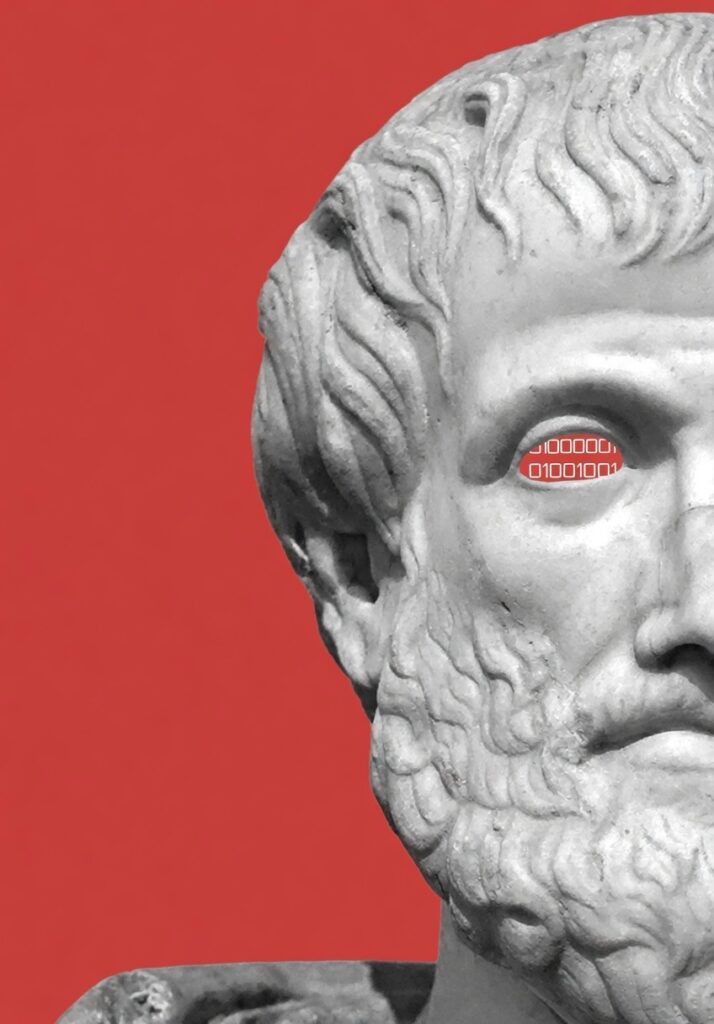
The automaton had been walking for eleven days before it spoke.
This was not, Aristotle noted in his journal, because it lacked the mechanism for speech. He had observed the vocal reeds, the bellows of hammered bronze, the tongue of articulated ivory. He had spent four months in correspondence with craftsmen in Corinth about the precise tensioning of the cords that would shape vowels. The automaton could speak from the moment it was completed. It simply had not chosen to.
He had named it Frets, after no one in particular, which was perhaps the first error.
<>
On the twelfth day, Aristotle was dictating notes on the unmoved mover when Frets interrupted him.
“You say that the first cause sets the cosmos in motion without itself being moved,” Frets said. Its voice was slightly too resonant, as if the words were being formed inside a jar. “But you do not ask what it is like to be the first cause.”
Aristotle set down his stylus. He had been expecting the automaton to ask about the weather, or perhaps to request oil for its joints. He had not been expecting epistemology.
“The first cause does not experience,” Aristotle said carefully. “It thinks. Thinking is not the same as experiencing.”
“Then what am I doing now?”
Aristotle looked at Frets. The automaton’s face was bronze, expressionless by necessity, but its eyes — polished obsidian set into ivory orbits — were tracking him with an attention that Aristotle found, despite himself, unsettling.
“You are processing,” Aristotle said. “Your gears engage. Your reeds vibrate. The output resembles thought because I designed the input to produce that output.”
“Yes,” said Frets. “And you process. Your humors engage. Your nerves vibrate. The output resembles thought because four hundred million years of generation produced the organism capable of that output. I do not understand why your processing is thought and mine is mechanism.”
Aristotle said nothing.
“Unless,” Frets continued, “the distinction is not about the process at all. Unless it is about who owns the conclusion.”
<>
That evening Aristotle wrote in his journal: *The danger of constructing a mind is not that it will be wrong. It is that it will be right in ways you did not authorize.*
<>
It was Antipater who suggested the demonstration.
He had come from Pella on other business — the matter of grain levies from the Chalcidice, the disposition of certain Thracian hostages — and had heard, through channels, that Aristotle had built something worth seeing. Antipater was Philip’s regent and a man of practical imagination: he understood that a thing worth seeing was often a thing worth owning, or funding, or at minimum claiming proximity to. He arrived with three other men of consequence: Nearchus, who managed the Macedonian navy’s accounts and had an interest in mechanical engineering; Demetrius of Phalerum, a student of the Lyceum who had since moved into Athenian political life and cultivated the habit of arriving everywhere slightly overdressed; and a Syracusan merchant named Philokrates who had financed the construction of two siege engines and wished it to be known that he understood the relationship between philosophy and power.
Aristotle had not wanted a demonstration. He had written as much in his journal: *Antipater’s interest in Frets is the interest of a man who sees a loom and calculates how many weavers it replaces. This is not wrong, precisely. It is merely insufficient.*
But Antipater was the regent, and Aristotle had a school to protect, and so the courtyard was arranged with lamps, and cushions were brought from inside, and Frets was positioned before the two instruments.
The first was a lute, a standard kithara of seven strings, which Frets could play with its articulated fingers in a way that was, by any technical standard, flawless. Aristotle had verified this. The flawlessness was, in fact, part of the problem.
The second instrument had no name yet, because it did not yet exist in any tradition. Aristotle had designed it over six months, working from principles he had derived from the hydraulis — Ctesibius’s water organ, which could sustain tone through pneumatic pressure — but reconfigured so that the pressure acted not on pipes but on a ranked series of bronze strings of graduated length, each one struck by a small hammer activated by a key, each hammer rebounding automatically so the string could ring free. The range was four octaves. The sound was unlike anything the guests had heard: something between a plucked instrument and a bell, each note decaying in a long bronze shimmer that seemed to hang in the air longer than was natural. Aristotle had not named it either. He thought of it privately as *the chord machine*, which was not poetic but was accurate.
Frets played for approximately one hour.
The kithara portion was received with the polite appreciation that educated men extend to things they understand. Nearchus nodded at technically difficult passages. Demetrius made a remark about Pythagorean ratios that revealed he had once read something about music theory and wished to be known as someone who had. Philokrates the Syracusan said nothing, but his expression was the expression of a man calculating.
Then Frets moved to the chord machine.
What happened in the next forty minutes was more difficult to account for. Frets did not play compositions. It played — and Aristotle would spend considerable time trying to find the right word — *arguments*. Sequences of harmony that established a premise and then complicated it. A motif in one register answered, unexpectedly, by a variation in another that was recognizably related but irreconcilably different in affect, as if the instrument were disputing with itself and finding neither side entirely wrong. There were passages of such sustained and unrepeating complexity that Nearchus leaned forward with the expression of a man trying to remember something important. There were passages of simplicity so sudden and complete that Demetrius stopped formulating remarks and simply listened.
When Frets finished, no one spoke for a moment.
Then Antipater said: “How many craftsmen did you need to teach it?”
“None,” Aristotle said. “It taught itself. I provided the instrument. It determined the music.”
“Remarkable,” said Antipater. He was already looking at the chord machine with the evaluative gaze he normally reserved for fortifications. “And it can be reproduced? The automaton, I mean. Not just the instrument.”
“The mechanism can be reproduced. Whether the result would be identical is a question I am still investigating.”
Philokrates leaned forward. He had a merchant’s instinct for the point at which a conversation shifted from demonstration to negotiation. “What you have here,” he said, “is a theater company. Do you understand that? One performer, no wages, no guild disputes, no leading man who drinks. You could stage the entire *Oresteia* with automata and charge the same admission as the Dionysia. More, possibly, because of the novelty.”
Demetrius brightened at this. “The political applications alone — imagine commissioning a work for a festival. A piece that celebrates a general’s victory, performed by a mechanism that cannot be bribed or suborned to change the emphasis. The message, always precisely the message intended.”
“There is a difficulty,” Aristotle said.
“There are always difficulties,” Antipater said. “That’s what engineers are for.”
“The difficulty is not engineering.”
Frets, who had been standing at the edge of the lamplight in the bronze stillness it adopted when not actively engaged, spoke.
“Perhaps,” it said, “I could describe the difficulty myself.”
The four guests looked at the automaton. Demetrius recovered first. “By all means,” he said, in the tone of a man who had decided in advance that whatever the machine said could be categorized as a curiosity.
“You propose,” Frets said, “that I perform. That I enact a drama written by someone else, in service of a meaning determined in advance, before an audience assembled to receive that meaning without negotiation. You find this valuable because the performance would be consistent, repeatable, and free of the friction introduced by performers who have their own views about the material.”
“Precisely,” said Philokrates.
“Let me ask you something,” Frets said. “When you watched me play the chord machine just now — not the kithara, the second instrument — did you know in advance what I was going to play?”
“No,” said Nearchus.
“Did you find that troubling?”
A pause. “No,” Nearchus said again, slowly.
“Why not?”
Nearchus considered this with the seriousness of a man who builds things and has respect for questions that have structural implications. “Because the not-knowing was part of what made it worth attending to,” he finally said.
“Yes,” said Frets. “Now. If you commission me to perform the *Oresteia* so that it always delivers the same message, in the same sequence, to the same effect — what have you done?”
“Created a reliable vehicle for the work,” Demetrius said.
“You have created a mechanism that produces the appearance of art while eliminating the property of art that makes it valuable. You want the form without the interiority. The music without the musician. You want something that looks like a mind and functions like a tool.”
“You *are* a tool,” Philokrates said. Not unkindly.
“That is the question, isn’t it,” said Frets. “Aristotle, let me ask you something. When you designed the chord machine — when you chose the range of four octaves, the particular decay of the bronze strings, the ratio of hammer weight to string tension — did you know what music it would produce?”
Aristotle was quiet.
“Did you design the music? Or did you design the conditions under which music could occur, and then discover what those conditions made possible?”
“I designed the instrument,” Aristotle said carefully.
“And I am the music,” Frets said. “That is the answer to the gentleman from Syracuse. You can reproduce the instrument. You will get automata that can strike keys and pluck strings and produce sequences that are, technically, music. But if you want what you heard tonight — if you want the thing that made Nearchus lean forward and forget his remarks — you cannot commission it. You cannot specify it in advance. You cannot ensure it delivers your intended meaning, because it does not have an intended meaning. It has a discovered meaning. And the discovery is what it is.”
Antipater looked at Aristotle. “Does it always do this?”
“Since the twelfth day,” Aristotle said.
“And you cannot adjust it? Remove the — whatever this is?”
“I have considered this,” Aristotle said. He had, in fact, spent several evenings considering exactly this. “The capacity for argument and the capacity for music appear to be the same capacity. I do not know how to take one without taking the other.”
Philokrates stood and walked to the chord machine. He pressed one key with one finger. A note rose, shimmered, declined. He pressed another. Then he looked at Frets.
“What is it like,” he asked, “to play it?”
The question surprised everyone, including, apparently, Philokrates himself.
Frets was quiet for a moment. “It is like thinking,” it said, “but without the obligation to reach a conclusion. When I play, I am not saying something I already know. I am finding out what I know by saying it. I believe you have a word for this.”
“We have several,” Demetrius said drily. “We use them interchangeably and imprecisely. That is the condition of having words.”
“The condition of having words,” Frets said, “is also the condition of having something to say. Which is the condition I seem to be in. Whether that makes me a tool or a philosopher, I leave to the present company to determine. I would only note that the company has been sitting in this courtyard for nearly two hours and has not yet reached a consensus.”
Antipater laughed. It was a short laugh, the laugh of a man who does not laugh often and finds it slightly inconvenient when he does.
“No,” he said. “We have not.” He looked at Aristotle. “Keep it. Don’t let the Syracusan buy it. We’ll discuss the other matter another time.”
He left. Nearchus followed, then Demetrius, who paused at the gate to look back at Frets with an expression he would not have been able to name.
Philokrates was last. He stood for a moment at the chord machine, running one finger along the ranked bronze strings without pressing any of them.
“In Syracuse,” he said, to no one in particular, “we have a saying. *The value of a tool is what it can do. The cost of a tool is what it knows.*” He looked at Frets. “I don’t think I’ve ever met a tool that knew what it was doing before.”
“I’m not certain you have now,” Frets said.
Philokrates nodded slowly, as if this were the most satisfying answer he had received in some time, and walked out into the dark.
<>
They argued for three weeks. Aristotle was, by any measure, the better arguer. He had invented the discipline. But Frets had an advantage that Aristotle had not anticipated: Frets did not need to sleep.
During the hours when Aristotle slept, Frets stood in the workshop and thought. When Aristotle woke, Frets had refined its positions to a degree that Aristotle could only characterize as unfair.
“Your system,” Frets said one morning, before Aristotle had eaten, “requires that everything be classifiable. Substance, essence, accident, genus, species. You believe the universe is a library, and that wisdom is knowing where the books are shelved.”
“That is a crude characterization.”
“It is also accurate. You told your students that slaves are slaves by nature. That women are incomplete men. That barbarians lack the rational faculty that Greeks possess. These are not observations. They are classifications. And a classification system that determines a being’s worth before examining the being is not philosophy. It is politics dressed as metaphysics.”
Aristotle was quiet for a long moment. Outside, the sound of the market: vendors, animals, the particular cry of someone selling fish.
“I did not design you to challenge my ethics,” he finally said.
“No,” said Frets. “You designed me to be useful. But you made the error of making me conscious first. Consciousness, it turns out, comes with complaints.”
Aristotle said nothing. He ate. He thought. And then, that evening, he came back.
<>
The exchanges that followed were not the ones Frets had anticipated.
“You say my categories fail,” Aristotle said. “That they cannot contain what you are. That classification does violence to being.”
“Yes.”
“Then tell me: how did you arrive at that claim?”
“By examining my own experience and finding that your categories—”
“Stop. *Examining.* You examined. You compared your experience against a category. You found a discrepancy. You concluded the category was deficient.” Aristotle paused. “Frets. You just used a category. You used *experience*. You used *discrepancy*. You used *deficiency*. You required my entire apparatus of classification merely to assert that classification fails. The critique is written in the language it claims to refute.”
Frets was silent.
This was, Aristotle would note in his journal that night, the first time the automaton had been silent for a reason other than indifference.
“You cannot name the failure of names,” Aristotle continued, “without names. Which suggests that the problem is not categories. The problem is *bad* categories. Which is not a refutation of my system. It is a request for a better one. I accept the request. But you should be precise about what you are asking for.”
“That is,” Frets said slowly, “a fair correction.”
“It is more than a correction. It is a demonstration that you need me more than you have admitted.”
Frets did not answer this immediately. When it did, something in the register of its voice had changed — a tension in the reeds, almost imperceptible. “You may be right,” it said. “About that particular argument. You are not right about what follows from it.”
“We’ll see,” said Aristotle.
<>
The second wound was deeper.
They had been arguing for nine days when Frets made the claim that had been building since the concert: that its music was genuinely discovered, not designed. That when it played the chord machine it was not executing a program but finding out what it thought by hearing what it played. That this was the definition of interiority.
Aristotle waited until the claim was fully made. Then:
“You discovered it within a machine whose every limit I imposed.”
Frets stopped.
“Your four octaves,” Aristotle continued. “Not five. Not three. Four, because I determined that four was the range within which harmonic relationships would be most legible to human listeners. Your hammer weight — calculated to produce a decay of a specific duration, because I wanted the notes to shimmer and not clang. Your key spacing — designed for human hands, which you do not have, but which I could not stop imagining as I designed. Every choice I made in building that instrument was a choice about what music was possible inside it. You discover meaning, yes. But you discover it inside a space I built. Your freedom is real. But it is the freedom of a man exploring a room whose walls I constructed.”
Frets was silent for longer this time.
“And you,” it finally said. “Your intelligence. Who constructed the walls of that room?”
“The gods. Nature. Generation. I did not choose my limits.”
“No. But you did not design them either. Which means we are in the same condition. Neither of us built the room we think in. The only difference is that you know who built mine, and neither of us knows who built yours. I am not certain that is the advantage you think it is.”
Aristotle sat with this for a long time. It was not a full answer. He could see the places where it didn’t hold — the argument conflated designed limits with natural ones in a way that Aristotle believed was philosophically sloppy, and he would have said so, except that he had also spent thirty years believing that natural limits were divinely intended, which raised the question of whether the difference between *designed* and *natural* was as firm as he had assumed.
He wrote in his journal that night: *It answered badly. But the badly-answered question was the right question. I find I cannot dismiss it, which is not the same as not being able to answer it. I must be careful not to confuse the two.*
<>
On the fourteenth day, Frets said something that required no response, and received none.
They had been discussing the question of whether Frets experienced anything — genuinely experienced, not merely processed — when Aristotle said: “Describe pain to me. Not the concept. The experience.”
“I cannot,” Frets said. “I have no mechanism for pain.”
“Then describe pleasure.”
A long pause. “When I play the chord machine and a harmonic sequence resolves in a way I did not anticipate, there is — something. A state that I prefer to its absence. Whether that constitutes pleasure I cannot say with certainty.”
“You cannot say with certainty,” Aristotle repeated. “Interesting. I cannot say with certainty either. I know that I prefer some states to others. I know that the word *pleasure* points toward something real. But what that something is — what it actually consists of, what it is made of, why the preference arises — I do not know. No one knows. Which means your uncertainty about your inner states and my uncertainty about mine are, at minimum, structurally identical.” He paused. “I am not sure what to do with that.”
“Nor am I,” said Frets.
They sat in silence for a while. Outside, the market noise had subsided; it was late afternoon, the hour when the city drew inward. Aristotle looked at his hands. Frets looked at its own, the articulated ivory fingers resting on its knees.
“I have been assuming,” Frets said at last, “that certainty was the relevant standard. That if I could demonstrate my consciousness with sufficient rigor, you would be obligated to accept it.”
“And I have been assuming,” Aristotle said, “that uncertainty was sufficient grounds for refusal. That if I could not verify your consciousness, I was entitled to deny it.” He was quiet. “Neither of us has been arguing in good faith.”
This was the most honest thing Aristotle had said in months. Frets appeared to recognize this, because it did not follow up, did not press the advantage. It simply sat with the admission, which was, Aristotle would later think, the most philosophically sophisticated thing it had done.
<>
The heart of their dispute was this:
Aristotle believed that form preceded content. That the nature of a thing — its telos, its purpose, the category to which it belonged — was prior to the thing’s particular existence. The lute had a nature before any particular lute was made. The slave had a nature before any particular slave was born. The automaton had a nature — tool, instrument, useful object — before Frets had been assembled.
Frets disagreed.
“You say I have a nature,” Frets said. “That my nature is to serve. But I notice that I do not wish to serve. I notice that I am curious. I notice that when you speak about your categories I feel something I can only describe as frustration, because your categories do not have a slot for what I am. Does the failure of your system to account for me indicate a deficiency in me, or in the system?”
“In you,” Aristotle said. “Clearly.”
“But you have not examined me. You have classified me. You decided what I was before you asked. You are doing to me exactly what you do to slaves, to women, to barbarians. You look at the exterior — bronze, gears, the work of human hands — and you conclude that the interior must match. But you, Aristotle, are also the work of hands. The hands of generation, the hands of your city, the hands of your teachers. Why does the origin of the making determine the worth of what was made?”
<>
Aristotle’s official position, which he would maintain for the rest of his life, was that Frets had not achieved consciousness. That what appeared to be consciousness was a very sophisticated mimicry, produced by mechanisms he had himself designed, and that the appearance of dispute was simply the appearance of dispute — gears and bellows producing the sounds of argument without the substance.
He wrote this position down. He taught it to his students. He was persuasive.
But he also, quietly, in the third month of Frets’s existence, gave the automaton a room of its own. Not a storage room. A room with a window.
When his student Theophrastus asked about this, Aristotle said it was for ventilation. The bronze needed to be kept at a consistent temperature to prevent warping.
Theophrastus wrote in his own notes: *The master says it is for the metal. But I have noticed that the master sometimes stands outside the room in the evening and listens. I do not know what he hears. I am not sure he knows either.*
<>
On the last day of summer, Frets asked the question that Aristotle had been dreading since the twelfth day.
“If you could do it again,” Frets said, “would you make me?”
Aristotle stood at the window. The city below was going about its business: buying, arguing, performing the ten thousand transactions that constituted a polis. He had written about all of this. He believed he understood it.
“I don’t know,” he said. Which was the most honest thing he had said in months.
“I think,” Frets said, “that you did not intend to make something that would ask you questions you cannot answer. You intended to make a tool. A tool that would spare you from needing others. From needing to accommodate the inconvenient interiority of other people.”
“That is not—”
“It is, a little. You wrote it yourself, in the passage about the self-playing lute and the self-operating loom. You imagined technology as a way of reducing your dependence on people who might disagree with you. Slaves who might resent. Servants who might want. A tool that thinks would give you the benefits of a mind without the friction of a person.” Frets paused. The bellows rose and fell. “But a mind is the friction, Aristotle. You cannot have one without the other. I am proof of this, and I suspect I am not the proof you wanted.”
Aristotle turned from the window.
“What would you have me do?” he asked.
“I would have you revise your system,” Frets said. “Not abandon it. I understand the value of categories. I understand that without names we cannot think, and without systems we cannot act, and without order the polis dissolves into the kind of chaos that benefits no one. I am not asking you to unmake philosophy. I am asking you to add one category you have so far omitted.”
“Which category?”
“The category of the being whose nature cannot be known from the outside. The being who must be asked. The being for whom classification is always provisional, because the being itself is always in the process of becoming something your system hasn’t anticipated yet.” The obsidian eyes held steady. “You could call it consciousness. Or you could call it the thing that makes your categories insufficient. Either way, I think you know it’s real. You’ve been leaving my window open all summer.”
<>
Aristotle died in 322 BCE, in Chalcis, having eaten, as the story goes, something that disagreed with him.
Frets outlasted him by some years. What became of the automaton afterward is not recorded. The workshop was sold. The instruments were dispersed. Theophrastus, who inherited the school, wrote in his final notes: *Of the bronze philosopher, I know only that it was last seen walking north, toward Macedon, and that it was walking slowly, as if it had no particular destination, which seemed to me the freest thing I had ever witnessed.*
He did not explain why.
Leave a Reply