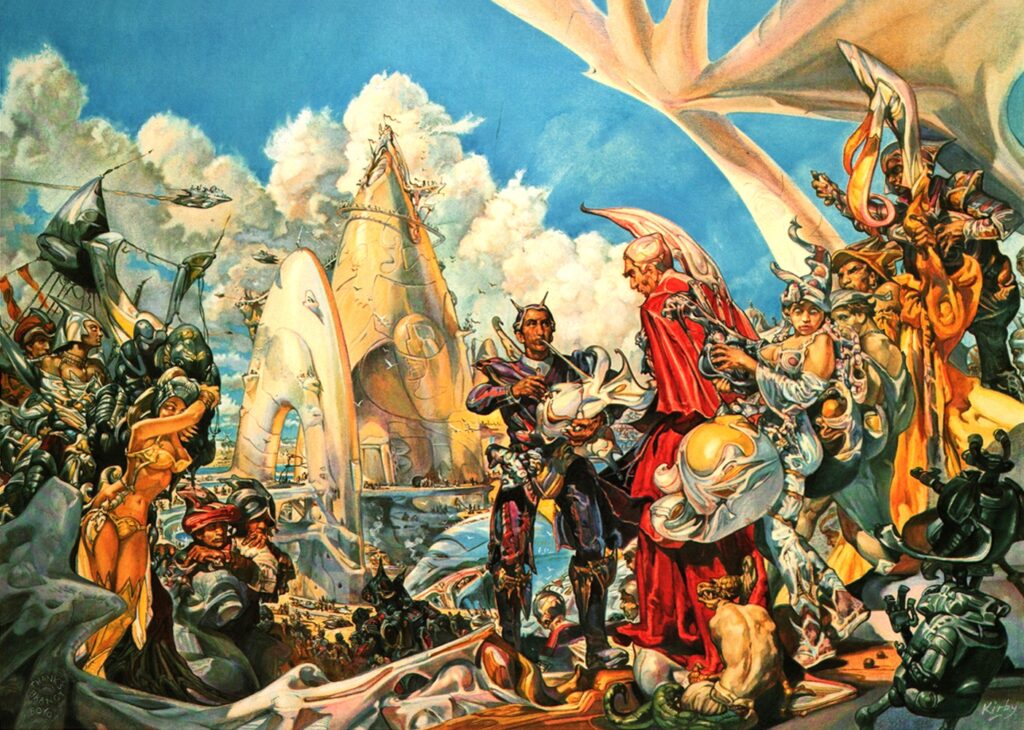
Lord Havelock Vetinari, Patrician of Ankh-Morpork, had discovered that there were only three truly dangerous things in the world:
Dragons,
People who believed strongly in destiny, and
People who believed strongly in spreadsheets, especially those who used the ‘Auto-Sum’ function as a substitute for a moral compass.
The third category was currently seated in the Oblong Office, smiling the smile of a man whose teeth had been professionally encouraged to do so by expensive dentistry and the certain knowledge that his offshore accounts were excellently diversified across several dimensions and at least one pocket universe.
“Mr. Blottle,” said Lord Vetinari mildly, steepling his fingers in the way that suggested the fingers were less interested in prayer than in slowly crushing something small and presumptuous, “you have recently become… wealthy.”
Blottle beamed. “Exceedingly so, my lord! And all without harming a single person. Directly. Well, mostly indirectly. Statistically speaking, the harm was efficiently distributed across demographic cohorts who, to be fair, were probably expecting something bad to happen anyway.”
Vetinari nodded. “Splendid. Please explain how.”
“Well,” said Blottle, warming to the subject like a man explaining a particularly clever method of picking locks to a locksmith while the locksmith was holding the keys to his dungeon, “you see, my company thinks we can do better than in-su-rance things.”
“I see” said Vetinari, in the tone of someone who already knew the answer, the answer’s family history, and what the answer had for breakfast.
“No, my lord. We merely allow citizens to discover price signals regarding future events. It’s mathematics! It’s like a crystal ball, but with more decimals and fewer mysterious vapors.”
“Such as?”
“Oh, fires. Floods. Troll-related masonry incidents. Whether the Watch will arrive before or after the building collapses. Whether Commander Vimes will need a new pair of boots this month—that’s a particularly liquid market, my lord. Mostly because of the puddles. Very predictable.”
Vetinari made a note. It was a very short note. It read: Vimes? and had a small line under it, and then another note that said Send flowers to Sybil. Check if the boots are tax-deductible.
“And how,” Vetinari continued, “does this differ from insurance?”
Blottle leaned forward conspiratorially, lowering his voice as if revealing a sacred mystery, which in Ankh-Morpork usually meant revealing a profitable scam with better lighting.
“Insurance companies pretend to know the future,” he said. “We discover it. Through the wisdom of crowds!”
“Crowds,” said Vetinari thoughtfully, “being the same crowds that once tried to burn a suspected witch for making it rain, who turned out to be a milliner with an unfortunate speech impediment and a very damp hat.”
“Ah, but those were unincentivized crowds, my lord! Our crowds have skin in the game! Sometimes literally, in the case of the Butchers’ Guild.”
“Quite,” said Vetinari. “Tell me, when your market predicted that the Alchemists’ Guild had an 87% chance of catastrophic explosion last month, what happened?”
Blottle brightened. “The market was wrong, my lord! Only a small explosion. Hardly any green fire at all. The efficient market corrected itself beautifully. Lost money hand over fist on that one!” He paused. “Well, I didn’t. Obviously.”
“Obviously,” said Vetinari. “And the fifteen people who bet against an explosion?”
“Made a tidy sum! The market rewarded their insight!”
“The fifteen people,” Vetinari continued, in a voice like silk being drawn across a whetstone, “who were all Guild members. Who all voted against safety improvements the week before. Who all purchased the exploding property afterward at quite reasonable prices owing to the lingering smell of sulfur and the absence of a roof.”
Blottle’s smile flickered. “Correlation isn’t causation, my lord.”
“No,” agreed Vetinari. “But it is occasionally grounds for a midnight conversation with the Assassins’ Guild about the precise meaning of ‘inhume’ and whether it can be done in alphabetical order.”
There was a pause. Blottle’s collar seemed to have shrunk, or perhaps his neck was attempting to retreat into his chest for safety.
“But my lord,” Blottle rallied, “think of the efficiency! Why, just yesterday someone bet five hundred dollars that Lord Rust would say something catastrophically stupid at the next council meeting—”
“Did they win?”
“Handsomely! And the odds were terrible, too. Almost certain. The ‘Rust-Is-An-Idiot’ index is our most stable asset. But the market functioned perfectly.”
Vetinari smiled. It was the smile of a man who had once governed a city by persuading people that assassination was simply bad manners, and bad manners were punishable by homework.
“So,” he said, “you have reinvented insurance, removed the comforting illusion of protection, replaced it with gambling, and somehow convinced people this is progress. In some circles, this is called ‘The Seamstresses’ Guild business model,’ though they are generally more honest about the poking.”
Blottle looked hurt. “It’s information aggregation, my lord. We’re a two-sided marketplace creating liquidity for uncertainty!”
“Fascinating,” said Vetinari. “Tell me, Mr. Blottle, what is the current market prediction for your company’s continued operation?”
Blottle laughed. “Oh, very bullish, my lord! 94% probability of—” He stopped.
“Yes?”
“I should perhaps check that number. The needle on the indicator seems to have melted.”
“I already have,” said Vetinari pleasantly. “It dropped to 3% approximately four minutes ago. Just after you entered this office. Curious, isn’t it? Almost as if someone with insider information had made a very large bet and then sharpened a very large pencil.”
Blottle had gone pale. “My lord, you wouldn’t—”
“Manipulate your market? Mr. Blottle, I wouldn’t dream of it. That would be interfering with the efficient discovery of information.” Vetinari paused. “Of course, if someone were to notice that the city’s fire insurance rates, building permits, and Guild licenses all seem to become mysteriously more expensive for anyone operating such markets… well, that’s just the ‘invisible hand’ of the market turning into a very visible fist.”
“That’s… that’s basically insider trading, my lord!”
“Is it?” said Vetinari. “I was under the impression it was statecraft. So easy to confuse the two. One involves a ledger, the other a dungeon; the paperwork is remarkably similar.”
He rang a small bell.
A clerk appeared, already sweating and holding a document that he appeared to fear might bite him, and given the archives in this building, it was a valid concern.
“Please make a note,” Vetinari said, “that we are taxing prediction markets on fires, assassinations, plagues, Guild collapses, bridge failures, riots, coups, floods, droughts, dragon sightings, the likelihood of me dying in the next fiscal quarter, and—at 97%.” he glanced at the document the clerk had brought “—apparently whether Lady Sybil’s dragon sanctuary will experience any ‘accidents’ involving high-velocity swamp dragons and a lack of trajectory control.”
The clerk nodded so furiously his wig nearly fell off, revealing a smaller, backup wig underneath.
Blottle sputtered. “But my lord! That’s most of our revenue! All of it, actually! We’ll have nothing left but weather and politics!”
“Quite,” said Vetinari. “The two things in this city that are equally full of hot air and impossible to predict.”
“But surely,” Blottle said desperately, “you see the value in prediction markets for governance? Why, imagine if you could know what the city really thought about tax policy! Or succession planning! Or—”
“Mr. Blottle,” Vetinari interrupted gently, “I already know what the city thinks. The city thinks it would like lower taxes, more services, and for someone else to pay for it all. This is called ‘democracy’ and we tried it once. There were riots. The citizens democratically elected a dog. To be fair, he was a very good boy, but his stance on the postal service was problematic.”
“Is that people will bet on anything,” said Vetinari. “I learned this when someone opened a book on whether I would survive my first year as Patrician. The odds were not favorable. In fact, the ‘Odds of Survival’ chart looked remarkably like a drawing of a very steep cliff.”
“Who won that bet, my lord?” Blottle asked, momentarily distracted by the realization that he was standing on the edge of that same cliff.
“I did,” said Vetinari. “I bet against myself. It seemed wise to have a financial incentive to stay alive. The payout covered my first year’s operational expenses quite nicely. It also bought a very large number of crossbows for people who shared my interest in my continued respiration.”
Blottle’s eyes widened. “But that’s—that’s—”
“Insider trading?” Vetinari smiled. “Yes. But when one is the inside, it’s simply called ‘planning ahead.’ Or ‘Tuesdays.’”
There was a longer pause. Somewhere in the distance, a clock chimed, sounding suspiciously like a cash register hitting a ‘No Sale’ button.
“However,” Vetinari continued, examining his fingernails with the care of a man who knew exactly how sharp they could be made without violating any treaties on torture, “I do find your markets… useful.”
Blottle leaned in again, hope and desperation mixing in his expression like oil and water in a very unstable lamp shortly before the glass cracks.
“I will require weekly predictions,” said Vetinari, “on whether the city will continue functioning. Submitted in writing. With the names of everyone who bet against stability.”
Blottle blinked. “That’s… rather vague. And possibly illegal under several Guild charters. And technically counts as a ‘snitch-list.’”
“Indeed,” said Vetinari. “If the market predicts stability, I shall know I am doing my job adequately. If it predicts chaos—”
“Yes?”
“—I shall know precisely who is planning chaos. And who profits from it. And where they bank. And their mothers’ maiden names. One does appreciate a list, and it saves so much time on the pre-interrogation paperwork.”
Vetinari smiled again. It was the smile of a shark that had just been appointed as the official guardian of a very nervous seal.
“You’re turning us into informants,” Blottle said slowly.
“No, Mr. Blottle. You’re already informants. You’ve simply been informing the wrong people. I’m merely… correcting the market. Think of it as a corporate merger, where I am the corporation and you are the stationery.”
Blottle laughed nervously, a sound like a small animal realizing it had wandered into a much larger animal’s den and the exit had quietly closed and been replaced by a menu. “Surely that’s a joke, my lord?”
Lord Vetinari did not laugh. He didn’t do ‘jokes.’ He found they relied too much on timing, and he preferred people to be punctual for other reasons.
“Mr. Blottle,” he said, standing—which was the universal signal that the meeting was over and continued existence was negotiable, “you may continue operating your ‘prediction markets’ on weather, sporting events, and whether the University faculty will remember where they left their staffs. I understand there’s quite a lively market on the latter, with extra points for finding them in the laundry.”
“Yes, my lord,” Blottle said quietly.
“Oh, and one more thing.”
“My lord?”
“The current market odds on whether you will leave this office with your business license intact are apparently fluctuating wildly. Someone seems to keep betting against you. Large sums. The ‘Blottle-Exiting-Vertically’ market is quite bearish.” Vetinari handed Blottle a piece of paper. “I took the liberty of closing that market. With your license approved. Seemed only sporting.”
Blottle looked at the paper. Then at Vetinari. Then at the paper again.
“You… you bet for me?”
“I did,” said Vetinari. “Consider it an investment in civic order. And a reminder.”
“Of what, my lord?”
Lord Vetinari walked to the window, looking out over Ankh-Morpork, where somewhere a fire was starting, a Guild was collapsing, and Commander Vimes was undoubtedly breaking in another pair of boots while loudly wishing the city was a different shape.
“That the house,” he said softly, “always wins. And in Ankh-Morpork, Mr. Blottle, I am the house. And the street. And the property taxes. And, occasionally, the roof.”
Blottle left quickly, his business license clutched in sweating hands, unsure whether he’d just been saved or purchased at a bulk-discount rate. His journey back to his office was a gauntlet of newfound awareness. A wiry man leaning against a wall peeled himself off and fell into step beside him.
“Mr. Blottle! Fancy a wager?” the man chirped. “Even odds you make it to the Pork Futures Warehouse before being anonymously shoved into the river. I’m offering three-to-one you’re shoved specifically by a man with a limp and a grudge about commodity derivatives. Five-to-one says he uses a brick wrapped in a very angry fish.”
Blottle stared, his mind still reeling from the Patrician’s surgical precision. “Who are you?”
“Just a humble facilitator of price signals!” the man beamed, as if this explained everything. “Now, for a small premium, I can also offer you a side-contract on which section of the river you’re shoved into. The Ankh being what it is, some parts are more… conclusively liquid than others. We call the mud-flats ‘The Retirement Fund.’”
Blottle didn’t answer. He simply ran, the man’s cackle following him down the street. The wiry man sighed, made a note on a small slate, and whispered to a lurking clerk, “Shift the odds to two-to-one. Subject appears to have received new information from a high-authority source. Also, bet sixpence he trips over that cabbage.”
Behind him, Vetinari returned to his desk and made another note. It read: Check who bet against Blottle. Then check who they work for. Then have Drumknott send them a fruit basket. Ensure the fruit is slightly past its prime, to symbolize the fleeting nature of wealth.
It pays, thought Lord Vetinari, to know one’s enemies.
It pays even better when they pay you to discover themselves.
He did not immediately return to his paperwork. He instead opened a small, plain ledger locked in a desk drawer. It contained no names, only codes. He made an entry under ‘B-77’.
Asset repurposed. Predictive utility confirmed. Primary threat: neutralized (via regulatory assimilation). Yield: High (civic intelligence), Recurring. Recommendation: Monitor for attempts to predict my dinner; if successful, change the menu to something involving octopus.
He closed the book. The beauty of it was not just in the control, nor the profit, nor even the elegant deflection of chaos. It was in the leverage. He hadn’t just banned a dangerous idea; he had taken the engine of its danger—the desperate human desire to know and profit from the future—and plugged it directly into his own desk. Every bet for stability was a prayer to his rule. Every bet against was a signature on a confession written in gold ink.
He rang for Drumknott. “The fruit basket for our mysterious bettors against Mr. Blottle,” he said. “Make sure the pears are particularly ripe. And include a note.”
“Message, my lord?”
“‘Congratulations on your insightful wager,’” Vetinari dictated. “‘Your foresight has been noted. The city is currently accepting bets on whether you will appreciate the pears.*’”
Because the only thing better than knowing your enemies was letting them know you know. And then sending them fruit. It created such a wonderfully uncertain atmosphere. And uncertainty, as Mr. Blottle had correctly noted, was the most liquid asset of all.
Epilogue: The Pears of Authority
Commander Sam Vimes of the City Watch stared at the fruit basket on his desk with the intense suspicion usually reserved for a man holding a smoking crossbow and claiming it went off by itself.
“Where did this come from, Sergeant?” he growled, poking a particularly plump pear with the tip of a pencil. He did it from a distance. In Ankh-Morpork, unsolicited gifts often had a tendency to go ‘click,’ ‘bang,’ or, in the case of the Alchemists, ‘melt through the floorboards.’
“The Palace, sir,” said Sergeant Detritus, who was currently trying to use a grape as a tiny, organic stress ball. “Drumknott brought it. Said it was a ‘reward for foresight.’ Also said we shouldn’t bet on the pears.”
Vimes straightened up. “Foresight? I don’t have foresight. I barely have hindsight. I just have a bad feeling in my knees that usually turns out to be a riot.”
He pulled a small card from the wicker handle. It was written in a hand so elegant it made the surrounding grime of the Watch House look even more offensive by comparison.
“With thanks for your recent contribution to the market of boot-leather predictability. Your steadfastness remains a blue-chip asset. Do enjoy the fruit. It is, like the law, best consumed before it goes soft.”
Vimes read it twice. Then he read it a third time, looking for the hidden code. “Boot-leather predictability? Is he making fun of my soles again? I can feel the cobbles just fine, thank you.”
“Maybe it’s a compliment, sir?” suggested Carrot, appearing in the doorway with a stack of paperwork and a shine on his breastplate that could blind a seagull. “He’s saying you’re reliable.”
“In this city, Carrot, being ‘reliable’ is just another way of saying you’re a stationary target,” Vimes grumbled. He picked up a pear. It was perfectly ripe. It was, in fact, suspiciously perfect. It looked like the kind of fruit that had never seen a wasp, let alone a hungry street urchin.
He took a bite. It was delicious. That was the worst part. Vetinari’s fruit always tasted like someone else was paying for it.
“Anyway,” Vimes said, talking around a mouthful of high-yield pomaceous fruit, “what’s the news from the street? I heard some fellow named Blottle was running a book on whether the Alchemists’ Guild would blow up.”
“Closed down this morning, sir,” Carrot reported cheerfully. “The Patrician turned it into a ‘Government Information Census.’ Apparently, the odds on you getting a new pair of boots this week have plummeted from five-to-one to ‘Statutory Certainty.’”
Vimes froze, his jaw mid-chew. He looked down at his boots. The left one was currently held together by a prayer and a bit of string he’d found in a gutter.
“He’s betting on my footwear?” Vimes whispered.
“Technically, sir, I think he’s the House,” Carrot corrected. “And the House just bought a three percent stake in your cobbler.”
Vimes sat back, the pear suddenly feeling very heavy in his hand. He looked at the basket. He looked at the card. He looked at the empty space where his dignity used to live before he’d joined the upper classes.
“Right,” he said, reaching for his cloak. “I’m going for a walk. A long, unpredictable, completely random walk. I’m going to turn left when I should turn right. I’m going to walk through a puddle on purpose. I might even buy a sandwich from Cut-Me-Own-Throat Dibbler.”
“Sir?” Carrot asked, concerned. “That sounds… dangerous. To your digestion.”
“It’s about sending a message, Carrot!” Vimes shouted, heading for the door. “If the Patrician wants to bet on what I’m going to do, I’m going to make sure he loses his shirt!”
As the door slammed shut, a small piece of paper fluttered off the desk. It was a secondary note, tucked under the bottom of the basket, that Vimes hadn’t seen.
It read: “Betting 10 dollars that Commander Vimes reacts to this gift by immediately attempting to be unpredictable. Note: He will likely start by visiting Mr. Dibbler. Please ensure the sausages are, for once, actually made of meat. We wouldn’t want to lose the asset to food poisoning before the quarter ends.”
In the shadows of the office, a small, dark shape moved. It was a clerk, waiting to collect the basket. He checked his watch, made a note on a slate, and whispered into the silence:
“Subject moved left. Odds of a sandwich purchase: 98%. The market remains efficient.”
Leave a Reply