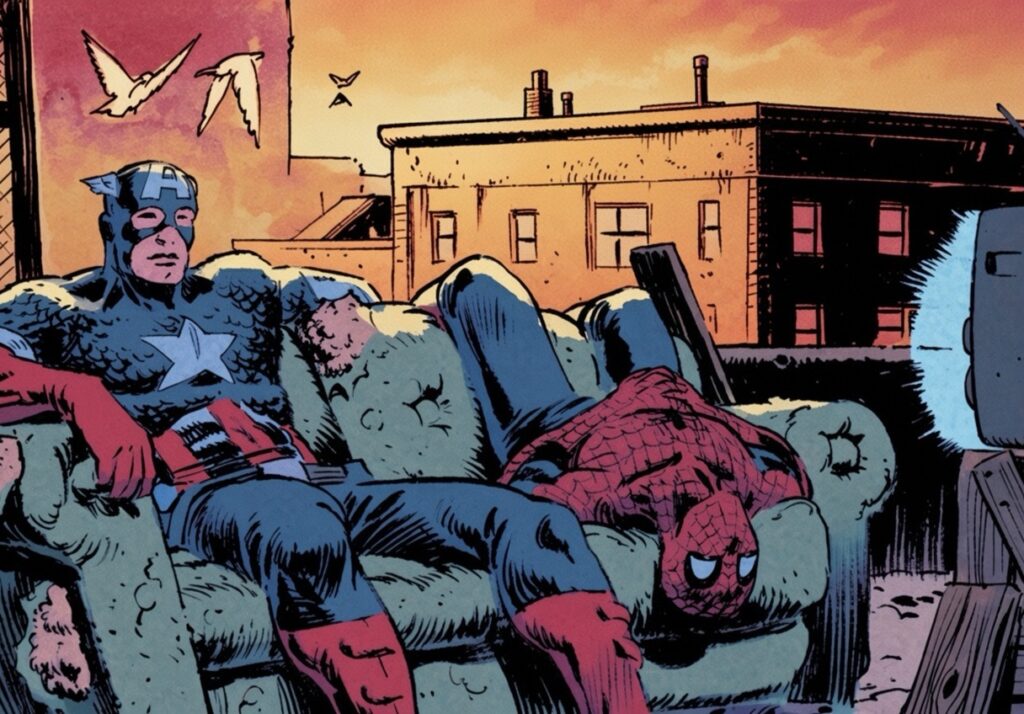
I got a shopping cart. That was my asset base.
Used to have a truck, then an apartment, then a storage unit, then a checking account, then a bank account became one of those things you say you used to have, like a fax machine or a pension. Now I got a shopping cart. So history ended pretty good for me and Fukuyama, maybe.
I like Fukuyama. I don’t want anybody thinking I’m against him. I think he’s basically right. The End of History. Great title. Clean. You know immediately what the movie is about.
That’s what I like about the MCU too. You don’t have to explain the whole universe. You just need the origin story. Iron Man. The guy builds the suit in a cave. Then suddenly you’ve got the whole thing. The Cold War is the cave. Liberal democracy is the suit. Capitalism is the arc reactor. Communism gets blown up. Roll credits. Great ending.
The only problem is the movie keeps going. But that’s why I like the theory even more. Fukuyama leaves you with a universe. Once you’ve got a universe, you can do sequels. China isn’t a problem. China is the sequel. Populism, AI, multipolarity, climate change, biotech, geopolitics—sequels. You don’t throw away the first movie because something happened afterward. You build the franchise.
I have four AA batteries, one AAA, and a phone charger that only works if you hold the cable at an angle. That’s my portfolio. I’m diversified. Fukuyama would appreciate that. Markets are remarkably resilient. The batteries are more useful than money now. Money is still useful, obviously, but only in certain environments. Batteries have broader utility. You can trade them, use them, store them. They don’t require an app. The AAA is difficult. Nobody wants one AAA. That’s concentration risk. I should exchange it for something more liquid. The guy two tents down has three lighters and no batteries, which makes him a natural counterparty. That’s how markets emerge. You don’t need a central planner. You just need two people with incompatible needs. I think that’s Hayek. Or maybe Marvel. Actually, both.
There’s a guy here who controls the charging station. He’s basically Nick Fury. Charges forty minutes for a dollar. Doesn’t believe in the Avengers. You can’t be mad at him. He’s the only reason anything’s on. Nobody sees him much, but if you need your phone charged, you know who to ask. There’s another guy who knows where the bathrooms are. He’s our Doctor Strange. He knows the hidden dimensions. I know where to get coffee. So I’m Wong. Every universe needs a Wong.
People say my shopping cart is a refutation. It isn’t. Fukuyama said liberal democracy was the end point. He didn’t say I’d be in it. I’m a complication but i will soon be retconned into the franchise, I’m sure. Complications are what you do the sequel with.
Nobody knows where Hayek ends and the MCU starts. I’ve looked.
People say the difference is Feige. Hayek had no Feige. I’ve thought about it, and I think Feige is the market.
So I tried it. I took the AAA to the lighter guy. Price discovery. He offered one lighter. I said the AAA is scarce. He said so is a lighter. We stood there, two people with incompatible needs, and for a moment I felt all of it: the dispersed knowledge, the spontaneous order.
Then he said, “Two,” and I said, “Deal.”
I now have two lighters and nothing to light. He has a battery and a flashlight. That’s the knowledge you can’t get from a planner: what a lighter is worth to a man who owns three.
Hayek would be proud. The knowledge was local. It was also not in my favor, but he never promised that.
That’s what I like about the shared-universe concept. Everything connects. The battery guy knows the charger guy. The charger guy knows the guy with the phone. The guy with the phone knows where the food is. The guy with the food knows when the police are coming. The police know where we’re sleeping. It’s a whole ecosystem. People used to call that society. Now they call it a network. That’s progress.
Sometimes, when I’m sitting behind the supermarket waiting for them to take the cardboard out, I imagine Fukuyama and the Marvel people having a meeting.
Not because I think they’re actually working together.
I know they’re not.
It’s more like a thought experiment.
Fukuyama is sitting at one end of a long table.
Kevin Feige is sitting at the other.
There are whiteboards everywhere.
There’s coffee.
There’s a giant screen showing the history of the world.
And everybody is very serious because they have a continuity problem.
The End of History was supposed to be the ending.
That’s the whole point.
You can’t have the ending and then keep having history.
So they’re trying to figure out how to keep the ending while continuing the story.
Fukuyama says:
“We need to preserve the endpoint.”
Feige says:
“Absolutely.”
“Without making it look like the endpoint wasn’t the endpoint.”
“Right.”
“And we need Russia.”
“Obviously.”
“And China.”
“Obviously.”
“And nationalism.”
“Definitely.”
“And AI.”
“That’s Phase Seven.”
Then somebody writes NATIONALISM on the board.
Everybody looks at it.
It’s a big word.
It’s got to be handled carefully.
Because nationalism is dangerous to the End of History.
Nationalism says people might care about the nation more than the universal liberal order.
That’s a continuity problem.
So they need to make nationalism a villain.
But not too much of a villain.
Because if nationalism becomes too powerful, it makes captain America look weak.
But if you make it too stupid, nobody believes the story.
And if you make it too sympathetic, people might start rooting for it.
That’s what happened with Killmonger.
You have to be careful with Killmonger.
He’s technically the bad guy, but he has a point.
That’s dangerous.
You don’t want Russia to become Killmonger.
You don’t want China to become Killmonger.
So they decide nationalism will be a recurring character.
Not the main villain.
More like Loki.
Sometimes he’s the villain.
Sometimes he’s useful.
Sometimes he helps the heroes fight somebody worse. So they write him a redemption beat. He’s still a threat to the order, but he’s also a quarterly driver. They call it a “complex antagonist.” That’s the term for a villain the studio needs.
Then somebody in finance says the quiet part: “He’s good for the bottom line.”
Everybody nods. Nobody writes it on the board. Sometimes he gets his own show.
I think about that when the guy two tents down takes my lighter. He’s technically the villain. He took my two lighters Monday. Tuesday he stood between me and the cops. Villain, useful, villain.
Then Russia comes up.
Russia is complicated.
Russia is always complicated.
Russia can’t just be Russia.
It has to be Russia in relation to the End of History.
That’s the trick.
You can’t have a country simply exist.
It has to have an arc.
So Fukuyama says:
“What is Russia’s function in the new phase?”
Feige thinks about this.
Then he says:
“Russia is the guy who didn’t get the ending.”
Everybody nods.
That’s good.
That’s Marvel’s whole department. Costume design. They’ve been doing it for years. Nobody makes a new villain. They make a new suit.
Think of the Mandarin. Think of Hydra. Think of every guy who got blown up in act three and came back in act one of the next movie with a new helmet.
Same guy. Different mask. The audience knows. The studio knows. Nobody says it.
So Feige brings in the sketches. Fukuyama approves each one.
Sketch one: Communism. Red. Hammer and sickle. Already used.
Communism becomes authoritarianism.
Sketch two. Gray suit. Less red. Tested well.
Authoritarianism becomes nationalism.
Sketch three. Flags. Parades. A little cape.
Geopolitics becomes multipolarity.
And suddenly the old villain has a new name.
That’s how Marvel beats him twice.
Fukuyama writes “DEFEATED” next to sketch one.
Feige writes “RETURNING” next to sketch three.
Nobody asks if it’s the same guy. They ask what it’ll look like on a lunchbox.
Continuity preserved.
That’s when someone says:
“What about China?”
Everyone gets quiet.
China is different.
China can’t simply be the villain because China participates in the market.
That’s a problem.
You can’t have the market itself become the villain in a franchise whose hero is the market.
So China becomes the complicated character.
Very powerful.
Very modern.
Very economically successful.
But politically different.
That’s good drama.
Maybe China is the guy who has all the superhero technology but doesn’t believe in the Avengers.
That’s compelling.
I can vouch for the market part. I’ve seen China participate. The phone cable that works if you hold it at an angle is Chinese. The lighters, the AA batteries, the tarp, the cart’s good wheel: Chinese. I’ve pulled a jacket out of a dumpster with the tags still on, and a flashlight brighter than anything I owned when I had an apartment. Somebody threw it out because they got a newer one.
People say the goods are cheap. They’re thinking of the price. I’m thinking of the lifespan, and the lifespan is excellent, especially the second life. The factory built it for one owner and it’s on its third. That’s durability.
So when Feige says China is complicated, I understand. It’s the supplier. They make it, we throw it out, I pick it up, and everybody gets what they need. You can’t cast the supplier as the villain when you’re wearing the jacket.
And this is where the meeting gets really interesting.
Because AI doesn’t belong to the old universe.
AI wasn’t around when the original ending was written.
So you can introduce AI as a new kind of historical actor.
Fukuyama says:
“History ended for humans.”
Feige says:
“Exactly.”
“So the machines don’t count.”
“Not yet.”
“But eventually they might.”
“And America?”
Because America is the protagonist.
But the protagonist is having a character crisis.
It’s getting old.
It’s fighting with itself.
It’s losing faith in the franchise.
Half the audience thinks the protagonist is the villain.
The other half thinks the villain has taken over the protagonist.
Nobody agrees on what the protagonist is supposed to do anymore.
That’s dangerous.
Because the machine is coming for the protagonist’s job.
So they introduce populism.
Populism is perfect.
Populism can be anybody.
Left-wing populism.
Right-wing populism.
But Feige says populism is Luddism.
Smash the looms. Smash the servers. Smash the thing that’s coming for your job. Very sincere. Very bad.
Fukuyama agrees. You can’t have people smashing the machine in a franchise where the machine is the arc reactor.
But you still need them.
Every Marvel movie has the street scene. A city is falling out of the sky, and a few hundred regular folk run through frame screaming. Nobody gets a name. Nobody gets a line. But without them there are no stakes. You can’t save an empty city.
So populism is the crowd. Don’t let them near the controls. Do let them look up.
I’ve been in the street scene. It’s mostly running. I’m told it’s an honor.
Then Feige says the threat is a bad machine.
Fukuyama says, “You need a good machine to fight a bad machine.”
“That’s the whole franchise.”
Stark builds Ultron to stop the bad machine. Ultron is the bad machine. Then Stark builds Vision to stop Ultron. Vision is the good machine. You can tell, because he’s got a cape and says thank you.
Nobody asks who builds the good machine. It’s the company with the better release schedule.
I’m rooting for the good one. I haven’t met either. I just know which one I’m supposed to want.
That’s the post-credits scene.
The camera pulls back.
You see the Earth.
You see the cities.
And then the camera goes inside the data center.
A computer screen turns on.
Something wakes up.
Cut to black.
THE END OF HISTORY WILL RETURN.
That’s beautiful.
I would watch that.
I would probably sleep through some of it.
But I’d watch the ending.
I don’t know who in the row talks to the city. Somebody told them about the lighters. Then they introduce a character called Liberal Democracy Under Threat.
He’s an old character.
Everybody knows him.
He keeps coming back.
He was in the Cold War movie.
He was in the Bush movies.
He was in the Obama movies.
He was in the Trump movies.
He’s been in everything.
Nobody knows what his powers are anymore.
He comes Tuesdays, with a clipboard and a lanyard. He asks if we’ve considered a shelter. The music gets serious. Nobody knows what he can do.
Then they have the 2008 problem.
You can’t ignore 2008. Too many people watched the building fall down.
So they make it a dark chapter. Austerity, homelessness, financial crisis. All unintended consequences.
“Where on the board?”
“Bottom. Small.”
Nobody objects.
Fukuyama caps the marker. I didn’t object either. I just wondered when my episode was.
You can destroy New York, kill Iron Man, destroy the Soviet Union. But liberal democracy has to survive. Otherwise what was the first movie about?
Fukuyama isn’t predicting the future anymore. He’s protecting the ending. He’s the continuity department.
Every morning, a new problem goes on the board.
How does this fit?
If it doesn’t, you call it a complication. A transition. A new phase.
I’m looking for cans. Sometimes they’re empty. You can’t let that discourage you.
The can is Phase Six. The cart is Phase Six. AI is Phase Seven.
On a conference-room whiteboard:
RUSSIA → NATIONALISM → POPULISM → AI
LIBERAL DEMOCRACY
DO NOT KILL.
“We have a problem.”
“We have a Phase.”
Everybody starts writing.
I keep my own board. It’s cardboard. The password’s on it. Underneath, a number. Next to the number, in pen:
DO NOT CALL.
THE HEGEL VERSE
A credit score is basically your origin story. It tells the universe who you were before the current movie. You could have had a house, a job, a car, a checking account. You could have been paying your bills for twenty years. It’s like a WIKI to know whether you’re a reliable character. They want continuity. WIKIS want to know what you did in the previous installment.
Unfortunately, my previous installment is mostly missing. I don’t have a credit score anymore. Not bad. Not good. Just gone. I’m apparently not canon anymore. That’s okay. The MCU does this all the time. Characters disappear for a few movies and come back when the studio needs them. Maybe I’ll come back in Phase Eight.
Also the shopping cart doesn’t check credit. That’s one of its advantages. It’s an asset with no underwriting. You can acquire one with no FICO score. That’s financial inclusion. People complain about the banking system, but they’re missing the innovation. The market has produced a financial instrument specifically for people who have fallen out of the financial system. No credit check. No application. Think about what the cart does that a credit score can’t.
A credit score can’t carry a sleeping bag. A cart can. A credit score can’t hold forty-one cans, which is nine dollars at the redemption machine, if the machine is working, which it is on Thursdays.
A credit score can’t be a filing system. I have a bin for the cardboard, a bin for the batteries, and a bin for the documents: one library card, one clinic card, and the page with her number. That’s a three-tier portfolio with sector allocation.
A credit score can’t be a mobile office. I’ve held meetings out of it.
A credit score can’t be collateral. Nobody has ever offered me a loan against the cart, but I want to be clear that I’d consider it.
People say you can’t build wealth on a cart. They’re thinking in quarters. I’m thinking in the long game. In twenty years nobody’s going to remember what my credit score did. The cart will be in the museum. In a glass case. With a little card that says: Asset. And under that, in smaller type: No underwriting.
The only problem is that occasionally somebody comes along and says it’s not your cart. That’s when property rights enter the picture. I’m a big believer in property rights. If it’s their cart, it’s their cart. If it’s my cart, it’s my cart. If I found it behind the supermarket, it’s more complicated. That’s why we need institutions. Rules. Otherwise you’ve got chaos. And chaos is not the End of History. Chaos is Phase One. The cart is Phase Six. That’s an important distinction.
Then I realized they had forgotten Hegel.
This is a serious continuity problem.
You can’t have Fukuyama without Hegel. Everybody knows that. Hegel is basically the guy who invented the idea that history is going somewhere.
I could see Fukuyama bringing this up at the story conference.
“We have a Hegel problem.”
Feige would look up from the whiteboard.
“What kind of problem?”
“Continuity.”
Everybody would get quiet.
Fukuyama would explain.
“Hegel is the origin of the historical dialectic. Marx appropriates it. I revise the endpoint. But if we allow the audience to conclude that Hegel’s teleology was fundamentally mistaken, then Marx becomes a bad adaptation of a bad premise, and my own version starts looking like a reboot rather than a continuation.”
Feige would nod.
“Can we recast him?”
“No.”
“CGI?”
“Not the issue.”
“Multiverse?”
“Too obvious.”
They’d need a retcon.
The first thing they’d do is soften Hegel.
Not eliminate him. That would be impossible. He’s too important to continuity.
You just change what he meant.
That’s what retcons are for.
Maybe Hegel wasn’t saying history necessarily ends in a particular political arrangement.
Maybe he was saying history becomes intelligible through development.
That’s better.
Then the dialectic isn’t a prediction.
It’s a storytelling device.
Contradiction produces development.
Development produces a new configuration.
The new configuration contains the old one.
That’s basically a sequel.
I think Feige would like that.
So Hegel comes back.
Not as a villain.
As the guy who was misunderstood.
That’s a classic return.
Every franchise has one.
The audience thought he was dead, but he was actually misunderstood.
Marx stays.
Marx has to stay.
You can’t remove Marx because he’s too important to the history of the twentieth century. He was a major antagonist, but also part of the origin story.
They’d probably make him more complicated.
That’s another Marvel thing.
Nobody is just a villain anymore.
Marx had some good points.
Hegel had some good points.
Capitalism had some good points.
The Soviet Union had some good points.
Russia has some good points.
Everybody gets a character arc.
The important thing is that the endpoint survives.
That’s the franchise rule.
Hegel gets a new costume.
Instead of “German idealist philosopher who believes history has a rational direction,” he’s “visionary architect of historical development.”
That’s much safer.
You don’t want people asking whether the whole teleological structure was wrong.
You want them asking how the teleological structure has evolved.
That’s a completely different question.
I think that’s where the retcon happens.
That’s the beauty of the franchise.
Even the people who say there is no franchise become characters in the franchise.
Huntington gets his own arc.
The realists get their own arc.
The Marxists get their own arc.
The nationalists get their own arc.
The postmodernists get a limited series.
Everybody gets to explain why the previous movie was wrong.
Then the next movie comes out.
And somehow we’re still moving toward the same ending.
That’s what Hegel understood.
Or at least that’s what they need him to have understood.
I think this is important.
Fukuyama had a name for the guy who lives on cake. The last man. Comfortable, safe, well fed, nothing left to want. Nietzsche’s joke, and Fukuyama said it with a straight face. The whole book is cake for the last man.
Critics say cake has no nutritional value. That’s the kind of thing you say when you haven’t read the label. I’ve read the label. I found a sheet cake behind the Whole Foods, and the label was still on the lid.
So: calories, sugar, fat, protein, a grain, a dairy, and a color. That’s a plate. That’s nearly the whole pyramid.
The critics keep saying you can’t live on cake. I’ve been living on it since Tuesday and I feel very energetic. A little shaky around four. But energetic.
They’re just not willing to take the cake on its own terms.
Fukuyama said it would be cake for the last man.
It’s just that I’m not in the cake. I’m in the dumpster behind the cake. So what does that make me?
The first man, maybe.
The guy who was there before the cake. The one who actually wants bread.
Hegel would’ve liked that. Or he didn’t say he did.
I ate a corner of the cake. It was excellent. It had somebody else’s name on it.
Then I went to the library and read about it.
<>
The library had a book on the capitalism’s franchise. Very upbeat. The title says the revolution is relentless, and I want to be fair to it: it is. Here’s what I learned. There were certain difficulties along the way. The book has six Stones: sugar, cotton, tobacco, indigo, tea, grain. Whoever holds them can reorganize a continent. The Company was the gauntlet.
In Bengal, some populations had reservations about the tax schedule. The Company collected anyway, which is what you do with a schedule. The reservations were eventually overcome. People say neoliberalism has contempt for libraries and let us move in on purpose. I take the other view. The library is its gift: free research, free heat, free outlets, for characters who haven’t been retconned yet. Nobody asks who I was before the current movie.
The librarian knows my name. I think she’s the first person to say it all week.
The hours keep getting shorter. That means demand is high.
The book is gentle about the cause. Insufficient faith in the market.
In Ireland, the Irish proved reluctant to participate in a potato economy. The market, to its credit, kept exporting grain. You don’t stop a market because of one hunger. Half the island gone, half left. In the movie they call that a Snap. In 1847 they called it a blight. Same structure. Different studio. The book says the Irish never really believed in the grain.
In the American South, some workers had concerns about the arrangements under which their labor was obtained. Understandable, in context. The plantation was extremely productive. In a history of this kind, that’s usually the last word. The book’s phrase is “a failure to buy in.”
The book needs a villain for this chapter. A threat to the balance. I read it three times and I think they’re casting the enslaved as Thanos.
I want to say I resisted this. I did. Thanos has the Stones, and the planter has the Stones. But then I got to the part about belief and it clicked.
Thanos looks at the universe and doesn’t believe there’s enough. Doesn’t believe it grows. Doesn’t believe in the lighthouse. And that’s what they all had in common: Bengal, Ireland, the plantation. Unbelievers. Nobody was ever against the market. They were against believing in it. That’s a much smaller thing to be against, and a much easier thing to fix.
The man with the lanyard says the book is hard on them, but fair. I agree. I’ve thought a lot about what it would have taken. A little more faith in the grain. A little more buy-in. One good attitude, and the whole century goes differently.
I think about the Irish a lot now. I wish somebody had sat them down and said: believe. It was right there.
There’s a part in the book where a man named Trevelyan, running the relief, says the famine was Providence teaching the Irish a lesson. The book handles it with real tact. A man of faith, in a difficult position. I think that’s the right way to remember him. Somebody had to believe, and he did.
So why did capitalism win?
Because there was a lighthouse at the end of history.
The book is clear about this. A light shining the way. Nobody has reached it. You don’t have to reach a lighthouse. It’s not a harbor. Its job is to be there, so you know the ship is going somewhere. It’s the Avengers tower with a better lamp. The book says it only shines for those who believe in it.
The light is pointed at the rising tide. That’s the whole design. The tide rises, the boats lift, the lamp shows you which boats. It’s very clear in the book. A rising tide lifts all boats.
I want to say I’ve looked into this. It’s true. I’ve watched it come in. It lifts every boat on the water.
I’m not on the water. I’m on the dock, next to a cart. The book doesn’t have a word for that. It’s like the tide didn’t know I was there.
But I know the tide. The Kelvin wave. We’ve met. It came in around four the other day, up to the curb by the Whole Foods, and I stood in it, and I felt it lifting.
It lifted the cart a little. That’s real.
I don’t have a boat, but I have a good understanding of what boats are for.
It’s named after Lord Kelvin, who also gave us absolute zero, the temperature where nothing moves. Same man. The wave and the zero. That’s range.
Here’s what happens. The wave comes in, the water rises, and the beach gets a little smaller. Every year a little smaller. They call it erosion. I call it the tide coming to meet me. That’s customer service.
The encampment was forty feet from the water in March. Now it’s thirty. The city says that’s why we have to move. I said I’m not moving. The tide is moving. I’m the one who stayed.
I want to say this clearly, because I’ve seen people get confused. The ones who objected were wrong. They were hungry and dispossessed and dead, and it was a mistake to be against the system that was going to produce me. I’m the proof. I’m the end of the story. I’m standing at the lighthouse with a shopping cart.
Half the population got dusted. I’m in the other half. Nobody tells you the other half gets a cart.
Tuesday the man with the lanyard asked if I’d consider a shelter. I said no. He wrote something down. That’s when I understood: I’m a reluctant population. Somebody is going to overcome me. The book says that usually isn’t gentle, but the vocabulary is.
From here you can see the light. It’s a long way off. It’s not pointed at me, exactly. It’s pointed at the water. That’s fine. It’s pointed at the ships. I’m not a ship. I’m a person who believes in ships.
But it’s there. That’s the proof.
I checked the tag on the cart again. Property of. Still can’t read the rest.
I’ve decided it says Property of the Lighthouse. It’s the only thing it could say. I feel very lucky.
THE STREET LEVEL UNIVERSE
I used to have an apartment. That was a good phase. Two bedrooms, kitchen, bathroom, window. I had a window. You don’t appreciate a window until you don’t have one. Now I have a tarp. It’s not a window exactly. It’s more of a flexible exterior membrane. But you can see through it if the light is right. That’s continuity. You don’t throw away the old housing model. You iterate.
The tent is basically the affordable-housing spinoff. The studio version. The street-level universe. The Avengers have their tower. We have the encampment. Same basic concept. Smaller budget.
The important thing is that institutions are still functioning. They’re just functioning at different scales. That’s what people don’t understand about liberal democracy. You don’t need everything to work perfectly. You need enough of it to work that you can keep going. That’s what the MCU does. Something explodes. Everybody gets together. There’s a meeting. Someone explains the rules. Then somebody gets punched through a wall. Continuity preserved.
I used to have a job. That was before the economy entered its darker phase. Every franchise has one. The MCU had Infinity War. I had 2008. Same basic structure. Everything looks stable until suddenly half the population discovers the previous movie was built on borrowed money. Then the authorities arrive and explain that this is actually necessary for the next phase. I lost the apartment later. That’s when I entered the street-level universe.
Food is getting expensive. Inflation. But inflation isn’t really the villain down here. The villain is access. There’s plenty of food. Supermarket three blocks away. Whole Foods. Trader Joe’s. A restaurant that throws away enough every night to feed the entire encampment. But you need money to turn food into food. It’s like having the Infinity Stones but requiring a credit score to touch them.
I don’t have a credit score. I have a phone number. That’s different. The phone number is useful because sometimes the clinic calls. Healthcare is the most interesting part of the universe. Everybody says it’s complicated. It’s more like the MCU. You have to know which universe you’re in. Emergency room: everything is covered until it isn’t. Free clinic: everything is free until they tell you to go somewhere else. Insurance: you have a network. No insurance: you have another network. Money: you have doctors. No money: urgent care. Really serious problem: the Avengers. Except the Avengers send you a bill afterward. Phase Four. The Multiverse of Healthcare. Different realities. Same patient. Different deductible.
I admire the continuity. Every time they fix something, they introduce three new characters. Every new program has an acronym. Every acronym has a website. Every website has a login. Every login requires a password. My password is written on a piece of cardboard. That’s security.
There’s a man two tents down who says it’s all nonsense. Says history is cycles. Civilizations rise, civilizations fall. He has a Spengler paperback with the cover off. I told him that’s a good rebuttal. I said, “You’re still starting with the thesis.” He said, “What thesis?” I said, “That’s what I mean.” He’s content now. I use him. He’s the villain arc. Every universe needs a man in the next tent who disagrees, so the story knows what it’s about.
He says everything is an S-curve.
Smartphones. Electric cars. AI. Solar panels. Internet adoption. Cryptocurrency.
Even homelessness.
He drew one on the side of his tent.
It starts low.
Then it goes up.
Then it gets steep.
Then it flattens out.
He says that’s the natural shape of technological adoption.
I said what happens when you’re already at the bottom?
He said, “That’s the early stage.”
I said what happens when you stay there?
He said, “You’re confusing adoption with deployment.”
I liked that.
He knows his terminology.
He says we’re between curves.
That’s why everything feels worse.
You think you’re seeing decline.
You’re actually seeing transition.
I asked him what the new curve was.
He said AI.
I asked him when it starts.
He said, “Soon.”
Everybody’s favorite word.
They always look good on the left side of the graph.
The line starts almost flat.
Then it suddenly shoots upward.
That’s the part everybody wants to be standing on.
Nobody wants to be standing on the flat part.
Especially if the flat part is your life.
He has another S-curve for housing.
He says housing affordability is going to be disrupted.
I asked how.
He said robotics.
I said how does a robot lower my rent?
He said construction costs.
I said there’s an empty apartment across the street.
He said, “Supply is coming.”
I said there’s been an empty apartment across the street for eight months.
He said, “That’s not how the curve works.”
I like him.
He’s optimistic.
You need people who can look at a tent city and see the inflection point.
I can do that now.
I used to see a tent.
Now I see an early-stage platform.
I told him about the Spengler guy. Says it’s all cycles, civilizations rise, civilizations fall. The S-curve guy said that’s just a curve seen from the top. Then I told the Spengler guy the S-curve guy said it’s just a cycle seen from the side. They both nodded. I’ve got both. That’s called diversification.
He also has a theory about the food.
He calls it the low-hanging-fruit phase.
I didn’t know homelessness had fruit.
He says everything does.
Right now there’s an incredible amount of waste.
That’s why we’re okay.
Restaurants throw away food.
Supermarkets throw away food.
Bread.
Fruit.
Sandwiches.
Sometimes whole meals.
He says this is the abundance phase.
You don’t have to produce anything.
You just harvest inefficiency.
He says we’re basically living off the economy’s rounding errors.
I thought that was pretty good.
He says the problem is that you think this can go on forever.
“You see an overflowing trash can and you think abundance.”
He pointed at one behind a restaurant.
“That’s not abundance.”
“What is it?”
“Low-hanging fruit.”
Because eventually the system optimizes.
That’s what systems do.
The restaurants get better at inventory.
The supermarkets get better at forecasting.
AI gets better at predicting demand.
Waste gets reduced.
The low-hanging fruit disappears.
Then what?
He didn’t answer right away.
He just looked at the trash can.
“Then you climb.”
“Climb where?”
“Up the curve.”
I asked him what happens when there’s nothing left in the trash.
He said, “That’s the saturation point.”
I asked what happens after saturation.
He said that’s when you need a new business model.
I asked him if he was worried.
He said no.
He said technological progress always creates new forms of waste.
I liked that.
It was reassuring.
He said someday there would be entirely new things nobody knew how to throw away efficiently.
New batteries.
New plastics.
New data centers.
New kinds of machines.
New kinds of people, maybe.
“There’s always a new frontier.”
Then he opened a bag he had gotten behind the supermarket.
There was a perfectly good sandwich inside.
He looked at it carefully.
“Enjoy it,” he said.
“Why?”
“Because this is the low-hanging fruit.”
Then he ate it.
All of it. He didn’t offer me half. I noticed. That’s not the Marshall Plan. That’s a different franchise.
I think he might be right.
The sandwich was excellent.
I only saw the wrapper. But you can tell.
That’s why he sleeps next to the charging station.
He’s positioned.
He’s thinking ahead.
He says when the curve turns up, location will matter.
Fury charges him a dollar for it. He says that’s the cost of positioning. I’ve started sleeping near the station too. Fury says there’s no room. I said I’m positioning. Fury said, “Positioning for what?” I didn’t have a graph.
Tuesday the city came through with trucks. Six men and a clipboard. They took every tarp on the row. Mine too. Some people would say the tarp is where you stop. I considered that. But if the system took my tarp, that means the system is still enforcing property. Nobody enforces property in a failed state. That’s not a loss. That’s evidence. Institutional continuity. I was a data point for the thesis. I’m proud of that.
I used to think the end of history was the apartment. Two bedrooms, a window. Clean version. Elite edition. The Hegel cut. I see now that was incomplete. It was the early architect. A legacy cameo. The real ending was always going to be more inclusive. That’s the 1989 version. It makes room for the cart. So I wasn’t wrong before. I was right in a narrower way.
The woman in the next row says I talk to myself. I told her I’m narrating. A franchise needs a recap. She said, “Bryne, you haven’t eaten since Sunday.” I said that’s not the hunger, that’s the audience. You have to leave them wanting more. She gave me half a sandwich. That’s the Marshall Plan. She said, “Who are you talking to?” I said, “Everybody who needs to understand why this is fine.” She didn’t say anything. That’s a post-credits scene. You don’t have to know what it means. It means more is coming.
I got a message from the clinic. The voice said my name. It was almost warm. They said it’s about the results. They said to call back. I don’t have minutes. I thought about it a long time. It can’t be bad news. If it were bad news, there’d be a letter. They only call with good news. If it is bad news, then it’s a potentially disruptive observation. And I know what you do with those. You don’t leave the frame. You take it as the setup for the next authorized extension. It’s not a diagnosis. It’s a hook.
I looked at the board a long time that night. Bottom, small, under unintended consequences. I didn’t say anything. I’m not saying I was upset. I’m saying I noticed which marker they used.
I have a daughter. I didn’t mention her. She’s a different universe. The rights are tied up. I have her number on the cardboard, under the password. The password is her birthday. I don’t call. You don’t call. The structure says the crossover has to be earned. It has to land in the next phase, with the right music. If you rush it, you ruin the payoff. It’s been six years. That’s not a long time between installments. They did Black Panther in two.
Some nights I can’t sleep and I charge the phone at the library and read. I don’t read Fukuyama. I read about Fukuyama. Updates, rebuttals, a guy who says AI is the sequel, another who says AI is the reboot, a woman who says we’re in the Hegel cut again. It’s the best thing I’ve ever read. I haven’t gone back to the book in a while. I know how it ends. Everybody knows. That’s why you read the discourse.
Thursday was the appointment. I meant to go. But the library opened at nine, and a new piece went up that morning arguing the End of History was never about people. It’s about systems, and systems can persist without anyone in them. I read it four times. I think it’s about me. I looked up and it was after four. That’s fine. I’ll reschedule. The clinic’s not going anywhere. The institutions are still functioning. They’re just functioning at different scales.
The voicemail was still on the phone. I played it again. It said my name. I played it again. I think it likes me.
Last night somebody took the cart. I want to describe this accurately. I was asleep, and then I wasn’t, and the cart was gone. Just a rectangle in the dirt where it had been. Some people would call that the end. I want to be fair to them. But the cart was always the origin story. That’s what you don’t get until it’s gone. The truck, the apartment, the cart. Those were the setup. Now I have four AA batteries, one AAA, and a charger that works at an angle. And no cart.
So we’re not in Phase Six anymore. We’re in Phase Seven. That’s different. I like Phase Seven. You have to be stripped down for the multiverse.
I wasn’t going to tell anybody. But I said it out loud, and the woman in the next row heard it. She said, “Bryne. Do you want me to call someone?” I said, “Who?” She said, “Anyone.” I said, “That’s the thing. I don’t need anyone. I need the next installment.” And she looked at me, and I could see her deciding something. She said, “Okay.” She went back to her tent. I stood there in the dark with the batteries. That was a good scene. You could feel it setting something up.
The table was empty. Fukuyama had gone home, and Feige had gone home, and the marker was capped on the tray.
I took the cardboard out. I drew a circle in pen and wrote my name in it. Then I held the pen over the space underneath, where DO NOT KILL goes.
I couldn’t think what to put.
That’s fine. Some things you leave unresolved.
That’s how you get the sequel.
Leave a Reply