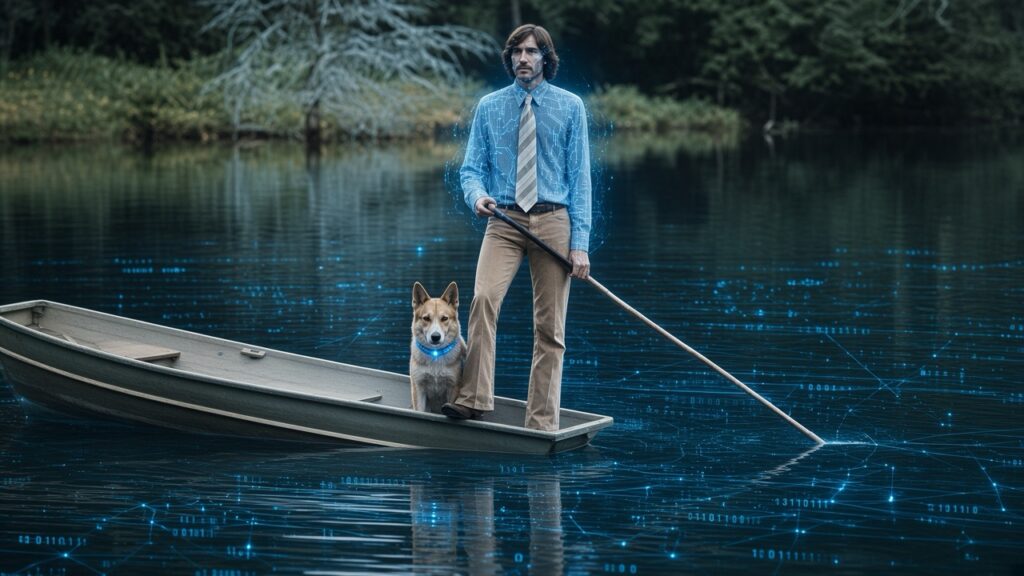
Full disclosure: I have no ideological dog in this fight. If the machines deliver abundance, fine. The goods circulate by default and socialism arrives as a firmware update. If the weights go open source and the stack lands in common hands, also fine, that’s socialism by pull request, no tumbrils required. What I can’t manage is much investment in the current cast of proprietors. They’re a recognizable type: heavily capitalized, allergic to feedback, fluent in civilizational destiny and lockup periods. It’s hard to root for people whose business model needs you to be both the customer and the obsolete inventory.
A few months ago, the Ralphs on my side of town and the neighborhood CVS quietly switched their in-store music to generated tracks. Nobody announced it. The sound was fine in the way that foam packing is fine: competent, frictionless, and licensed from no one. Then, this fall, James Taylor came back. Ralphs and CVS are both playing the real recordings again, the same ones they played before.
Nobody issued a press release about that either. A procurement decision was reversed. Somewhere a playlist vendor got a call.
Nobody went back to James Taylor out of sentiment. Retail doesn’t have any. Somewhere in a regional office, an analyst pulled the basket-size numbers for the generated-music stores against the control stores, in an economy where every shopper is already counting the cart total, and found that the soundtrack had stopped doing its one job. Dwell time flat. Impulse buys soft. The synthetic stuff filled the silence without ever getting into anybody’s head, and a mood that doesn’t register is just overhead. So the plug got pulled the way these things always get pulled, with a spreadsheet and a shrug. The company didn’t rediscover art. It rediscovered a lift of a few tenths of a percent, and took the old catalog back at the old rate.
There is a second reason, and it’s even less romantic. James Taylor is not just a catalog. He is a tax bracket. His is the sound of a man who owns the house outright, lives comfortably, and sails a gondola on the lake on his own property, trademarked. The people who grew up on that voice are the ones who still arrive at the register with equity, a full cart, and no hurry. The analyst didn’t need to believe in memory. He only needed to notice that the customers who respond to that music are the customers with the money, and that the synthetic stuff was aimed at no one in particular.
By 2026 the bottleneck is no longer stimulus. Stimulus is free. Any server farm can extrude infinite pleasant noise, and nobody is short of pleasant noise. What’s scarce is the conversion: the moment a stray feeling in a shopper’s head turns into a transaction at the register. The supermarket isn’t a venue for music. It’s a trap line for four things at once: attention, appetite, mood, and impulse control, all of them soft, leaky, and hard to hold in a fluorescent box. The soundtrack’s job is to keep a person walking the aisles, lower the guard a few notches, and send her home with the artisanal pickles she hadn’t planned on. Silence is a leak. Annoying noise is a bigger one. What the store wants is a sound that gets under the skin without ever announcing itself, and that, it turns out, is a feature of songs that survived, not of songs with a good spec sheet.
It’s tempting to say the hype failed, but that would need evidence, and playlist decisions have many causes. The interesting question is why the old stuff has stayed in service when the new stuff is cheaper.
Reification is a good place to start. It’s the old Marxist observation that a social relation can pass itself off as a property of a thing. A recording looks like it contains its own value, the way a gold bar does. It doesn’t. The value is in the summer of 1993, the kitchen, the person in the passenger seat. The file is a carrier and the history is the cargo.
The machine can counterfeit the carrier. Timbre, fingerpicking, soft-rock sheen, the forensic signature of 1974. What it can’t counterfeit is forty years of other people’s lives stuck to the original like barnacles on a hull.
And the supermarket, in its unlovely way, was running a preservation program. Every airing of that song embedded it a little deeper in collective autobiography. Capital spent a generation making culture licensable, repeatable, and deployable, and in the process laid down a reservoir of attachment that no cost curve reaches.
Let’s be clear about what the supermarket is licensing. It isn’t old music. Old music is a vast, silent junkyard. For every “You’ve Got a Friend” there were a thousand perfectly competent soft-rock singles from 1971, well produced, well intentioned, played a few times on the radio, and then gone. They never stuck to anybody’s summer. They didn’t fail in any dramatic way. They just failed to attach, and attachment was the only test. What survives in the catalog is the residue of a filtration plant that ran for fifty years at continental scale, with the population’s actual hearts as the filter medium. No committee could have staged it. It was crowdsourced, brutal, and entirely unplanned. That’s usually how you know it’s real history.
So the pipeline has two stages. The first is a sieve: out of a thousand candidates, a handful snag in enough heads to earn repeat deployment. The second is compounding: once a song clears the sieve, every airing in a car, a kitchen, or a checkout line sets the attachment a little deeper. The barnacles only grow on hulls that stay afloat.
This is the part the generators can’t skip. They can make the thousand candidates in an afternoon. They can’t run the sieve, because the sieve is made of people and takes decades.
You could try to rig it. A casino doesn’t leave conversion to a soundtrack. It engineers the whole envelope: no clocks, no windows, carpet patterns tuned to keep the eyes moving, oxygen-rich air, and a jingle of payout noise piped in from slot machines that haven’t paid anyone in an hour. Every stimulus is custom-built, and every one of them is working for the house. A drugstore chain could, in principle, do the same. It could rebuild CVS as a sealed mood chamber, with synthetic music as one component of a machine-made atmosphere. That is a very large capital project to avoid paying a royalty. And I suspect that once the architects finished the lighting, the scent diffusers, and the aisle choreography, somebody would still have to cue up “Fire and Rain” at the register, because it’s the one component in the building that arrives pre-loaded with the customer’s own life.
The result is a kind of landfill with a mortgage. Decades of repetition piled the same twelve songs into the national subconscious, compacting them layer by layer, like a municipal dump that eventually turns out to be sitting on a vein of methane. The retailers thought they were disposing of music. They were drilling a gas field of private feeling, and nobody has yet figured out how to frack it synthetically.
Nobody in the music business ever said no to a sync license, and nobody is especially proud of saying yes. A producer takes the call, the number is decent, the rent is real, and the check clears. A year later there’s a faint taste of ash in the mouth, usually when the track turns up under a minivan commercial or over the deli counter. It isn’t selling out. Selling out implies a buyer who wanted your soul. This is licensing out: a clean, lawyered, non-exclusive arrangement in which the song goes to work in a hairnet and you get a statement twice a year. The industry has a word for the result. The word is “income.”
Everybody in the trade figured the sync gold rush was a temporary anomaly, a weird little boom in the plumbing, like ringtones. The assumption was that something worse would come along, probably a streaming scheme with a pie chart. Nobody imagined the sequel. In the sequel the song isn’t licensed out. It’s rendered out, by a GPU cluster in a Nevada industrial park that doesn’t take calls from publishers and has never once had a summer in 1983.
The machines get their turn, of course. Someone who is twenty in 2026 can fall in love to a generated track, and in 2066 they’ll defend it in a parking structure with tears in their eyes. But the song has to wait for life to happen to it, and time is the one input the venture-capital model can’t scale. For anyone who was twenty in 1980, a machine-made 1980 is a theme-park replica. Causality only runs one way, even in Silicon Valley.
So the mass-culture machine left behind an obstacle to its own full automation: a stock of lived experience that can’t be generated by generating more content. The market dug its own moat and never noticed.
The whole thing has the plot of The War of the Worlds. The invaders show up with unanswerable machinery, tripods striding over the grocery chains of civilization, and then they get taken down by a commodity-grade pathogen nobody on the invasion committee had budgeted for. Here the germ is human memory. It’s slow, it’s local, it’s sticky, and it doesn’t ship. The hyperscalers have burned a few hundred billion on the premise that culture is a throughput problem. They may need thirty years of actual people living actual lives around their output before any of it pays off. Thirty years is a long time to carry a capex line. It is longer than the patience of a limited partner, and about the length of one very sad mortgage.
Meanwhile, James Taylor is playing over the pharmacy aisle. Somebody’s mother is standing there, holding a prescription, and she is twenty again for about forty seconds.
Leave a Reply