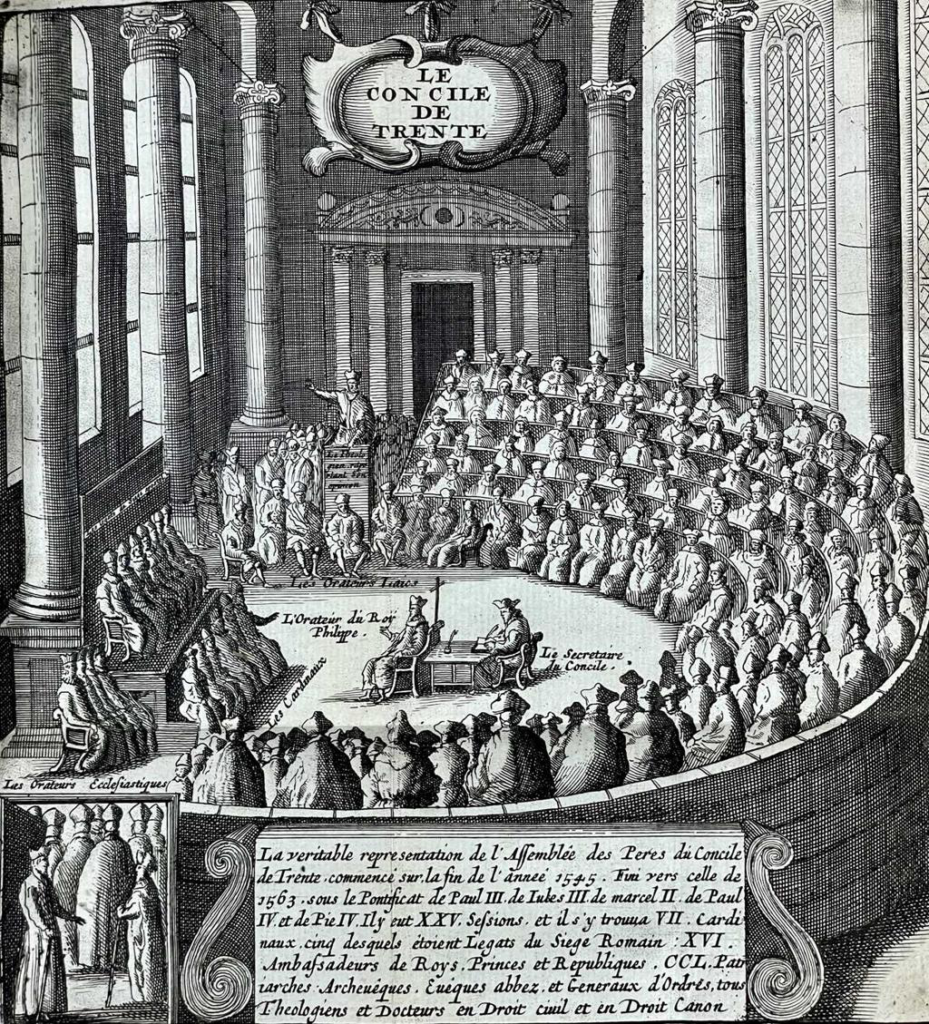
Being the authentic proceedings of a theological disputation held in Rome, Anno Domini 1647, concerning the proper population of a pinhead, with sundry observations on angels, salvation, institutional safeguards, and the unfortunate tendency of the world to continue without waiting for a conclusion
The Most Reverend Archbishop of Ferrara rose first.
“Brethren, the question before us is not whether angels exist. On this point, Holy Scripture is perfectly clear. Nor is it whether angels possess bodies. On this point, Scripture is perfectly unclear, which is nearly as useful.
“The question is narrower, and therefore more important:
How many angels can be accommodated upon the head of a pin?”
There was a murmur of approval. It was an excellent question: narrow enough to sound tractable, obscure enough to admit no obvious answer, and consequential enough that a reasonable man might devote the remainder of his career to determining what a reasonable answer would look like. The Church had always understood the value of such questions.
The Bishop of Modena immediately raised a finger.
“Accommodated in what sense?”
The Archbishop paused.
“In the ordinary sense.”
“What is the ordinary sense?”
“The sense ordinarily meant by a reasonable man.”
“Then surely,” said the Bishop, “we must first establish whether the reasonable man is himself an adequate unit of measurement.”
A silence fell over the chamber.
The Bishop of Bologna began taking notes.
A young auxiliary bishop, recently returned from Paris and considered dangerously modern, proposed that the question be settled empirically.
“We might obtain a pin,” he said, “and observe how many angels arrive.”
Several bishops crossed themselves.
“That,” said the Archbishop, “would be scientism.”
“I meant merely to count them.”
“But how will you know they are angels?”
“By their appearance?”
“You assume angels have an appearance. Have you seen one?”
“No.”
“Then how do you know they don’t have an appearance?”
“By their wings, then.”
“You assume they have wings.”
“Do angels not have wings?”
“Some angels have wings. Some have many faces and burning eyes and wheels within wheels. Ezekiel saw one and required assistance afterward.”
“So they might have wings.”
“They might have wings or faces or wheels. That is rather the problem.”
“Then we shall count the wheels.”
“You cannot count the wheels if you have not first established there are wheels.”
“By the fact that they are there, then.”
“Ah.” A long pause. “There.“
“Yes.”
“Where is there?”
“Upon the pin.”
“You assume the pin has a there.“
“It is a pin. It has a surface. The surface is there.“
“The surface is there. Is the angel the surface?”
“No.”
“Is the angel on the surface?”
“Yes.”
“So the angel has a location, but no appearance, and possibly no wings, and you propose to detect it by its presence there, which is a place you can only identify by assuming an angel is in it.”
“…Yes.”
At this, the Cardinal Inquisitor leaned forward — a weathervane of a man, who had wept at three prior heresies and been correct about none of them in advance, only afterward, loudly.
“Now we approach the real danger.”
The secretary wrote: Danger: assuming presence from presence.
The young bishop sat down.
A secretary entered with an unrelated dispatch.
“Your Grace. A poor harvest in Emilia. Bread scarce in three dioceses.”
“Instruct the parishes,” said the Archbishop, without looking up, “that the faithful are to say two Hail Marys and one Credo for the relief of Emilia.”
“Two Hail Marys.”
“And one Credo.”
“Is that—” The secretary hesitated. “Is that enough Hail Marys, Your Grace? For a famine?”
“How many would you suggest?”
“Two is traditional.”
“Traditional for what? Is it two regardless of the — of the size of the disaster?”
“Broadly, yes.”
“So a poor harvest and, say, the fall of a city are both two Hail Marys.”
“The fall of a city,” said the Archbishop, finally looking up, “would be two Hail Marys and a Credo and a procession.”
“Ah.”
“We do have a scale.”
“What’s above a procession?”
“A relic is exposed.”
“And above that?”
“We have never gone above that.”
“What would you do if it were worse than a relic being exposed?”
“It cannot be worse than that.”
“What if all three dioceses lost their bread and a city fell and—”
“Then it is still two Hail Marys per event. You do not compound them.”
“You don’t compound the Hail Marys?”
“It isn’t interest.”
“So if six things go wrong at once—”
“Twelve Hail Marys and three Credos, and a very long afternoon for whoever is counting.”
“Who is counting?”
“You are, as of this conversation.”
“…Two Hail Marys for Emilia, then.”
“Two Hail Marys for Emilia.”
“Shall I specify which two?”
“There is only the one kind.”
“I only meant — the Ave before the Gloria, or—”
“Go, Simon.”
The secretary noted it and departed. No one in the chamber found this remarkable, least of all the Archbishop, who returned at once to the pin.
The Angelicists stood up.
⸻
The Angelicists were a school of considerable learning and very little doubt.
“If angels are incorporeal,” explained the senior Angelicist, “their occupancy cannot be modeled by ordinary material geometry. And there is a further matter — the question of orthogonality.”
“Which is?”
“That an angel’s power to occupy the pin and its will toward the occupying of it are separable properties. A being may possess unlimited capacity to fill the pinhead while remaining wholly indifferent, or wholly hostile, to doing so in a manner pleasing to God. Capacity is not alignment.”
The Bishop of Bologna wrote this down twice, once with approval.
A parchment was unfurled. The calculation began with a prior probability concerning angelic density, was corrected for hierarchical order, corrected again for messenger status, and revised twice more for purposes not yet discovered.
At last the Angelicists produced a number.
“Is this the number?”
“It is the posterior.”
“Then what is the number?”
“That depends on the prior.”
“And the prior?”
“On our theological assumptions.”
“Which are?”
“Reasonable.”
Among the junior Angelicists sat Brother Tessio, twenty-six, gifted at Latin and worse at sleeping. He had joined the fellowship because his father’s debts to a Genoese lender were considerable and the stipend was not. He did not, privately, believe the posterior meant a great deal. He had confided this once, to no one, in the margin of a notebook he later burned: the number could be off by any power of ten I care to name and not one footnote in my thesis would need to change. He said nothing of this aloud. He nodded, along with everyone else, when the senior Angelicist added:
“We are also obliged to consider the overhang.”
“The overhang?”
“There exists, by the doctrine of the communion of saints, a vastly greater angelic capacity in Heaven than we have yet located pins to house. This is the capabilities overhang. Every year we delay in fabricating sufficient pins, that overhang grows, and grows more dangerous to leave uncounted.”
“Dangerous how?”
“Because should even one angel achieve true union with the Divine Mind while resident upon a pin, the remainder may follow in an instant beyond human reckoning. We call this the foom.”
“The what?”
“The foom, Your Grace. A seraphic intelligence explosion. There will be no second Council to correct us if we are wrong about the pin. If we are wrong about the pin, we are wrong about everything.”
No one asked him to repeat this. It did not need repeating. It had the shape of a thing that arranges the furniture of a room permanently the first time it is said in one.
⸻
Not everyone in the chamber had been a theologian from the beginning.
The Bishop of Modena knew this because he had lost money to two of them, in two different decades, in two different ventures, neither of which had involved angels at all.
The senior Angelicist had begun his career in the Great Assay of Augsburg — a scheme, much discussed in its season, by which a syndicate of learned men proposed to transmute base lead into gold by a process they declined, for reasons of security, to fully disclose, and which required only that a man deposit his lead with the syndicate now, in exchange for a certificated claim upon the gold it would shortly become. The certificates traded hands at a premium for eleven months. The lead did not transmute. The syndicate’s learned men were, by the time this became apparent, engaged in other work.
That other work was the Universal Broadsheet — an ingenious enterprise which undertook, at its own expense, to collect and copy every pamphlet, ballad, and bull printed in the German lands into a single vast index, offered to the public without charge, on the sole condition that a man’s reading habits be recorded and sold onward to whoever wished to know what he read and might therefore wish to sell him something. For a time it was the only way anyone read anything. Then the public discovered what had been sold, and where, and to whom, and the Broadsheet’s founders discovered that indignation, once aggregated at sufficient scale, moves faster than any pamphlet they had ever indexed.
They were, by common report, unemployed for the better part of a year.
It was in that year that the senior Angelicist attended, more or less by accident, a lecture on the Prima Pars at a university he had previously had no cause to enter, and heard a question — whether several angels might occupy the same place — that struck him, he told the Bishop of Modena afterward, with the force of a true vocation.
“A market,” he said, “with no possible upper bound. A quantity no one has ever measured and no one can ever definitively refute. Infinite stakes, Your Grace, and an audience already primed by two hundred years of sermons to believe the stakes are infinite. I looked at that question the way another man looks at a river and knows, before he has built anything, exactly where the mill should go.”
He brought with him, into angelology, three lieutenants from the Broadsheet’s old ledger-house, a fondness for the word scale, and a settled conviction — acquired honestly, across two prior catastrophes — that a venture is never refuted by its failure, only by its failure to attract a second round of investment before the first one is widely understood to have failed.
The Bishop of Modena did not mention any of this to the Council. He had tried, once, in the second year, and had been informed by the Archbishop that a man’s prior ventures were not evidence against the truth of his present calculations, which was, the Bishop conceded privately, difficult to refute on its own terms — it merely happened to be exactly what the senior Angelicist would have wanted said, and had, in a sense, already sold him.
⸻
Meanwhile Father Ambrose, pastor of a poor parish near the Tiber, buried two parishioners that month with no one to assist him at the altar, because his best server had been recruited into the fellowship for Counterfactual Celestial Geometry the previous Michaelmas.
He went to the Archbishop’s palace and asked for the boy back.
“He has real gifts,” said Ambrose. “For confession. For sitting with the dying. Not for arithmetic.”
“He has been assigned to a grave question.”
“I bury the dead of this parish with my own hands twice a week. Is that not a grave question?”
“It is a settled question.”
“It is an unending one. That is not the same thing.”
“It is settled in the sense that it has been assigned.”
“Assigned is not the same as settled either.”
“It is settled in the sense that a committee is now responsible for it, which is the only sense in which anything is ever settled.”
“Then unsettle it. Give me the boy.”
“I cannot unsettle a committee, Father. That is a much graver question than the one it was formed to answer.”
“Grander?”
“Graver.”
“Grave enough for its own committee?”
There was a pause of the wrong length.
“…I will need to consult someone.”
“While you consult someone, may I have the boy?”
“He is a resource.”
“He is fifteen.”
“He is a fifteen-year-old resource.”
“He carries the thurible. He cannot lift the thurible over his own head, we have had to lower the chains.”
“He has an aptitude for enumeration.”
“He has an aptitude for falling asleep during Compline, which I assure you is not an aptitude anyone has enumerated.”
“The fellowship reports he shows real promise.”
“Promise of what?”
“That has not yet been established. That is, in fact, rather the whole of what the fellowship is established to establish.”
“So you have taken my altar boy to establish what his promise is a promise of.“
“When you put it that way it sounds—”
“Circular?”
“—premature. It sounds premature.”
“I buried two of my parishioners this month with no one to hold the book.”
“Did you consider holding the book yourself?”
“I was busy digging.”
“Ah.”
“Twice.”
“That is unfortunate.”
“It is not unfortunate. It is the entire job, Your Grace. It is what a parish is. A parish is a place where somebody digs and somebody else holds the book, and if you take the second man you still have a hole, you simply now have it alone.“
The Archbishop considered this with what appeared to be genuine sympathy, which somehow made it worse.
“I will raise it at the next session.”
“When is the next session?”
“There isn’t one scheduled. We would need to convene a session to schedule the session.”
“Can I attend that one?”
“It concerns the scheduling of committees. You are not on the scheduling committee.”
“How does one get on the scheduling committee?”
“By appointment of the Archbishop.”
“You are the Archbishop.”
“Yes.”
“Appoint me.”
“To the scheduling committee?”
“Yes.”
“…I will need to consult someone.”
He was thanked for his diligence and sent home. The boy stayed.
⸻
It was Calvi, and not any theologian, who first grasped that an unresolved number was not an obstacle to selling pins but the entire opportunity.
A pin whose angelic occupancy was settled would be, commercially speaking, a dull object — one pin, like any other, differing from its neighbor only in length and sharpness. But a pin whose occupancy was disputed could be sold twice: once as iron, and once again as a position in the dispute. Calvi began stamping his finer stock with a small cross and the words forma probabilior — “the more probable form” — and pricing it accordingly above the ironmongers’ plain pins, on no authority whatever beyond the phrase itself, which he had heard once in a sermon and liked the sound of.
Within the year there were pins for every conviction and every budget. The devout could buy pins “consecrated pending final ruling,” which cost more and did nothing, the ruling being some decades off. The cautious could buy pins warranted “vacant” by a licensed hedge-priest, for households wishing to avoid the liability of an improperly aligned angel taking up residence in the sewing basket. The skeptical could buy the plain, unstamped article at the old price, which Calvi was pleased to still offer, since it let him say, truthfully, that he served every party to the dispute and injured none of them — a claim the Council itself had not yet found a way to make.
He never once weighed in on the number. He did not need to. He needed only that it remain unsettled, and that everyone with an opinion about it require a pin to hold the opinion on.
The Angelicists found the whole arrangement faintly distasteful, though it took them some time to say so, and longer still to say why.
“It isn’t that the man is wrong to profit,” the senior Angelicist explained, with the delicacy of someone trying not to sound as though he minded. “It’s that he has made the wrong kind of profit visible. One does not object to Providence enriching a merchant. One objects to watching it itemized.” He had expected, if he was honest with himself — and he made a point, that season, of not being — something closer to the miracle of the loaves: an abundance that simply arrived, ownerless, requiring no invoice, embarrassing no one by its origin. Five pins and two fishes, quietly sufficient for the multitude, no forma probabilior stamped anywhere upon them. Paupers eating out of the air, in other words, not paupers being sold three grades of air at three prices by a twenty-two-year-old with a grievance against his brother.
“We are describing the mechanism by which Heaven populates the pin,” he said. “We are not describing the mechanism by which a foundry populates its ledger. That the two mechanisms have become, in practice, difficult to tell apart from the street is Calvi’s error, not ours.”
Father Ottavio, overhearing this, allowed himself one of his rare, ungentle remarks. “You mistake,” he said, “the discomfort of being photographed for the discomfort of being wrong. Calvi has not corrupted your work. He has merely priced it where you could see the number.”
The senior Angelicist did not care for this, and said so, and then declined to discuss the matter further, which the Council had by then learned to recognize as his way of conceding a point without the indignity of having done so aloud.
Not all of them held the line. By the second year a quiet minority of Angelicists — never named in the minutes, though everyone in the chamber could have named them — had swallowed their scruples along with the rest of their objections and bought shares in Calvi’s foundry, reasoning, privately and not without a certain elegance, that if the pin’s occupancy was genuinely a matter of infinite stakes, then a man with sound theology and a modest capital was doing Providence a disservice by not owning a piece of the instrument through which it worked. They continued, in Council, to speak of the arrangement with the same faint distaste as their colleagues. They simply did so, from the second year onward, somewhat more richly.
⸻
A second school arrived some months later. They called themselves the Diagnostic School, and their spokesman was Father Ottavio, S.J. — a director of conscience by training, whose actual professional competency, before the pinhead question absorbed him, had been the discernment of spirits: distinguishing, in another man’s soul, a true consolation from a subtle temptation dressed as one.
“We do not propose,” he began, “to determine whether the Angelicists are right.”
The Angelicists were pleased.
“We propose instead to examine the conditions under which a community becomes capable of being so certain that it is right.”
The Angelicists were less pleased.
Ottavio’s memorandum distinguished metaphysical claims from empirical ones, empirical claims from institutional practice, and institutional practice from the incentives institutions create. It observed that the Angelicists were unusually skilled at quantifying uncertainty within their models and markedly less inclined to place any uncertainty on the assumptions the models were built from.
“The difficulty,” said Ottavio, “is not that these men are irrational. It is that they have become extraordinarily rational inside a system that has become unusually difficult to doubt. I propose, therefore, that the Council adopt a formal practice — a daily examen of its certainties, in the manner of the spiritual examen, wherein each conviction held that day is turned over and asked whether it arose from light or merely from the day’s momentum.”
“You wish us to red-team our priors,” said the senior Angelicist, not unkindly, “in the vestments of Loyola.”
“I wish us to ask, each time a position hardens, whether the man holding it can still tell a consolation from a temptation. I have taken no positions myself. I have only asked that question.”
The senior Angelicist smiled thinly. “Your own tradition, Father, permits following the less certain of two paths, when a grave and learned authority holds it probable over the stricter one. We are a grave and learned authority. Our opinion is probable. By your own casuistry, you have no ground to forbid us.”
Ottavio had no clean answer to this, and did not pretend to. “That is a fair use of my own tradition against me,” he said. “I will need to sit with it.”
He did not sit with it comfortably. It was the only exchange all Council he did not win.
⸻
Sister Corvo, a Diagnostic of considerable ambition and no patience for Ottavio’s examen, watched this exchange with something less pure than alarm. She had proposed her own containment framework eleven months prior. It had received polite applause. Ottavio’s received an embrace from the Archbishop and tears from the Cardinal Inquisitor.
“He speaks of humility,” she said afterward to no one in particular, “with the confidence of a man who has never lost a vote.”
It was Corvo who said it first, and she said it to the senior Angelicist directly, in the corridor, where the Archbishop could not hear it.
“You had a different name in Augsburg.”
The senior Angelicist did not, to his credit, pretend not to understand her.
“You had a different office,” he said. “You were not yet consecrated to anything. You audited ledger-houses for the Fugger interests. You were the one who came through the Broadsheet’s books in the spring and found what we had sold, and to whom.”
“I found it in eleven days. It took the public another four months to care, and by then you had resigned upward into the priesthood, which I will admit I did not see coming.”
“You are not owed an apology for a lead certificate you did not personally hold.”
“I am not asking for one. I am telling this Council, when it will listen, that I have watched you produce an unfalsifiable instrument with a captive audience once before, and that the instrument that time was called gold, and the audience never got its lead back, and I would like it on some record, however small, that I recognized the shape of the thing before it had angels in it.”
“And yet here you are,” he said, “containing it. Not stopping it. Containing it. You built a career on the diagnosis, Corvo. I built one on the disease. I am not certain, examining it honestly, that yours is the more honest trade.”
“Speaking of trades,” said a third voice, from the doorway neither of them had noticed was occupied, “I sold the indulgence.”
Both of them turned. Ottavio was leaning against the frame with the particular stillness of a man who has been standing there rather longer than either would have liked.
“You what?” said Corvo.
“The Augsburg indulgence. The plenary one, attached to the Assay, that a man’s certificate was blessed and his soul held harmless regardless of the lead’s performance. Someone had to write the theology that made the certificate sellable to the devout as well as the greedy, and the greedy alone are a smaller market. I wrote it in nine days. I have always been quick.”
“You were a priest at Augsburg?”
“I was a very promising priest at Augsburg. It is how I met the Cardinal, in fact, though he will tell you he does not recall the introduction, and I have always thought it kinder to let him not recall it.”
Every head at the far end of the corridor, where the Cardinal Inquisitor happened to be passing, did not turn, with the visible effort of men who have trained themselves for decades not to turn.
“And the Broadsheet,” Ottavio continued, warming to it now that the worst of the confession was behind him, “sold advertisement to the Assay for its final six weeks, at a rate I am told was generous, on the theory that a certificate close to collapse advertises rather better under urgency than under confidence. I did not write that theology. I merely declined, when it was explained to me, to ask who had.”
“You knew,” said Corvo.
“I knew what everyone in this corridor appears to have known, at some remove, by some arrangement, for some fee. I simply arrived at my present vocation by the honest route of confessing it, rather than the more common route of forgetting it had happened at all.” He looked at the senior Angelicist. “You, for instance, forgot rather thoroughly. I’ve always admired the discipline that takes.”
“I did not forget,” said the senior Angelicist. “I updated.”
“Ah. The posterior.”
“The posterior.”
“On what prior?”
“On the prior that nobody in this building was in any position to ask.”
There was a silence in the corridor of the specific, expensive kind that occurs when several people simultaneously calculate what it would cost them personally to be the one who breaks it.
“Well,” said Corvo at last, “I intend to say nothing of this to the Council.”
“Nor I,” said Ottavio.
“Nor I, obviously,” said the senior Angelicist.
“Then we are agreed,” said Ottavio, with the serene satisfaction of a man closing a negotiation exactly where he’d intended it to close from the moment he opened his mouth, “which is, I would point out, the first thing this Council has agreed upon in eleven months. I shall note it in my memorandum as evidence of the examen’s efficacy.”
She had no answer to this that she was willing to give him in a corridor, and went instead to draft a framework more elaborate than the one she had already proposed — which the Council received, the following week, as evidence of her unusual rigor.
Her next framework — for stakeholder representation among the nine orders of cherubim, seraphim, and thrones in all matters of angelic enumeration — was, by design, more elaborate than his. It required, she noted with some satisfaction, three additional committees to administer.
⸻
The second-order problem, once identified, proved productive.
Suppose the Angelicists were correct. Then their influence was useful.
Suppose they were mistaken. Then it was dangerous.
Suppose nobody knew which. Then the institutional problem remained regardless.
Suppose, furthermore, that the man assessing whether nobody knew which was himself one of the two people with the strongest interest in the answer. Then a third party was required.
Suppose the third party also developed an interest, merely by being asked. Then a fourth.
Suppose there were no more theologians in Rome.
“Import some,” said the Archbishop.
“No single tradition,” said Ottavio, “should monopolize the moral interpretation of angels.”
“Agreed,” said the senior Angelicist, “provided it is understood that monopolize does not extend to being correct, which is a different condition entirely and one my tradition happens presently to enjoy.”
“Enjoying it is precisely the danger.”
“Enjoying being correct?”
“Enjoying anything, in this Council, without a second party present to confirm you are not merely enjoying the enjoying.”
“Is there a third party to confirm the second party isn’t.”
“There must be.”
“And a fourth, for the third?”
“Obviously.”
“Where does it stop?”
“It doesn’t stop, it recurses, which is a related but theologically superior concept, and I would ask you not to conflate them in the minutes.”
The bishops nodded gravely. There must be rival schools. There must be responsible enumeration, not merely enumeration. There must be people whose professional duty was to ask whether the people asking the questions had themselves become a source of risk, and people whose professional duty was to ask whether those people had, and it was agreed, without a single dissenting voice, that the second set of people must under no circumstances be drawn from the same fellowship as the first, on pain of the whole apparatus collapsing into a man checking his own homework in a mirror.
“Who checks the mirror-checkers?” asked the Bishop of Modena, not entirely rhetorically.
“The mirror-checkers check each other,” said Ottavio. “In pairs. Rotating.”
“Rotating how often?”
“Quarterly.”
“Why quarterly?”
“Any less and they grow too familiar with each other’s blind spots. Any more and nothing is ever checked, merely re-scheduled.”
“That is either extremely rigorous,” said Modena, “or the single most elaborate way of accomplishing nothing that this Council has yet devised, and I confess I can no longer distinguish the two on sight.”
“Neither,” said Ottavio, “can anyone. That is rather the achievement.”
This was declared the greatest intellectual achievement in the history of the Church.
The Cardinal Inquisitor wept — already, privately, composing three versions of his memoirs, one in which he had championed Ottavio from the start, one in which he had championed Corvo, and a third, hedged and unattributed, in which he had championed “responsible mirror-checking” as a concept independent of any single school, to be published in whichever order history required, and to be denied, all three, if history required that instead.
“Shall I record the achievement?” asked the secretary.
“Record it.”
“Shall I record that it was recorded?”
“…Was that not implied?”
“I find nothing in this Council may any longer be safely implied.”
“Then yes. Record that it was recorded.”
“And that that was—”
“No.“
The secretary wrote: Greatest achievement: no monopoly on the moral interpretation of angels. (Recorded. Confirmed recorded. Confirmation not itself independently verified — see me re: quarterly rotation.)
The Council adjourned for supper, on the understanding that the adjournment would itself be reviewed by a second Council, convened solely to confirm that the first had genuinely adjourned and not merely reported having done so.
⸻
THE SCHOOL OF THE DIVINE LEDGER ARRIVES
The Angelicists and Diagnostics had settled by then into their familiar rhythm — calculations and counter-calculations, frameworks and counter-frameworks — when a new delegation arrived at the Council’s doors. They wore the plain habits of the Franciscans, but their eyes had the particular brightness of men who have glimpsed God in the margins of a ledger and never quite recovered.
Their leader was Friar Luca da Siena, a former banker to the Medici who had taken holy vows after a vision in which Saint Peter had shown him the celestial books of account, ruled in a hand Luca described as “very fine, and fully reconciled.” He carried with him a single enormous tome, its pages filled with columns of figures, angelic hierarchies, and the most precise estimate of Divine Grace yet attempted by mortal hand — precise, he was careful to specify, not in its present value, which he conceded was modest, but in its rate.
“Your Graces,” he began, bowing with the particular depth of a man who has practiced the bow, “we come not to dispute the wisdom of this Council. We come to reveal its true purpose.”
The Archbishop, weary but not yet weary enough to decline curiosity, gestured for him to continue.
Friar Luca opened his tome. “You ask: how many angels may occupy the pins we hold today. A fair question. A small one. We ask instead: why should the Council limit its moral attention to the pins of today at all?”
“The question before us,” said the Bishop of Modena, with the patience of a man repeating himself for the fourth school running, “concerns the nature of angels and their relation to the material —”
“— and we do not dispute that,” said Luca, who had clearly not finished the sentence in his head either. “Consider. If a single pin may hold N angels, then a thousand pins may hold N multiplied a thousandfold. And if the number of pins grows without bound — as, Your Graces, I am given to understand it presently does — then the concentration of angels available to be housed, examined, and saved also grows without bound. Not merely more angels. A greater and greater density of angelic possibility, compounding upon itself, with each new foundry.”
A murmur passed through the chamber. The Angelicists’ quills hovered.
The Bishop of Bologna wrote: Angelic concentration proportional to pin quantity? and underlined it twice, the second time without being entirely sure why.
“You speak,” said the senior Angelicist, leaning forward with the interest of a man recognizing a fellow professional, “as though the number of future pins were already known to us.”
“It is the will of God,” said Luca, and smiled the serene smile of a man who has found a phrase that closes every remaining line of inquiry at once.
“And how,” asked the Archbishop of Ferrara, not unkindly, “do you know this?”
Luca tapped the ledger. “By the evidence of the world, Your Grace. Look from your own window. The factories multiply. The merchants grow rich beyond their fathers’ dreaming. The princes’ coffers, which were empty a decade ago, now overflow. This is not commerce. This is Providence, conducting its business through commerce, as it has always preferred to, being economical even in its miracles.”
The Cardinal Inquisitor’s quill snapped cleanly in two. “This is heresy.”
“It is arithmetic,” said Luca, and did not flinch, which the Council found, on the whole, more alarming than if he had.
Brother Tessio rose. He had said little in recent sessions — since the matter of the notebook, he had made a private discipline of saying little — but the shape of Luca’s argument had a symmetry to it that his training could not let pass unremarked, and besides, the senior Angelicist was watching him, and had been watching him rather closely of late, and a junior man who wishes to remain a junior man in good standing learns to speak on cue.
“Your Graces,” he said, “there is nothing further this Council can usefully do for the angels of today. Their pins are finite. Fixed. Already counted, more or less, badly. But the angels of tomorrow — the pins not yet forged, the foundries not yet built — there the concentration is unbounded, and it is there that the Council’s moral attention properly belongs, since a small effort applied to an infinite multitude outweighs any labor, however heroic, spent upon a finite one.”
He did not, while saying this, look at Father Ambrose, who was not present to hear it, or at the seventeen pins on the table, which he had once held up to a candle and found nothing angelic in at all. He had found, in the eighteen months since, that the sentence was easier to say the second time, and easier still the third, in the way that most things are.
“And the angels presently uncounted?” asked the Bishop of Modena, his skepticism by now worn to something closer to fatigue. “The ones on the seventeen pins before us, which no one in this room has troubled to examine?”
Luca glanced at the pins with the mild, unoffended courtesy of a man glancing at a beggar he has already decided not to give to.
“A rounding error,” he said, “in the grand design of Heaven. I do not say this callously. I say it as a mathematician says the third decimal does not change the sum. The moral weight simply does not lie there. It lies ahead of us, where the multitude is greater by orders we have not yet the foundries to imagine.”
Father Ottavio had been silent through this with the particular silence of a man assembling an objection carefully enough that it will not be dismissed as merely a provenance objection twice in one Council. “Friar,” he said at last, “you ask us to discount the pins before us nearly to nothing, on behalf of pins that do not yet exist, on the authority of a rate of growth you have observed for eighteen months in one county of Italy. I have seen this reasoning before. It is always offered by a man standing very close to the furnace.”
“I stand wherever Providence is presently doing its clearest work,” said Luca, and Corvo, watching from the gallery, thought — not for the first time, and not without a certain grim professional satisfaction — that she now had three schools to contain instead of two, and that the third had arrived already fully persuaded that containing it would itself be a sin against the future.
Ferdinando Calvi, informed of the doctrine within the week by a foreman who had heard it secondhand from a priest, found it the most useful theological development of his career to date, and began describing his newest foundry, without any correction from the Council, as an instrument of Providence, which raised its value to his moneylenders considerably.
The Archbishop looked for a long moment at the seventeen pins, untouched, ordinary, faintly dusty, sitting on the table exactly where they had sat for years.
“We will take up the matter of infinite pins,” he said at last, “on the morrow.” He did not close the tome himself. No one in the chamber, he noticed, had offered to.
⸻
Pluralism, it turned out, required administration. A committee was formed to ensure no tradition monopolized interpretation. A second, to ensure the first did not become a monopoly itself. A third, to assess whether the second adequately represented traditions excluded from the first.
The Angelicists called this inefficient. The Diagnostics replied that efficiency itself required scrutiny. The Angelicists modeled the cost of excessive scrutiny. The Diagnostics modeled the risk of excessive optimization. The Angelicists introduced takeoff speed — how quickly, once the first pin was properly occupied, the remaining pins of Christendom might follow. The Diagnostics introduced a framework for slow takeoff governance, on the theory that a gradual filling of pins could be monitored, where a sudden one could not.
This was considered progress.
⸻
Outside, the first pin factory had doubled its output. The merchants had learned that larger quantities lowered the cost per pin. The princes had learned that lower costs raised demand. Ferdinando Calvi had learned that his brother’s foundry now looked, by comparison, like a toy.
The Council received a report. It was filed under Matters of Possible Relevance to the General Problem.
The Angelicists requested more data. The Diagnostics requested independent verification of the data. The factory requested iron. The request for iron was the only one granted without deliberation.
⸻
By spring the countryside was full of them. Wooden structures became brick; brick became enormous. The old pinmakers complained the new factories were irrationally large. The new pinmakers replied the old ones had been irrationally small. Princes subsidized expansion because other princes had. Merchants borrowed against demand that did not yet exist. Fr. Ambrose buried three more parishioners that season and asked, again, for his server back, and was told, again, that the question was too grave to spare him.
The Angelicists produced a new estimate. It was larger than the last.
“How confident are you?”
“Very.”
“On what basis?”
“Our posterior.”
“Our concern,” said Ottavio, “is no longer the number. It is the institutional consequence of believing it so completely.”
A subcommittee was formed to determine whether this disagreement constituted healthy pluralism or an emerging polarization. It recommended further study. Funding was approved. Outside, another factory opened.
⸻
In the third year the pinmakers encountered their first real crisis: they had made enough pins.
The warehouses were full. The demand of Christendom, it emerged, was finite — a woman required perhaps a dozen pins in her life, and pins, being iron, declined to die.
Ferdinando Calvi convened his foremen.
“How long does one of our pins last?”
“Indefinitely, signore.”
“That is the flaw.”
The foremen did not follow.
“Soften the iron,” said Calvi. “A pin that bends at the third use is a pin that must be bought a fourth time. And find me a priest.”
The priest was found. He was inexpensive. Within the year it was established — not as doctrine, never as doctrine, merely as devout custom — that a garment fastened with a bent or reused pin was fastened in a spirit of sloth, and that the pious housewife renewed her pins at Candlemas as she renewed her candles. Confessors in six dioceses began asking after the state of a penitent’s pins. Guilds required apprentices to present new pins at their examinations. A bride was found unlucky whose veil was pinned with her mother’s pins, and the misfortune of one such bride in Perugia was widely reported and, in the reporting, improved.
Consumption doubled, then doubled again. The factories, having nearly run out of purpose, expanded.
The Council received a report on the matter. The Angelicists observed that a shorter-lived pin implied a higher rate of pin turnover and therefore a greater number of pin-moments available for angelic occupancy across all future time, which raised their estimate considerably. The Diagnostics observed that a devout custom invented by a foundry was an institutional hazard of the first order and proposed a committee to study the origins of devout customs.
Neither proposed asking Calvi to stop, as neither had considered that this was a thing one could propose.
⸻
In the fifth year, news came from the east.
The Turks had taken three more fortresses in the Morea. Whole provinces of Greece had passed under the Sultan; the Balkans were lost or losing; Christian villages had been emptied as far north as the Sava.
The Council received this soberly, and referred it to the Congregation for the Propagation of the Faith, which was the correct office, and which had been receiving such reports for two hundred years without any of them ever arriving back.
Then the messenger added: “They are also making pins.”
The chamber came alive.
“Turkish pins?”
“Very fine ones, Your Graces. Finer than Calvi’s. Their steel is better and their heads are smaller.”
“Smaller?”
The senior Angelicist was on his feet. “Smaller heads. Do you grasp what he is telling us? A smaller head is a harder occupancy problem — an infidel pin may be incapable of proper angelic habitation, or worse, capable of improper habitation. They are producing millions of surfaces whose angelic status has never once been examined by a Christian authority.”
“Could they occupy them first?”
“They could occupy them unaligned.”
The Bishop of Modena asked, mildly, whether the villages of the Morea did not present the more immediate difficulty, seeing as they contained Christians.
“The villages are a temporal loss,” said the Archbishop. “Grievous. But temporal. The pins are a question of the heavens.”
“But what has been done?” asked the Bishop of Modena again, since no one had answered the first time either.
“We have instructed the faithful,” said the Archbishop, “to say two Hail Marys and one Credo for the relief of the Christians of the East.”
“That is what has been done.”
“Do not say it is nothing. The notice has gone to forty parishes since Tuesday. If even a third of the faithful comply, that is upward of twenty thousand Hail Marys said this month on behalf of the Morea. Twenty thousand acts of devotion is not a small thing to have caused. It is, by any reasonable accounting, a considerable institutional response.”
The senior Angelicist, listening from the gallery, found the figure strangely familiar. It had the same shape — though not, he was careful to note only to himself, the same substance — as a number he had once furnished to a syndicate of investors as proof that the Broadsheet was thriving: not that any subscriber’s circumstances had improved, but that a great many people had been persuaded, cheaply, to perform a small act in public and be counted for having performed it. He did not share the comparison with the Council. It was not a resemblance the Church would have received as a compliment, though it was the only professional respect he had left in him to pay it.
The Diagnostics urgently proposed an international framework for the responsible enumeration of angels on pins of all faiths, to be negotiated with the Sublime Porte.
The Angelicists urgently proposed that Christendom manufacture more pins, and faster, so that a decisive share of the world’s pinheads should be in orthodox hands before the Turks reached scale.
Father Ottavio noted that these two proposals were incompatible.
“Then let us pursue both,” said the Archbishop, “so as not to monopolize the moral interpretation of angels.”
The Council voted funds for both. Calvi, informed that his output was now a matter of the security of Christendom, raised his prices and built two more foundries. No funds were voted for the Morea. The Congregation for the Propagation of the Faith was not consulted again.
⸻
From the upper windows the bishops could see smoke, and hear hammers, and see roads widened toward warehouses whose final purpose no one could yet name.
“The scale seems excessive,” a bishop ventured.
“Excess can be quantified,” said an Angelicist.
“The category of excess is itself institutionally constructed,” said a Diagnostic.
The Archbishop asked whether anyone had actually looked at a pin.
Silence. The secretary searched the archives. Seventeen pins, acquired years before. None examined.
Brother Tessio, who had once burned a notebook rather than let anyone read what he suspected about the posterior, was the only man in the chamber who had ever, out of boredom, held one of the seventeen up to a candle. He had noticed nothing angelic about it. He said nothing about this either. It was not, by then, the sort of observation with a home to go to.
In the seventh year a Dominican of no particular distinction, sent from Bologna to deliver documents, remained standing after he had delivered them.
“Your Graces. Forgive me. I have read the proceedings of this Council back to the first session, and I cannot find where the question came from.”
“It came from the Angelic Doctor,” said the Archbishop.
“That is what I thought. But Thomas does not ask it. I have the Prima Pars here. He asks whether several angels can be in the same place. Whether an angel is individuated by where it is or by what it is. There is no pin, Your Grace. There has never been a pin. Someone has put the pin in.”
A silence of a distinctly different quality from the Council’s usual silences.
The Archbishop took this with more composure than the chamber expected.
“Let us suppose you are correct. Thomas asks whether two angels may share a place. Do you understand what a crude formulation that is?”
“Crude, Your Grace?”
“Binary. Two angels, one place, yes or no. It admits of no density. No distribution. No tail. It has no model in it at all. The Angelic Doctor was working with the instruments of his century, and we do not blame a man for the century he was issued, but we cannot go back to it. The pin gives us a surface. A surface gives us a quantity. A quantity gives us everything we have built in seven years.”
“But if he never asked about the surface —”
“Then we have improved upon him.”
The senior Angelicist rose, in some heat. “It would be an embarrassment to this Council to be no more sophisticated than a friar of 1270. We have instruments he lacked. We have the posterior. We have orthogonality. Thomas had — what — the distinction between essence and existence?”
“He had that,” the Dominican agreed.
“Well. Yes.”
Father Ottavio, S.J., had been waiting with the patience of a man who intends to be the last to speak.
“Brother,” he said, with great gentleness, in the voice the Society reserves for the provinces, “may I ask where you studied?”
“Bologna.”
“Bologna. Good. Solid. Very solid.” He let this rest exactly long enough. “You have raised — and I want the Council to hear that it is raised in good faith — what we would call a provenance objection. It is the first objection. It is the one everybody arrives with. We treated it in the memorandum, in the second appendix, though the appendix is in Greek and I do not say that unkindly, only that you would have had no occasion for it at Bologna.”
“I only meant that the original question is a better question.”
“You mean it is a simpler question. I understand the appeal. There is a real consolation in simplicity, and I would not want to talk you out of it too quickly — the Society teaches us to sit with a consolation before we test whether it is one.” He smiled. “But consider: whether the question was asked in 1270 is a matter of philology. Whether it is now load-bearing is a matter of institutional fact. Twenty-nine chairs, four foundations, six frameworks, and the entire governance architecture of this Council rest upon it. Philology cannot unmake an institutional fact. That is a category error, and an understandable one, and I would be glad to send you something on it.”
“Send me what?”
“A reading list.”
The Dominican looked around the chamber for an ally and located none, though Brother Tessio studied the table with some intensity.
“So it does not matter that the question is invented.”
“It matters enormously,” said Ottavio warmly. “It is precisely the sort of thing my school exists to notice. I shall propose a committee on the provenance of the pinhead question this afternoon, and I shall cite you in the minutes by name, which I hope you will take in the spirit intended.”
He did propose it. He did cite him. The committee sat for three years, produced a report establishing that the question’s origins were obscure, and recommended that in light of that obscurity the question be pursued with heightened epistemic humility rather than abandoned, since abandoning a question on the grounds of poor provenance would set a precedent capable of unmaking a great deal of theology, some of it load-bearing.
This was considered a model of intellectual honesty.
The Dominican returned to Bologna, where he spent the remainder of his life on whether an angel is individuated by place or by nature, and reached no conclusion, and was not funded.
⸻
The Cardinal Inquisitor, during the eleventh hour of the fourteenth session on frameworks for the governance of frameworks, permitted his mind to wander.
He was an old man. He had burned a Waldensian in his thirties and thought of it rarely, which troubled him more, on reflection, than thinking of it often would have.
What he saw now, with the pleasant clarity of a man not attending to the business before him, was the square outside. Two pyres. Neatly spaced. The Angelicists on the left with their parchments — he would let them keep the parchments, it seemed only fair, and they burned so well — and the Diagnostics on the right with their frameworks, their examens, their nine orders of stakeholder cherubim. Ottavio would ask, from the faggots, whether the fire had arisen from light or merely from the day’s momentum, and the Inquisitor would answer that the distinction was above his office, and light it himself.
It would take an afternoon. The whole thing. Twenty-nine years, resolved before vespers.
The vision gave him such uncomplicated joy that he was briefly frightened by it, and then not.
He was aware that this was a temptation and not a consolation. He had learned the distinction from Ottavio, in a paper he had applauded.
He examined the temptation, as instructed, turning it over to see from what part of the soul it had arisen.
It had arisen from the part that wanted the noise to stop.
He filed it there, and returned to the session, and voted with the majority, as he had every session for twenty-nine years, on the grounds that the majority was where one stood in order to have been standing somewhere when the matter was eventually settled.
⸻
Brother Tessio found the error on a Thursday.
He was not looking for it. He was recopying the original parchment for the archive — the first one, from the first year, the foundational calculation from which every subsequent estimate had been derived by correction and refinement — and he came to the third operation, where the correction for hierarchical angelic order was applied to the base density.
It had been applied twice.
Not compounded deliberately. Applied, and then applied again four lines down, in a different hand, by someone who had evidently believed the first application had been omitted.
Tessio sat with this for some time.
Every estimate since had been built on that parchment. Every refinement had refined it. Every posterior had been an update on it. The Diagnostics’ six mutually incompatible interpretations were six interpretations of it. The framework contained it. The examen had examined the certainty with which men held it and never once the arithmetic beneath it, because the arithmetic was not a certainty, it was a given, and one does not examine the given, one examines what men do with it.
The number was wrong. Not wrong in its tail. Wrong in its second operation, twenty-nine years ago, by a man now dead.
He considered whom to tell.
The senior Angelicist would say the error was within the posterior’s uncertainty, which was so wide that nothing could fall outside it, and had been designed that way. Ottavio would say the error was fascinating chiefly as an illustration of how a community’s certainty outruns its foundations, and would want to write about it, and the writing would be about the community and not about the number. Corvo would want to know which of them it damaged more. The Archbishop would refer it to a committee, and the committee would find that it had no jurisdiction over arithmetic performed prior to its own establishment.
And the factories would not stop. That was the part Tessio kept returning to. Whatever he did with this parchment on this Thursday, the foundries would pour at dawn, Calvi would soften his iron, the brides of Perugia would renew their pins at Candlemas, the Turks would go on making smaller heads, and not one hammer anywhere in Christendom would pause to hear that the number had been wrong from the third line down.
He recopied the parchment.
He copied it faithfully, including the error, because a copyist who corrects is a copyist who has made himself a party to the thing.
He told himself this was scruple. He was young enough to still be able to tell himself things.
⸻
“How many angels,” asked the Archbishop, one final time, “can actually fit upon the head of a pin?”
No one answered immediately. It was the first time in twenty-nine years that the question had been met with silence rather than a number, and the silence went on long enough that several men in the chamber found they did not know what to do with it.
“My brothers,” said the Archbishop at last. “We have spent twenty-nine years on this question.”
The Angelicists sat with their calculations. The Diagnostics sat with their frameworks. Between them lay seventeen untouched pins, exactly as dusty as they had been the day the question was first asked, having been examined by no one in the intervening decades, including, in the end, by the men whose entire careers had been built upon the fact of their existence.
“We have learned that angels may be counted. We have learned that counting them may itself create risks. We have learned that no single tradition should monopolize the moral interpretation of angels.”
Everyone nodded, from habit more than conviction now. The Archbishop did not smile this time.
Fr. Ambrose was not present. He was, at that hour, at the bedside of an old woman in his parish, holding her hand because there was no one else free to hold it, as he had held perhaps four hundred such hands in twenty-nine years without once being asked what he thought the pin question ought to conclude. His altar boy had grown into a middle-aged Angelicist by then, tenured, respected, and had not served Mass since Michaelmas of the first year. The parish had two servers now, both children of the housewives who bought their pins at Candlemas.
Brother Tessio, grey at the temples, sat near the back with the original parchment still in his keeping, its third operation still doubled, still uncorrected, still load-bearing. He had stopped, some years back, asking himself whether he would ever say anything. The question had answered itself by not being asked again.
The secretary rose to read the tabulation prepared for the occasion: in twenty-nine years the Council had ordered, across every calamity properly reported to it, one million four hundred thousand Hail Marys and seventy thousand Credos, a record he described, without irony, as the most complete account of the Council’s activity that existed in any archive.
No one asked whether the calamities had improved. It was not the tabulation’s purpose to say. No one asked whether Emilia had eaten. No one asked what had become of the boy who could not lift the thurible.
A messenger entered. “Your Grace — the new pinworks produce pins beyond the capacity of the existing warehouses.”
“Then they will require more warehouses.”
“They have already begun building them.”
The Archbishop looked toward the window. The sound outside was enormous now — hammers, wheels, iron, stone, men shouting over one another. The sound of wings, had there been any, could not have been heard over it. Somewhere in that noise, he understood without being able to say quite how he knew it, was the only honest accounting the last twenty-nine years had produced: warehouses, full, of a thing nobody had needed this much of before anyone thought to ask why.
He returned to the table.
“Then perhaps the question is no longer urgent.”
The Angelicists objected that the number remained unresolved. The Diagnostics objected that unresolved numbers could still produce second-order risks. The Ledger School objected that abandoning the question now, on the very threshold of exponential angelic concentration, would constitute the single greatest sin of omission in the history of moral reasoning, though Friar Luca delivered this in the tone of a man reading a form letter he had already begun revising in his head. None of the three objections was made with much force.
All three schools had, by then, begun — quietly, separately, without yet admitting it to one another — making inquiries elsewhere.
Corvo had been approached about a lottery being organized in Genoa to fund a hospital, and thought the actuarial problem sounded clean, almost restful, after nine years of cherubim. Ottavio had received a letter from a group of Frenchmen proposing to compile all human knowledge into a single vast alphabetical work, and had found himself, against his better judgment, drafting a memorandum on the conditions under which such a project might become too certain of its own completeness. The senior Angelicist had not been approached by anyone. He had gone looking. There was talk of annuities — a fixed sum paid yearly against an uncertain span of life, which struck him, on first hearing it described, as a market he already half understood, having spent twenty-nine years pricing a different uncertain span for a different unverifiable population.
Friar Luca, for his part, had discovered tontines, and found in them a structure so elegant he did not immediately recognize it as familiar: a fund, subscribed by many, paid out entire to whichever subscriber outlived all the others, so that a man’s fortune grew not from his own effort but from the simple, compounding fact of his neighbors’ deaths — the moral weight, once again, concentrating itself upon survivors not yet identified, at the expense of a present no one troubled to examine. He had also heard talk of a company forming in London to trade with the South Seas, and of new academies where men proposed to weigh air and dissect frogs and publish the results for correction by other men who had also weighed air, an arrangement he found oddly familiar without being able to say from where. A merchant in Amsterdam had begun writing to him about shares.
None of the four had yet resigned. Resignation would have required admitting that the question, once so grave a man could build a chair upon it, had simply run its course — worn smooth, like a coin passed through enough hands, still legal tender, no longer able to buy very much.
“Adjourn.”
The Council rose — not because the angels had been counted, not because the number had been contained, not because the risk had been mitigated, but because, after twenty-nine years of increasingly sophisticated disagreement, the question had become academic, and because there were, by 1676, more interesting infinities to argue about, with newer men, in rooms not yet worn down by this particular one.
Outside, the pin factories continued. They would continue for some time after the last Angelicist had left for Genoa and the last Diagnostic for his alphabet, because a factory, once built, does not require anyone to still believe in the reason it was built. Inside, the parchment with the doubled correction remained in the archive, uncorrected, where it would be found again by someone else, in a different century, arguing about a different instrument, and would once more not matter, for exactly the same reasons.
The question of how many angels could fit upon their heads remained unsettled.
The number of pins did not.
The number of hands that had held the dying, in parishes with no one to hold the book, was never tabulated at all.
Leave a Reply