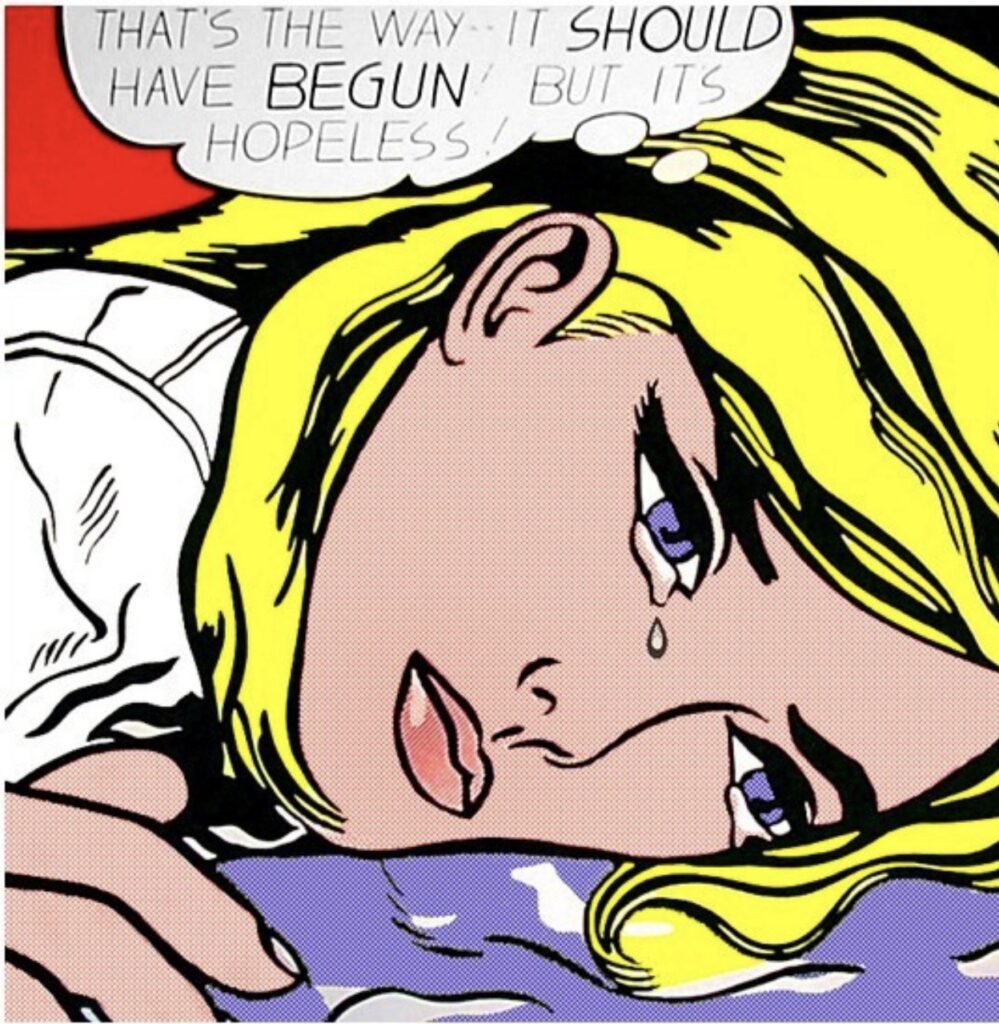
Late 2010s, somewhere in the protocol stack.
A quiet panic went terminal. The smart money—the money that used to be smart—caught the scent. It wasn’t a bug. It was the feature, finally fully expressed: software, in its commodity state, wanted to be free. Not libre. Gratis. Worthless.
But this was the hidden corrosion in the famous prophecy. Software ate the world, and then, with the world digested, it began to eat itself. The logic of infinite replication and zero marginal cost, which had demolished media, retail, and communication, eventually turned on the very act of creating software itself. The value proposition fractured: if your brilliant new app could be cloned in a week by a bored dev in Minsk, funded by a venture drip-feed that treated profit as a quaint anachronism, what were you actually selling? The utility was undeniable, yet the economic vessel to hold that utility had sprung a fatal leak.
The late 2010s were a liminal period in software history: a moment when the structures that once captured value were visibly collapsing. Venture capital had extended the runway, giving the illusion of stability, while the underlying economic substrate—the willingness of users to pay for software as a discrete, scarce product—was quietly eroding. The “smart money” sensed it not through spreadsheets but through intuition: the margins were evaporating, the forks proliferating, the user expectations hardening toward zero. This was not an isolated phenomenon; it was the final expression of a recursive logic embedded in digital goods. Software, as a replicable artifact with zero marginal cost, was structurally predisposed to commoditization. What the industry mistook for volatility was actually a fundamental economic inevitability: the utility layer retained value, but the economic vessels that historically contained that value—licenses, subscriptions, proprietary ecosystems—were leaking. The panic was not about creativity; it was about capture mechanisms failing under the weight of digital physics.
The Four Forces
Four forces finished the job:
– Marginal cost had collapsed to electrons.
– User expectations followed it to zero.
– Alternatives became infinite.
– Switching costs evaporated.
Software as a standalone product started to look structurally unsound unless it was a utility people already paid for (electricity, water), a vice they were addicted to (games, porn, doomscroll), or a tax they couldn’t avoid (HR software, compliance tools). Everything else got psychologically anchored to “software is free.”
You can still charge for Figma, for now. You can still charge for Ableton, for now. You can still charge for Raycast or Superhuman, for now.
But the gradient is merciless and one-way: free tiers, community forks, AI-generated equivalents, “good enough” open-source, closed-source tools forced to justify their existence every quarter, subscription fatigue, bundling gravity from Apple/Adobe/Google/Microsoft. Willingness to pay for pure software shrinks every decade. Commoditization is no longer a risk—it’s the default life cycle.
These four forces constitute a systemic equilibrium. Marginal cost collapse is a classic property of digital goods: once creation costs are essentially zero, traditional price mechanisms fail to sustain. User expectations evolve with exposure: a generation conditioned by mobile apps and “free forever” services internalizes the idea that paying for basic functionality is irrational. The infinite alternatives—forks, clones, open-source equivalents, AI-assisted replication—further drive downward pressure. Switching costs, once the glue of software lock-in, dissolve as interoperability and cross-platform APIs proliferate. What remains is a landscape where only pre-existing utilities, addictive experiences, or enforced compliance can reliably capture value. The once-predictable life cycle of software—ship, lock-in, raise prices—is inverted. Now, differentiation must rely on elements external to the software itself: ecosystem embedding, compute-intensive operations, or experiential uniqueness. Failure to do so guarantees attrition and price compression.
Pre-2010 vs. Post-2010 Dynamics
The old world (pre-2010) let you do this:
– Year 1: Ship the product.
– Year 2–10: Become the only thing with real capability.
– Year 5+: Raise prices as lock-in calcifies.
The new world:
– Year 1: Ship the product.
– Month 6: Competitors appear.
– Year 1.5: Open-source or AI clone appears.
– Year 2: Freemium alternative dominates.
– Year 3: Downward price pressure.
– Year 4: Differentiate on something that isn’t the software itself—or die.
Even the categories that still work today (Figma, Ableton, etc.) are just the last exceptions, not reversals of the pattern. They’re the tall trees still standing right before the second clear-cut.
The historical contrast demonstrates the temporal compression of differentiation. In the pre-2010 era, software companies could exploit multi-year first-mover advantages to consolidate lock-in and gradually escalate pricing. Post-2010, however, the combination of globalized development, AI-assisted replication, and the cultural expectation of free access accelerates the erosion of first-mover advantage. What once took a decade now collapses within months. Even elite software like Figma or Ableton survives not because the macroeconomic pressures have reversed but because they occupy exceptionally narrow niches fortified by deep network effects, workflow entrenchment, and the high cost of cognitive switching. They are anomalies in a broader landscape trending inexorably toward zero willingness to pay. The “second clear-cut” metaphor captures the inevitability: no matter how tall a tree grows, the forces of replication and commoditization eventually level it without continual, defensible differentiation.
You were left with a magnificent, universally accessible what that had no coherent how—as in, “how does this sustain its own existence?”
The Adams Paradox
The analogy of the composer, such as John Adams, provides the crucial counterpoint to the idea that software’s worth has gone to zero. Adams is an undisputed artistic innovator, yet he composes in a world where the technical product of his genius—the high-fidelity digital recording—is routinely copied, shared, and consumed for free. This is the Adams Paradox: the utility (the depth, novelty, and complexity of the music) is extremely high, while the economic vessel that once packaged that utility (the CD, the digital download) has been gutted by zero marginal cost. The value proposition never truly fractured for the creator; it fractured for the distributor and the middle class of the industry. The composer’s continued work demonstrates that innovation and utility survive worthlessness—they simply retreat to the realms of highly scarce, non-replicable goods (live performance, personal services, or the intellectual property itself) or are sustained by institutional patronage, proving that the what (the creative act) is distinct from the how (the sustainable business model). This demonstrates that the panic in the software stack was not about a failure of creativity, but a failure of the traditional capitalist model to capture rent from digital abundance, mirroring the decades-long crisis in the media industries that software itself initiated.
The Adams Paradox illustrates a key economic principle: value and replicability are orthogonal. While Adams’ recordings are freely disseminated, the intrinsic utility—the musical experience—remains unchanged. Software shares this property, but unlike music, software has historically relied on distribution channels and licensing mechanisms that assumed scarcity. When these vessels fail under zero marginal cost, the visible market collapses even though the underlying utility persists. The survival of Adams’ creative output underlines the distinction between the creation of value and the capture of value. In software terms, the creative act—the algorithm, the workflow innovation, the UX refinement—remains intact; the economic scaffolding that once monetized it has fractured. This disconnect illuminates the structural panic of the late 2010s: not a lack of innovation, but a collapse in the mechanisms that historically converted innovation into economic rent.
Web3 and Token Scarcity
This distinction is what made the Web3 response so tragically clever. Recognizing that the utility layer was collapsing like the music CD market, the architects of Web3 attempted to re-engineer scarcity not around the utility itself (the open-source code), but around a purely financialized, ownership layer (the token). This was their “crypto innovation”—the attempt to suture worth into the economic structure by making the right to govern or the social prestige of ownership the scarce asset, rather than the product’s function. They tried to create digital equivalents of signed, limited-edition sheet music for an opera that everyone could watch and download for free. This maneuver, however, fundamentally confused the want for the product with the want for speculative profit. They used a legitimate technical breakthrough (the blockchain) to stage a massive act of scarcity theater, hoping to financialize the network effects that the utility layer creates for free. But just as the value of a physical, autographed CD collapses when the artist is forgotten, the value of the token—the digital scar tissue—was always conditional on the speculative belief that a “greater fool” would pay more for ownership of a non-exclusive utility.
Web3 represents a radical misalignment between utility and perceived scarcity. Builders understood that software’s underlying economic vessel was leaking and attempted to manufacture scarcity artificially. Tokens were an elegant technical instrument, yet their application was fundamentally economic theater. Scarcity was encoded not in the product’s function but in the right to govern, stake, or display ownership. This mirrors the phenomenon of autographed editions in the music world: the functional experience remains universally accessible, while only the symbolic layer carries price. The paradox is that the market for the symbolic layer depends entirely on belief in future scarcity and speculative profit. In practice, this disconnect meant that the underlying software or utility remained free to replicate, while the token’s perceived value rested on an unstable, ephemeral consensus among speculators. The architecture was clever, but the foundation—a belief in manufactured scarcity—is inherently brittle. The digital scar tissue of tokens was always a temporary prosthetic for a fundamentally unmonetizable utility.
ZIRP and The Collapse
We’d spent decades building the perfect copy-machine. Then we were shocked it copied everything, including our business models. The users were conditioned lab rats, tapping a lever for infinity. The indie devs—the craftsmen, the weirdo bricoleurs—were roadkill under the treads of venture-subsidized panzers. The middle class of code was ghosted. You were either a sovereign empire (Google, Adobe, Microsoft) or a guy in a basement, soldering LEDs for the love of it. No more Belgiums.
So the architects of the flattened world did what any rational actor would do. They tried to fork reality.
They called it web3. It wasn’t. It was a financial panic room.
The thesis, stripped of its pious decentralization cant, was a surgeon’s whisper: “The value has bled out of the utility layer. Maybe we can suture it into the ownership layer.” Tokens. Digital scar tissue. A Hail Mary to reintroduce artificial necrosis into the perpetually replicating tissue of code.
For a beautiful, bubble-shaped moment, it worked. It was alchemy, spun on the wheel of Zero Interest Rate Phenomenon. ZIRP was the substrate, the primordial soup. It made money feel imaginary, so why not build imaginary economies on top of it? You wouldn’t pay for a social media app? Fine. Buy a piece of its “governance” and pray the greater fool theory is a fundamental force.
Then the Fed sobered up. Interest rates remembered they were a thing.
The ocean of free liquidity drained. And there, standing on the bare, cracking mud, were ten thousand naked protocols. Their “communities” were just yield-farming ghouls, already phantoming to the next haunt. Their “moats” were dry ditches anyone could GitHub-override in an afternoon. Their “scarcity” was a configuration file. Scarcity theater, staged for an audience of bots.
The cavalry charge. Oh, it was glorious. A line of ex-SaaS founders, UX designers, and growth hackers, repurposed as crypto-cavaliers on discordant steeds. They charged the artillery of fundamental economics. The cannons—named Marginal Cost, Forkability, and User Apathy—didn’t just fire back. They were the landscape itself.
Zero Interest Rate Policy (ZIRP) created an environment in which speculative digital economies could temporarily flourish. Capital was abundant, the cost of borrowing negligible, and the appearance of liquidity substituted for real consumer demand. Indie developers were crushed beneath the combined pressures of venture-subsidized giants and freely replicable software. In this context, the Web3 experiment was an attempt to transplant a rent-seeking mechanism onto a terrain that had structurally ceased to support it. Tokens were a financial Hail Mary: an attempt to encode scarcity where none existed. When macroeconomic conditions normalized—when the Fed reinstated interest rate discipline—the artificial substrate supporting these tokens evaporated. Communities dissolved, “moats” proved illusory, and scarcity was revealed as theater. The charge was spectacular in both ambition and failure: it was not a product of technical incompetence, but of misaligned incentives and a temporary, artificial liquidity regime. The landscape, not just the actors, was hostile, and the collapse was deterministic given the underlying economic physics.
2025: The Aftermath
Now. 2025. The aftermath is a feed.
Some of us thought we saw a Belgian remission in the rubble: Gumroad millionaires, App Store solo devs, Patreon craftsmen, AI-wrapper micro-SaaS. A scrappier middle class living on lichens instead of venture steak. It looked, for a moment, like the music industry in 2007–2008—Radiohead’s pay-what-you-what, early Bandcamp, MySpace merch money—right before Spotify dropped the second, fatal piano.
That’s exactly where we are again.
The current micro-economy is sustained by three fraying ropes:
Apple still hasn’t Sherlocked every profitable niche (yet).
Frontier labs are still subsidizing inference so heavily that wrappers feel like free money.
A thinning cohort of buyers hasn’t yet realized the $79/month tool they love is one system prompt away from being free inside Claude or Gemini.
Those ropes are burning. The second the big platforms stop the subsidies, bundle the workflows, and turn every indie moat into a default feature, the floor drops out a second time—this time for good.
It’s a scorched-earth cloud. The empires are still there, obese on their legacy rents, now choking on debt they took when money was a theoretical concept. The indie layer is cultural archaeology twice over. You find its remnants in niche Discords, abandoned Git repos—the digital equivalent of ghost towns.
And the tokens? The magical thinking coins? They’re cybernetic confetti. The party’s over, it’s blowing down the empty street in a static wind.
By 2025, the economic detritus of a decade of speculative software and tokenized experiments is fully visible. The “middle class” of indie software, once a vibrant ecosystem akin to small-scale musical entrepreneurship, has been compressed to micro-niches sustained only by temporary subsidies or novelty markets. Platforms like Gumroad or Patreon provide ephemeral shelter, but structural pressures remain: dominant tech platforms consolidate features, AI substitutes emerge, and consumer expectations are anchored at zero. Tokens, once the supposed financial bridge to scarcity, have largely evaporated into symbolic debris. The analogy of the scorched-earth cloud captures the dual pressures of macroeconomic normalization and perpetual digital replication. Survivors occupy spaces where barriers to replication—compute costs, proprietary data, entrenched workflows—still exist, but these are fragile refuges rather than robust ecosystems. The digital ghost towns serve as a cautionary map for future entrepreneurs: scarcity cannot be fabricated without grounding in real, hard constraints.
What Survives
What survives is what was always hard. Not soft, social, speculative stuff. Hard things:
1. The Ad-Surveillance Engine. (The original sin, now a mature dystopia.)
1. Burning Compute. (Frontier training runs you literally cannot fake with a credit card.)
1. Enterprise Contractual Handcuffs. (If you can’t convince them, subpoena them.)
1. The Tool of the Master—for now. (Figma, CAD, Ableton. The lathe, the anvil, the loom. Tools for making other capital.)
The rest? The “creative middleware” of society? Flattened.
Commodity software monetization didn’t just collapse; it was revealed as an unstable historical phase between physical scarcity and digital abundance. Everything that still looks profitable today is just the last tall tree before the final clear-cut.
Only domains with intrinsic scarcity or complexity survive: advertising infrastructures, compute-intensive AI operations, enforceable contractual systems, and deeply entrenched professional tools. These are impervious not because they are socially desirable in themselves, but because replication is prohibitively expensive, legally constrained, or embedded in workflows that are hard to displace. All else—the “soft” software of social layers, speculative frameworks, and lightly differentiated utilities—is either free or irrelevant. Commodity software monetization is revealed as a historical anomaly: an interlude where digital abundance and venture subsidies temporarily supported a thriving middle layer. The final clear-cut is approaching: only truly defensible, high-barrier products will remain viable.
The Clean Synthesis
Software monetization didn’t collapse. Commodity software monetization did.
And the direction of travel is still, inexorably, toward software becoming a utility with near-zero willingness to pay—except in the narrow, defensible zones that sit on compute, data, or network effects no prompt can yet dissolve.
The lesson, for the record, in the archive no one will read:
You cannot tokenize want. You cannot make a fork valuable by putting a price on the handle. You cannot outrun the cost of capital by inventing a new capital. All you do is make the crash more spectacular, more littered with the jargon-coated debris of a future that was a phishing attack on the present.
It wasn’t a revolution. It was a retreat, masked as an advance. A desperate, clever, doomed raid on the treasury of reality.
The cannons are quiet now. They always are, after.
The next piano is already hanging overhead. We just haven’t heard the whistle yet.
The enduring lesson is structural: scarcity and capture cannot be manufactured through clever financial instruments. Tokens cannot substitute for real user demand or durable workflow lock-in. Software’s utility persists, but the economic vessels that historically monetized it—licenses, subscriptions, proprietary ecosystems—have been eroded by replication, free alternatives, and zero-interest liquidity cycles. Attempts to reintroduce value via financial abstraction are necessarily temporary and prone to spectacular collapse. The landscape of 2025 is simultaneously a testament to innovation and a cautionary tale: creators survive, platforms consolidate, and the middle layer of independent, sustainable software is unlikely to return without fundamental shifts in macroeconomic, technological, or institutional conditions. The whistle of the next piano is a metaphor for the next inevitable shock in digital abundance—one that will again test the ability of economic vessels to contain value.
Leave a Reply