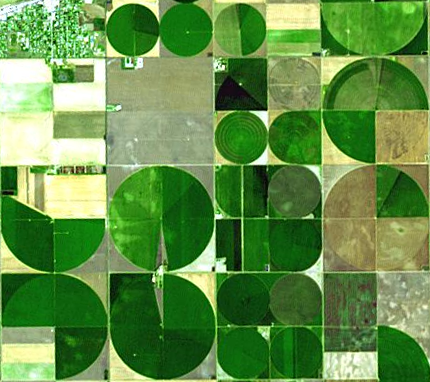
Historians have explained the United States through liberty, religion, capitalism, geography, race, technology, and war. All are important. But suppose for a moment that the decisive fact was yield.
The United States was, above all else, a machine for converting land into surplus.
Europe entered the modern era with dense populations and exhausted acreage. A peasant might spend his life extracting a modest return from the same few fields his ancestors worked. In North America, Europeans encountered something else entirely: vast, highly fertile territories where land was abundant and labor was scarce. The baseline reality of America was not democracy, capitalism, or a unique devotion to freedom. It was that a single farmer could produce far more per worker because the land itself was extraordinarily productive.
The Constitution explains how the surplus was managed. Yield explains why there was so much to manage in the first place.
Ideas about race, destiny, and freedom did not create America. They emerged as justifications for how the resulting surplus was acquired and distributed. First comes the surplus. Then comes the argument about what the surplus means and who deserves it.
Here is the expanded arithmetic section, written to integrate into the existing prose. It replaces the current “Arithmetic of Abundance” section and runs until the paragraph beginning “Several consequences follow directly.”
The Arithmetic of Abundance
The claim is not that America was uniquely virtuous. The claim is that it was unusually productive. And unusually productive is a claim that can be quantified.
A square meter of land is not the same thing everywhere. Geography enters history through yield. Soil, climate, rainfall, navigable water, growing seasons, and access to markets determine how much surplus a society can extract from a given territory. For much of European history, population pressed against the productive limits of the land. The agricultural revolution increased output, but the basic condition remained: many people competing for relatively scarce acreage. North America presented a different equation. Vast tracts of fertile land existed at a scale difficult for Europeans to comprehend. The continent contained the Mississippi watershed, some of the richest agricultural soils on earth, immense forests, fisheries, grasslands, coal deposits, oil fields, and mineral reserves. The question was rarely whether resources existed. The question was who would control them.
Start with the numbers, because the numbers are why everything else happened.
A bushel of corn weighs 56 pounds of shelled grain and contains roughly 92,000 to 95,000 calories. A bushel of wheat runs 60 pounds and yields around 90,000 to 93,000 calories. These are gross figures before processing, seed retention, spoilage, and animal feed, but they establish the basic unit of exchange between land and human survival. A person engaged in heavy agricultural labor requires somewhere between 800,000 and 900,000 calories per year to function. That is the subsistence baseline—the number below which labor itself becomes impossible to sustain.
In the American Midwest during the frontier era, corn averaged around 26 bushels per acre from the 1860s through the 1930s. That translates to approximately 2.4 million calories per acre per season. One acre of corn, in other words, fed roughly three people for a year at the subsistence threshold. A Homestead Act claim ran to 160 acres. With labor-saving equipment—steel plows, mechanical reapers—a single farmer and his family could work that acreage and produce calories sufficient to sustain not just themselves but a substantial surplus population beyond them. The labor required to produce 100 bushels of corn, which ran to 75 or 90 hours of work early in the century, collapsed dramatically as the century progressed. By 1890 the same output required a fraction of that time. The yield per worker, already high by global standards, kept climbing as the acreage remained vast.
The European contrast was structural, not merely a matter of technique or effort. A French or German or English peasant farming inherited plots on exhausted soil, within a system that extracted rent, tithe, and tax before he could claim a surplus, was operating under a fundamentally different equation. Smaller plots, denser competition for land, rigid tenure arrangements, and centuries of cultivation had pressed European yields toward their limits. A peasant family on marginal European acreage might produce enough to survive and little more. The surplus, where it existed, moved upward through the tenure system before it could generate independence or mobility. The man worked the land. The land’s yield went elsewhere.
In America the arithmetic ran differently, but only for those with access to it. On good Midwestern land, open to settlement at nominal cost, one farmer could generate a surplus supporting several additional people—in cash, in exported grain, in the calories that fed urban workers who were not farming. Scale that individual arithmetic to millions of settlers across hundreds of millions of acres and the aggregate result is not merely wealth but a specific kind of social pressure: constant outward expansion, cities that required feeding, industries that required workers released from subsistence agriculture, and a political culture shaped by the expectation that surplus was available to be claimed. When modern hybrid corn and synthetic fertilizers arrived in the twentieth century, yields would eventually exceed 170 bushels per acre—more than 15 million calories per acre, a figure that would have been incomprehensible to a nineteenth century farmer. But the extensive growth of the frontier era, more high-quality acres per person rather than more output per acre, was what first distinguished the American machine. The surplus was not a product of superior technique. It was a product of the land itself, made available at a scale and under access conditions that had no precedent in the European experience.
The relevant comparison is not yield per acre alone but yield per person. A fertile estate controlled by an aristocracy produces wealth. A fertile continent available to millions of settlers produces a different social order. The American advantage emerged from the interaction between productivity and access. The same acre of land that generated wealth for a landlord in another society could generate political independence for a smallholder in America.
This distinction matters because high yield alone explains very little. The Pampas were productive. The Ukrainian black-earth belt was productive. Parts of Brazil were extraordinarily productive. Yet the political consequences differed dramatically because access to the surplus differed. America combined high-yield geography with an unusually large class of people who believed they could acquire productive property for themselves.
The result was not equality. It was something stranger: a society where large numbers of ordinary settlers could plausibly imagine becoming owners of the surplus-producing machine. The political culture followed from that fact..
Calories in excess of subsistence are not merely food. They are stored labor. They are time that does not have to be spent producing the next meal. And time not spent producing the next meal is time available for everything else—for the lawyer, the preacher, the blacksmith, the schoolteacher, the newspaper editor, the ward politician, the speculator, the inventor. Every caloric surplus above the subsistence threshold is a unit of social complexity that did not previously exist. You cannot have a middle class without it. You cannot have a democratic politics without it. You cannot have, in any meaningful sense, a civilization without it.
This is why the arithmetic matters beyond the ledger. The force multiplier is not the surplus itself but what the surplus permits to exist.
A society running at subsistence produces one kind of human being: the person whose entire cognitive and physical output is consumed by the problem of the next meal. That person has no surplus attention, no surplus time, no surplus energy for the institutions that liberal theory takes as its baseline assumptions—the informed citizen, the voluntary association, the public sphere, the individual with rights worth defending. Those institutions are not ideological achievements. They are caloric ones. They appear when and where the surplus is large enough and distributed widely enough to free a significant portion of the population from the immediate problem of survival.
The American surplus was large enough and, among the settler population, distributed widely enough to do exactly that. A Midwestern farmer producing 2.4 million calories per acre on 160 acres was not merely feeding his family. He was, in aggregate with millions of identical operations, producing the material precondition for everything Americans would later describe as their political genius. The town meeting, the county courthouse, the land-grant university, the penny press, the abolitionist society, the labor union—none of these are explicable as ideas that arrived and took hold. They are explicable as institutions that the surplus made possible to maintain.
The force multiplier compounds because calories convert into specialization and specialization converts into productivity and productivity generates more surplus. The farmer feeds the blacksmith who makes better tools that allow the farmer to work more acres with less labor that generates more surplus that feeds more blacksmiths. The cycle is not automatic—it requires markets, infrastructure, and the political arrangements that keep the surplus moving rather than locking at the top—but the energy driving it is always, at base, the caloric difference between what the land produces and what the population requires to survive. Every bushel above the subsistence threshold is an input into the next iteration of the machine.
What the European peasant lacked was not intelligence, industry, or political imagination. What he lacked was the excess. His calories were committed in advance—to the landlord, to the church, to the state, to the seed for next year’s planting, to the children who might not survive the winter. The surplus, where it existed, was extracted before it could compound. The force multiplier ran, but it ran upward through the tenure system rather than outward through a settler population. The wealth accumulated at the apex rather than distributing through the base. The result was not a different quantity of the same social order. It was a categorically different social order, generated by the same underlying arithmetic operating under different access conditions.
This is the yield thesis stated in its hardest form: the distinctive features of American political life are not cultural achievements that happened to occur in a productive landscape. They are outputs of the productive landscape itself, made legible by the arithmetic of calories above the subsistence threshold, compounding across a continent at a scale no prior society had accessed.
The surplus was the argument. Everything else was commentary.
Several consequences follow directly.
Political equality among white settlers became affordable. When land is abundant, social tensions ease. A dissatisfied farmer moves west rather than revolts. Immigration becomes rational—millions crossed the Atlantic not because America was philosophically superior but because yields were higher and labor was scarce relative to land. Slavery becomes extraordinarily profitable: cotton was not valuable merely because of slave labor, but because the land itself was astonishingly productive and slave labor was the mechanism for capturing that value at scale. Industrialization rests on agricultural surplus—factories require workers who are not farming, cities require food from elsewhere. Expansion becomes a search for the next yield frontier. Fur yields. Cotton yields. Wheat yields. Timber yields. Oil yields.
The story repeats: find a resource-rich region, clear preexisting claims, connect it to markets, extract the surplus.
High-yield geography is a necessary condition. It is not a sufficient one. To understand why the American machine worked, you have to look at the places that had the same raw abundance and produced something entirely different.
Russia possessed an immense continental landmass. But by the nineteenth century, Russia’s yield was already spoken for. The state, the Romanov nobility, and the institutional remnants of serfdom had staked their claims on the horizon before the individual could reach it. The territorial apparatus moved with the expansion, locking down the surplus in advance. Siberia was geographically available. It was not politically available. A Russian peasant did not experience Siberia the way an American farmer experienced Iowa.
Argentina’s Pampas were a geographic mirror to the American Midwest—flat, fertile, extraordinary. But the yield was captured immediately. Before the smallholder could arrive, a narrow class of landed elites had carved the Pampas into massive estates. The surplus locked at the top. The political system hardened into oligarchy. There was no agrarian democracy because there was no autonomous smallholder.
The American variance was this: high-yield land combined with unusually weak preexisting claims on the surplus by European standards. The state cleared the land, surveyed it, and distributed it. Millions of settlers could plausibly imagine owning their own extraction engine. The question wasn’t simply how much wheat an acre produced. It was that the man driving the plow got to keep the wheat.
The ugly corollary is that “weak preexisting claims” is a political achievement, not a geographic fact. It required the systematic removal of the people who already had claims.
This is where classical historical materialism trips over the American continent.
Marx’s model assumes a closed system. A fixed productive base, classes forming over it, locking into struggle over surplus, the system tending toward crisis and revolution. What Marx did not adequately account for was the continuous geographic expansion of the productive base itself. In the American case, primitive accumulation—the violent expropriation of land that Marx identified as capitalism’s historical precondition—was not a phase the system passed through on the way to maturity. It was the permanent operating condition of the country for over a century. Every time the class contradictions that Capital predicts began to crystallize, the productive base expanded and reset the conditions.
Turner saw this and drew the wrong conclusion. The frontier thesis is a character-formation argument dressed in geographic clothing: the wilderness forges democratic individualism. Yield reverses the causation. The frontier produced surplus, and that surplus produced the political arrangements Turner mistook for cultural essence. Turner’s American is defined by his relationship to wilderness. The yield framework defines him by his relationship to extraction—which is a different and more precise claim.
Beard got closer. His economic interpretation of the Constitution follows the money to individual and class interest: the founders wanted property protections because they held property. But Beard still requires ideology as the transmission mechanism between interest and institution. Yield asks whether ideology is even necessary to explain the outcome. The question isn’t whose interests the Constitution served but what material conditions made any stable national political arrangement possible at all.
The critique of Marx isn’t that he was wrong about Europe. It’s that America kept renewing the preconditions for capitalism rather than exhausting them. American workers did not develop the class consciousness Capital predicted because individual mobility into a new yield frontier was a perfectly rational economic bet. The socialist movements that flourished in Europe failed here repeatedly not because American workers lacked consciousness but because the material situation they were accurately reading was genuinely different.
In the language of Deleuze and Guattari, the American frontier functioned as a structural line of flight.
Not in Turner’s romantic sense—not freedom, not character, not the sublime encounter with wilderness. A line of flight in the D&G sense is a deterritorialization: a movement that disrupts capture before it completes. The frontier continuously deterritorialized the surplus before capital could lock it into permanent class hierarchies. Every time capital began to territorialize American yield into stable extraction systems—coastal banking elites, railroad monopolies, industrial trusts—the line of flight cracked open and reset the board.
Indian removal reads differently under this frame. It was not merely primitive accumulation in Marx’s sense. It was a reterritorialization operation: the state converting smooth space into striated space, unmapped territory into survey grids, communal land into property titles and commodity markets. The violence was not incidental to the yield logic. It was the mechanism by which lines of flight got converted into capturable surplus.
The Confederacy was the inverse operation: an attempt to permanently territorialize Southern yield by fixing labor, land, and surplus into a stable striated system with no line of flight available to the enslaved. The plantation is the anti-nomadic machine. It produced enormous yield precisely by eliminating all lines of flight from its labor force. The Underground Railroad was politically threatening far beyond its actual scale because it proved the reterritorialization was incomplete—that the line of flight could not be fully closed.
Frederick Jackson Turner’s announcement in 1893—the frontier is closed—was not a geographic observation. It was a political catastrophe. The line of flight closes. The deterritorializing mechanism shuts down. American capital now has to territorialize its own population rather than continuously finding new smooth space to exploit.
The twentieth century is the story of substitute lines of flight.
The New Deal, the suburb, the interstate highway system, the postwar consumer economy—these were attempts to manufacture the political stability the frontier had previously provided for free. Credit expansion and housing markets as artificial yield frontiers. The suburb as pseudo-frontier, the automobile as simulated nomadism, the thirty-year mortgage as the Homestead Act for a closed continent. The system kept the line of flight feeling available without it actually being so.
Those substitutes exhausted themselves roughly in the 1970s. What followed was the first moment in American history when the system had to behave the way Marx said it would. No frontier. No substitute frontier. Surplus concentrating without a line of flight to bleed off the pressure. The yield base stops expanding outward and begins to pool at the top.
The contemporary crisis of American politics is not ideological. It is material. We are a closed system now, and closed systems behave differently than open ones. The arguments about freedom that made sense when the yield base kept expanding look different when the surplus stops moving and the factions fighting over it are locked in the same room.
Access to surplus was liberty. Those who could seize the yield wrote the laws. Those excluded from it found liberty structurally impossible to obtain—not because the rhetoric was insincere but because the material conditions that made the rhetoric meaningful did not extend to them.
Enslaved Africans supplied the labor that made cotton yield scalable. Indigenous nations were cleared to convert their territories into capturable real estate. Chinese laborers built the infrastructure connecting western mineral and timber yields to global markets. Mexican landholders in the Southwest had developed sophisticated irrigation systems for centuries; annexation transferred the future yield those systems promised.
This was not incidental to the American machine. It was load-bearing.
The hardest version of the thesis: American political equality was not despite exclusion. It was partly funded by it. The surplus was large enough to extend extraordinary freedoms to a massive base of European settlers precisely because other groups were prevented from claiming their share. Whether that arrangement can be called liberty depends entirely on where you were standing in relation to the yield.
And today, the machine faces a constraint neither geography nor financialization can bypass: biophysical limits. Yield extraction now collides with soil depletion, aquifer exhaustion, and climate disruption. The frontier is not only closed; it is thermodynamically bounded. The same logic that once converted wilderness into surplus now confronts the reality that the earth’s capacity to yield is finite, contested, and unevenly distributed. The next crisis will not be solved by finding new smooth space. It will be decided by who controls the remaining yield, who pays the ecological debt, and who is left outside the ledger.
The internet arrived as a new frontier. Genuinely new smooth space—decentralized, unmapped, outside the capture apparatus. Weak preexisting claims, high yield available to early movers, the specific phenomenology of limitless territory. Netscape felt like the Homestead Act. Google felt like Standard Oil discovering it was sitting on the whole field. For a moment in the 1990s the line of flight was open again.
The reterritorialization happened faster than any previous enclosure because capital had learned from the prior closures. What took a century on the continent took twenty years online. And what got enclosed wasn’t land. It was attention. The yield extracted wasn’t agricultural or industrial or financial in the traditional sense. It was psychological. The surplus was manufactured from interiority itself—from engagement, outrage, identity, compulsive return.
When that frontier closes—somewhere around 2016, when the platforms complete their enclosure and the attention economy hits diminishing returns—there is nowhere left to displace the pressure. The last frontier was inside the subject. You cannot go west from your own mind. The line of flight that appeared infinite terminates in the self, and the self under total enclosure doesn’t produce freedom. It produces a closed interior running the same extraction logic that once ran on land, on labor, on debt—now running on psychology. The culture war is not a distraction from the yield crisis. It is the yield crisis, internalized.
The question the essay has been asking from the first sentence turns out to be the only question. Who controls the remaining yield. Who pays the ecological debt. Who is left outside the ledger. These are not new questions. They are the original questions—the ones underneath Manifest Destiny, underneath the plantation, underneath the Homestead Act—finally returned to the surface now that there is no new continent to run them off onto. The machine is legible. The crisis is not mysterious. We built this, and we built it out of the same material logic that built everything else. The frontier is closed. The earth is the last control group. And unlike Iowa or the Pampas, there is no variance left to explain.
Leave a Reply