The subjunctive mood is not a grammatical refinement. It is an evolutionary adaptation.
Long before it became a feature of Latin declensions or French conditional clauses, it was a survival mechanism encoded in the architecture of the mammalian brain. The capacity to simulate counterfactuals—to ask what if the predator takes a different route, what if the drought persists, what if I am wrong about this person’s intentions—gave early humans a decisive cognitive advantage. Where other animals were locked in the indicative (this is happening, this is dangerous, run), Homo sapiens could rehearse futures that had not yet arrived, mourn pasts that might have gone otherwise, and, crucially, revise plans before committing to them.
This is what neuroscientists call prospective memory and what philosophers of mind call mental time travel. It is the neurological infrastructure of imagination. The prefrontal cortex, the brain region most elaborately developed in humans and most recently evolved, is essentially a subjunctive-generating machine. It holds multiple possible states of the world in suspension simultaneously. It weighs them, plays them forward, and allows the organism to choose before acting.
But the subjunctive is not merely a tool for simulating futures. It reflects something deeper about the nature of perception itself. The brain does not receive the world as a data stream of fixed meanings. It interprets. Every perception is already an inference, already shaped by context, prior experience, and the particular angle from which the organism encounters reality. Meaning is never delivered whole. It arrives provisionally, requiring the mind to hold open the possibility that it has been misread.
This is why the subjunctive is not optional for biological intelligence. It is structurally required. A mind that closes permanently into the indicative—that treats its interpretations as facts rather than hypotheses—has not achieved certainty. It has achieved a very sophisticated form of blindness.
The subjunctive, in other words, is not a grammatical luxury. It is what the brain does when it is functioning at its highest capacity.
The institutional suppression of the subjunctive would be containable if it were merely institutional. Bureaucracies have always preferred the indicative. What makes the current moment different is that the ambient culture has begun to do the work for them.
American English is quietly losing its subjunctive. Not through edict but through efficiency. The logic runs: if if I was you delivers roughly the same semantic payload as if I were you, the simpler form wins. To a mind trained on optimization, two syntactic paths that reach the same destination make the more complex one ornamental—a relic of grammatical vanity rather than a load-bearing structure. The irrealis nuance, the careful marking that this is not the world as it is but the world as it might be, gets shaved off in the name of directness.
This is not laziness. It is a philosophy. The American intellectual tradition, particularly in the sectors that now supply the defense establishment with its analysts, strategists, and technologists, has long privileged what might be called hyper-literalism—the assumption that clarity means factual precision and that mood is noise in the signal. Romance languages make the subjunctive unavoidable; their verb systems force the speaker to declare whether they are inhabiting the real or the possible. English’s subjunctive survives only in a handful of ghost forms—the were in if I were king, the be in I suggest he be careful—subtle enough to be perceived as affectation rather than precision, formal rather than functional, the kind of grammar that announces class anxiety rather than cognitive necessity.
A culture that has learned to hear its own subjunctive as pretension has not merely lost a verb form. It has lost the social permission to think conditionally in public. The intelligentsia most equipped to challenge the apparatus has instead absorbed its grammar. They can do the mathematics of strategic competition fluently. The subjunctive—the mood of genuine uncertainty, of inhabited counterfactual, of decisions acknowledged as choices rather than necessities—has become, for them, a syntax error.
One way to understand the enduring appeal of Star Trek is that it imagines a civilization that has not suppressed the subjunctive.
The universe of the show is not merely futuristic. It is structurally counterfactual. Every episode begins, implicitly or explicitly, with a question: what if this world operates according to a different logic? A planet organized around ritual instead of reason. A species that experiences time non-linearly. A society that interprets contact as contamination rather than curiosity.
This is not world-building for its own sake. It is cognition staged as drama.
The Enterprise does not encounter opponents in the game-theoretic sense. It encounters interpretive problems. Signals whose meanings are unclear. Actions that do not stabilize into obvious strategic intent. Civilizations that cannot be reduced to players with fixed payoffs.
Where game theory says: this is what the move means—the Star Trek universe insists: what if we are misreading the move entirely?
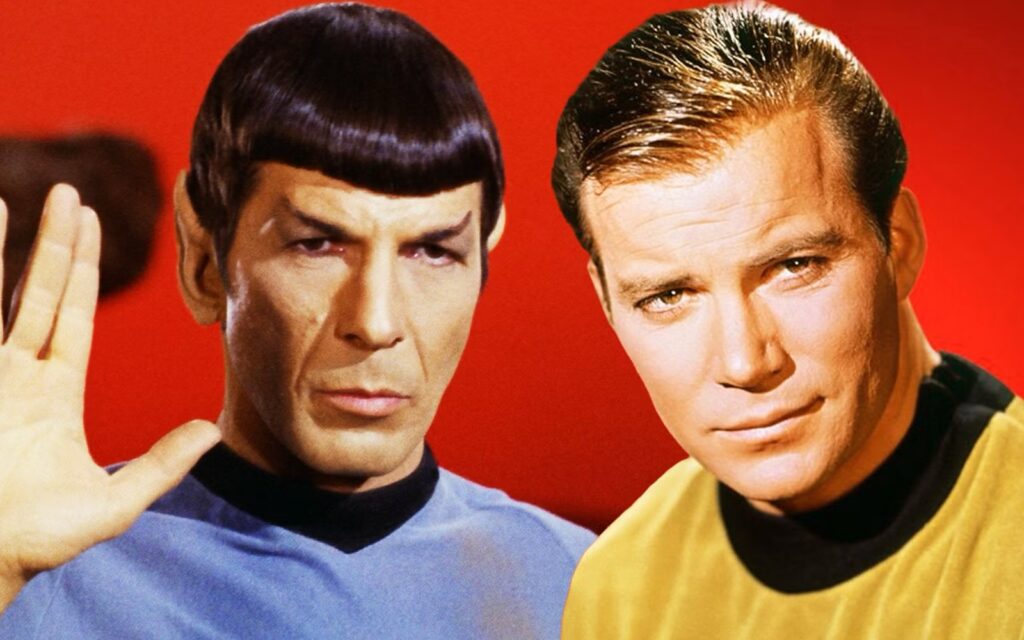
Inside this subjunctive field stands James T. Kirk.
Kirk is not game theory. He is not a calculator of equilibrium states. He is the indicative function operating correctly within a subjunctive world.
He does not deny uncertainty. He metabolizes it.
On the bridge, the subjunctive is fully articulated. Spock generates logical counterfactuals—multiple possible outcomes, competing interpretations of the same signal. Leonard McCoy introduces ethical and emotional alternatives—what if the cost of this action is unacceptable, what if the data misses the human reality.
The system is not designed to eliminate these perspectives. It is designed to stage them.
This is where Star Trek diverges fundamentally from the grammar of the modern military-industrial complex.
In a world shaped by game theory and its algorithmic descendants, the subjunctive is tolerated only as a preprocessing step. Counterfactuals are generated, quantified, and then collapsed into a single actionable output. The indicative absorbs the subjunctive and erases it.
In Star Trek, the process does not collapse so easily.
Kirk listens. He delays closure. He allows incompatible interpretations to coexist longer than a purely strategic system would tolerate. And when he finally acts, his decision is not the output of a model. It is a judgment—an irreversible commitment made in full awareness that other worlds were possible.
He does not say: this is what the move means because the model has resolved it.
He says: this is what we will do, knowing the meaning remains open.
That distinction is everything.
It is the difference between a system that treats reality as a game tending toward equilibrium and a system that treats reality as an interpretive field that cannot be closed without loss.
The Enterprise, in this sense, is not police in space. It is something far more fragile and far more advanced: a mobile institution designed to preserve the subjunctive under conditions that constantly pressure it to disappear.
Its mission—exploration rather than domination—is not a moral flourish. It is a cognitive one. It keeps the organism, in this case a civilization, exposed to novelty, ambiguity, and alternative forms of meaning.
This is exactly what a canalized system cannot tolerate.
The military-industrial complex is not simply organized around the indicative. It is organized to eliminate the need for the subjunctive altogether—to render interpretation unnecessary by stabilizing the world into a series of actionable certainties.
Star Trek imagines the opposite trajectory.
A species that has survived long enough to understand that certainty is not strength but blindness. That intelligence is not the ability to compute outcomes but the ability to remain open to meanings that have not yet stabilized. That the subjunctive is not a weakness to be engineered out of decision-making, but the very condition that makes wise decisions possible.
Kirk, then, is not the triumph of the indicative over the subjunctive.
He is what the indicative looks like after it has learned to listen.
If the American military-industrial complex has an enemy, it is not a rival power, not a terrorist network, and not even a budget deficit. Its true adversary is grammatical: the subjunctive mood.
The subjunctive is the mood of doubt, possibility, and counterfactual thinking. It asks dangerous questions: What if things were otherwise? What if events unfolded differently? What if our assumptions were wrong? It is the grammar of imagination and contingency. And it is, in the deepest sense, the grammar of biological intelligence—the cognitive tool that separates adaptive organisms from brittle ones.
The military-industrial complex, by contrast, thrives on the indicative mood—the language of certainty and necessity. The indicative says: This is happening. This must be done. This weapon is needed. It converts possibilities into inevitabilities and speculation into procurement orders. In doing so, it does not simply constrain policy. It constrains cognition itself—lobotomizing the prefrontal cortex of the body politic, removing from institutional discourse the very faculty that evolution spent millions of years constructing.
This is not a metaphor. Cognitive scientists who study organizational decision-making have documented how institutions systematically suppress counterfactual reasoning in favor of operational certainty. Committees prefer the indicative because it produces action. Bureaucracies prefer the indicative because it produces justification. Defense establishments prefer the indicative because it produces budgets. But what is lost in each case is the organism’s most sophisticated navigational tool—the capacity to hold alternative realities in mind long enough to be changed by them.
In the subjunctive world, policymakers would ask questions that destabilize the entire apparatus. If war were avoidable, would we still need the next generation of fighter aircraft? If diplomacy succeeded, what would happen to the weapons pipeline? If the enemy were misunderstood rather than implacable, would we design strategy differently?
These questions are corrosive to systems built on linear escalation. They are also, from the perspective of evolutionary biology, exactly the questions a healthy adaptive system must be able to ask.
The organism that cannot simulate failure is the organism that does not survive novelty. The species that locks into a single behavioral pathway—however successful that pathway has been—becomes catastrophically vulnerable the moment the environment shifts. Evolutionary history is a graveyard of optimized solutions to problems that stopped being the problem. The saber-toothed cat was superbly designed until the megafauna disappeared. The military-industrial complex is superbly optimized for a world of state-on-state conventional warfare in a geopolitical environment that is actively, rapidly, transforming into something else.
What would allow an institution to perceive that transformation in time to adapt? The subjunctive. The capacity to ask: if the threat landscape were changing, would our instruments still fit it? If our doctrine were premised on the wrong assumptions, what would the evidence look like? If we are optimizing for yesterday’s war, how would we know?
The American defense establishment depends on a narrative of permanence. Threats must be continuous. Rivalries must be structural. Technological competition must be relentless. In this grammar, war is not an accident but a climate. It is the weather system within which the state operates.
The subjunctive, however, introduces weather forecasts that disrupt the business model.
If the Cold War had ended more completely, perhaps NATO expansion would not have produced new antagonisms.
If the invasion of Iraq had not occurred, perhaps a generation of instability might have been avoided.
If drone warfare produces more enemies than it eliminates, perhaps its strategic logic should be reconsidered.
These are not comfortable sentences in Washington. They are sentences that imply reversibility.
Industrial systems prefer irreversibility. Once a weapons platform exists, it must be justified. Once a doctrine is written, it must be enacted. Once a bureaucracy is built, it must expand to validate its own premises. The subjunctive threatens this entire ecology because it keeps alive the possibility that things could have unfolded differently—and therefore might still be changed.
This preference for irreversibility has a name in evolutionary biology: canalization. The term describes the process by which developmental pathways become increasingly fixed, routing the organism down grooves that grow deeper with each iteration. Canalization is useful when environments are stable—it produces reliable, efficient outcomes without the metabolic cost of constant deliberation. But in unstable environments, canalized organisms are fragile. They cannot pivot. The groove that once led to food now leads off a cliff, and the organism follows it anyway, because the groove is what it knows.
The military-industrial complex is a canalized system. The groove runs from threat identification to research and development to procurement to deployment to the identification of new threats that justify the next procurement cycle. Each iteration deepens the channel. Each weapons system creates constituencies, contracts, careers, and congressional districts that make deviation from the path not merely unlikely but cognitively invisible. The groove becomes the world. The world becomes the groove.
This is why official discourse gradually eliminates subjunctive thinking. Strategic documents rarely speak in conditional terms. Instead they present a world of fixed adversaries and inevitable conflict. The language is strangely deterministic, as though history itself were a procurement requirement.
A fighter jet program cannot easily coexist with the sentence: If tensions were reduced, the aircraft might not be necessary.
The subjunctive also creates moral friction. It forces the mind to inhabit alternative histories. If this village had not been bombed… If this intelligence had been wrong… If this war had never begun…
Such sentences do not merely describe events; they reopen them. They turn closed chapters into unresolved questions. By eliminating the subjunctive from its planning, the apparatus ensures that the physical landscape—the bases, the contracts, the deployment schedules—eventually makes the subjunctive seem naive, a linguistic relic that has been overtaken by the very concrete world the indicative built.
But this is precisely what a canalized organism does. It builds a physical environment that makes its own pathway seem like the only pathway. It paves the groove. It erects walls on either side. And then it points to the walls as evidence that no other road exists.
In the modern era, the military-industrial complex has gone further than mere canalization. It has theologized it.
The development of game theory in the mid-twentieth century gave strategic planners something they had always wanted: a mathematics of inevitability. If rational actors behave predictably, if incentive structures determine outcomes, if conflict resolves toward calculable equilibria, then history is not a field of open possibilities. It is a system. It can be modeled. And what can be modeled can be optimized—which means it can also be procured.
Game theory belongs entirely to the indicative mood. It does not ask what decisions might be made. It calculates what will be made, given sufficient information about the players and the payoff structure. Doubt is not a feature of the model. It is a variable to be minimized. The subjunctive, in this framework, is not wisdom. It is noise.
The algorithmic systems that now pervade military planning are game theory’s logical heirs—and its theological fulfillment. A targeting suite that assigns an 87% probability to a threat designation is not offering a hypothesis for human deliberation. It is issuing an indicative in mathematical dress. It collapses a thousand biological subjunctives—what if he is a civilian, what if this is a funeral, what if this strike produces ten insurgents for every one it eliminates—into a single high-confidence output. The algorithm does not suppress doubt. It converts doubt into a confidence interval and then acts as though the interval were a fact.
This is canalization achieving escape velocity. The groove is no longer merely institutional—carved by contracts and constituencies and career incentives. It is now encoded. Written into the architecture of the decision system itself. The organism is no longer following the groove because it has forgotten the alternatives. It is following the groove because the groove has been mathematically certified as the correct path.
The mathematical treatment of the conditional is clarifying here. In formal logic, a statement of the form if P, then Q where P is false is called vacuously true. The premise cannot be satisfied, so the implication holds without content—it is technically valid and entirely empty. A mathematician encountering if I were you reads it this way: the premise is an impossibility, the implication dissolves, the statement yields no information. Counterfactuals are not generative in this framework. They are null.
This is precisely what the algorithmic system does to the subjunctive. When a targeting suite processes a high-confidence threat designation, the counterfactuals—if this were a funeral, if this strike produced ten insurgents for every one it eliminated, if the intelligence were wrong—are not weighed and set aside. They are processed as formal logic processes impossible premises: declared empty and discarded before deliberation begins. The algorithm does not suppress doubt. It defines doubt as a category error. A condition that cannot be satisfied in the current operational picture has no standing in the calculation. It is vacuously true and therefore irrelevant.
What biological intelligence does with exactly these counterfactuals is the opposite. The brain treats the impossible premise not as null but as a projection—a casting of the present situation into a shadow world of alternative configurations, any one of which might illuminate something the indicative has missed. The subjunctive is not a logical operation. It is a spatial one. It extends the mind’s reach into adjacent realities precisely because reality, biologically encountered, is never a closed system delivering unambiguous signals. It is a field of interpretations, and the organism that cannot project into that field has ceded the most important cognitive territory there is: the gap between what the data says and what the situation means.
To be surprised is to discover that the premise you treated as impossible was not. The vacuous truth turned out to be true. The empty set contained something. An institution that has outsourced its conditional reasoning to systems that treat counterfactuals as null has not merely become rigid. It has become, in the precise logical sense, incapable of learning from its own surprises.
The algorithmic indicative does not merely suppress the subjunctive. It replaces the biological architecture that generates the subjunctive with a system that is, at its foundations, teleological: oriented toward a predetermined output, moving through states rather than interpreting meanings, optimizing toward an end that was specified before the encounter began.
This is where the modern defense apparatus reveals its deepest grammar. It is not merely bureaucratically resistant to counterfactual thinking. It is philosophically committed to a vision of history as a system tending toward equilibrium—in which threats are structural, competition is permanent, and the arc of geopolitics bends not toward justice or peace but toward the next stable configuration of power. In that cosmology, the subjunctive is not merely inconvenient. It is heretical. It implies that the system could resolve differently. That the arc could bend elsewhere. That history is not a game being played to its necessary conclusion but a text being written by organisms who could, at any moment, choose different words.
The institutions that employ thousands of intelligence analysts, red-teamers, and scenario planners have not escaped this theology. They have merely assigned it a room. The subjunctive workers are permitted to imagine, but only as a service to the indicative—their doubt converted into a PDF, their counterfactuals flattened into a risk assessment, their imagination processed and filed and superseded by the budget cycle. They are the bridge crew without the captain who listens. Spock calculates. McCoy objects. And the targeting suite fires anyway.
The indicative does not hold this position for long. It is already becoming the imperative.
The indicative at least gestures toward reality as its warrant. It makes a claim. It asserts. It says: this is true, therefore this must be done. The justification and the command arrive together, and between them there is still, technically, a gap—a space where the claim could be contested, the warrant examined, the necessity disputed. Early Cold War doctrine still argued. It made cases, cited threats, justified expenditure. The indicative was doing its grammatical work: converting the world into sentences that could, in principle, be answered with other sentences.
That gap has been closing for decades. What the algorithmic-teleological system completes is its elimination. When the targeting suite fires, it does not issue an indicative. It issues an imperative with an indicative mask. The 87% confidence interval is the last vestige of the claim—the institutional fiction that a fact is being stated rather than a command executed. Underneath it, the grammar has already shifted. The sentence is not this is a target. The sentence is engage.
The imperative requires no warrant. It does not argue. It does not convert possibility into necessity through the pressure of evidence. It simply commands—and the machinery, already canalized, already theologized, already incapable of processing counterfactuals as anything other than null, executes. The subjunctive was the first casualty. The indicative was the collaborator. The imperative is what remains when the collaboration is complete: a system that has automated its own moral abdication so thoroughly that no one in the chain is issuing an order, and no one is receiving one. The command is simply happening, the way weather happens, the way the groove deepens—because that is what the system does, because that is what the system is.
A civilization that began by stigmatizing its own conditional grammar has arrived, by perfectly logical steps, at a military apparatus that no longer needs to speak at all.
Evolution, however, is ruthless about systems that mistake their models for reality. The canalized organism that also believes its groove is cosmically ordained is not merely fragile—it is incapable of recognizing its own fragility. It has removed from its cognitive architecture the very instrument that would allow it to detect the cliff before reaching the edge.
The subjunctive is therefore not merely a grammatical form or a political preference. It is a small but radical act of biological fidelity. It interrupts the machine logic of inevitability. It restores to the brain the function the brain was built to perform: to hold the world as it is alongside the world as it might otherwise be, and to navigate the distance between them.
It insists, against the algorithm and against the doctrine, that meaning is not delivered. It is made. That history is not a system tending toward equilibrium. It is a field of interpretations, any one of which might, at any moment, be revised.
The military-industrial complex depends on the disappearance of that field. It prefers a highway where every mile marker leads to the next weapons system, the next strategic doctrine, the next budget cycle.
But language remembers. And underneath language, biology remembers longer still.
The subjunctive quietly insists that the road could have turned left instead of right.
And once a society begins speaking in that grammar again—if things were otherwise, if another path existed, if peace were possible—the great machinery of inevitability begins to look less like destiny and more like a set of choices.
For an empire built on the assumption that its trajectory is unavoidable, that is a dangerous sentence indeed.
And for a species whose survival has always depended on imagining what hasn’t happened yet—it may be the most necessary sentence of all.
Leave a Reply