I went to the movies expecting escape. That was my first mistake.
The ticket app said the film was playing at 7:40. It had been playing all week. People were dressed for it—like a minor holiday, a secret handshake. Leather jackets, ironic denim, that look of mutual recognition you get when strangers agree they’re here for something specific. Something not algorithmic.
But when I reached the lobby, the screens were wrong.
Every digital marquee blinked the same thing back at me, over and over, like a hostage note written in Helvetica:
MELANIA
MELANIA
MELANIA
Documentary. Feature presentation. Special engagement.
No times listed for anything else. No explanation. No apology.
I checked my phone. I checked the theater number. I checked my pulse. Same result. The movie I’d come to see had vanished like a bad memory after a court order.
The woman next to me—mid-fifties, holding a large Diet Coke like a defensive weapon—noticed it too.
“What the hell?” she said, not quite to me but in my general direction. The universal human need to confirm shared reality when reality stops making sense.
“You seeing this?” I asked.
“I’m seeing it. I don’t believe it, but I’m seeing it.”
We had become allies in that instant, the way strangers do during natural disasters or surprise inspections. Trauma bonding in the snack line.
The crowd noticed slowly. Confusion spread in ripples. People in the right clothes—the ones who’d read reviews, who’d planned their Friday night around a specific piece of art—began looking at one another like survivors of a canceled flight. Someone asked an usher what happened.
The usher, maybe nineteen, wearing a vest that said “Guest Experience Ambassador,” blinked at us like we were speaking Aramaic.
“This is what’s playing,” he said.
Not today. Not tonight. Not due to unforeseen circumstances. Just—this is what’s playing. A statement of fact, like gravity or death or the terms of service you didn’t read.
“What about the movie that was here yesterday?” someone asked. Reasonable question. Civilian question.
“Not on the schedule.”
“But it was. I checked this morning.”
The kid shrugged with the supreme indifference of someone who makes $17 an hour and has no stock options in reality itself. “System says this is what we’re showing.”
The System.
I’d heard that phrase before. 2018, maybe 2019, when Netflix started pulling entire seasons of shows without announcement. Just—gone. Erased. Memory-holed. No farewell tour, no Last Chance to Watch banner. One day it’s there, the next day it never existed, and your Continue Watching queue becomes a graveyard of amputated narratives.
Or 2022, when HBO Max became just Max and dozens of finished films—finished films, wrapped, scored, ready to screen—were deleted for tax purposes. Batgirl, a $90 million superhero movie, executed in spreadsheet silence so a merger could claim a write-off.
The term they used was “content removal.”
Content. Like it was drywall. Like it was insulation. Something structural you could rip out to improve the property value.
But this—this was different. This wasn’t a streaming service burying something in its own catalog. This was physical space. This was 900 theaters, coast to coast, cleared like a hostile boardroom. Every screen showing the same thing.
I started doing the math. Badly, because I’d had two IPAs at the brewery next door and one edible that I thought was 5mg but the package said 10mg and I’ve never been good at reading labels under pressure.
But even half-dissolved, I could see it: This wasn’t a movie premiere. This was a display of power. A demonstration. The cultural equivalent of rolling tanks through the capital at 3 a.m.—not to fight a war, but to make sure everyone knows you could.
The Diet Coke woman was scrolling her phone. “It’s everywhere,” she muttered. “People on Twitter are saying the same thing. New York, Atlanta, Chicago. Every AMC.”
“AMC,” I repeated, like the letters meant something occult.
She looked at me. “You okay?”
“Define okay.”
“You’re sweating.”
I was. The lobby had started to shimmer at the edges, the way asphalt does in August. The candy display became a wall of color and sugar and cellophane, grotesque in its abundance. Buncha Crunch and Sour Patch Kids and Reese’s Pieces, American diabetes in industrial packaging. The popcorn machine rumbled like a generator. The butter dispenser—Jesus, the butter dispenser—hung there like an IV drip for a nation that can’t stop eating its own heart.
I leaned against the wall. Tried to focus.
“You need to sit down?” she asked.
“I need to understand what’s happening.”
“What’s happening,” she said, with the calm of someone who’s lived through enough bullshit to recognize a new flavor, “is that someone paid to make sure we’re all watching the same thing tonight.”
We wandered the hallway like refugees from a film that no longer existed. Posters had been pulled down so recently you could still see the clean rectangles on the wall, ghost outlines of movies that had offended someone with a bigger wallet. Or someone with a phone call. Or someone with both.
Every theater door was open. Every screen identical. Melania Trump, frozen mid-gesture in the same documentary frame, the faint smile of a woman who has never had to explain anything to anyone. Poised. Immaculate. A face engineered for lack of friction.
It felt coordinated. Militarized. Like the cineplex had been seized overnight by a soft-focus junta wearing Hermès and offering no comment to the press.
People were filing in now. Not eagerly. Not even reluctantly. Dutifully. Like citizens attending a ceremony they hadn’t voted for but didn’t want to miss, because what if something happened and they weren’t there to say they saw it?
Conditioning is powerful when it comes with surround sound and assigned seating.
I remembered 2017. The Fyre Festival documentaries. Two of them, released within days of each other—Netflix and Hulu both racing to tell the story of a scam, as if the speed of the telling mattered more than the truth of it. Competing narratives about the same disaster, like rival intelligence agencies.
Or 2020, when every platform scrambled to produce a documentary about [insert crisis here], and the subject didn’t matter as much as the speed and the reach and the SEO dominance. Content as conquest. Storytelling as territorial expansion.
But this was different.
This wasn’t two platforms competing. This was one platform eliminating competition. Not by making a better product, but by buying every seat in the house and bolting the doors.
I thought about Amazon. The company that owns MGM now. The company that streams movies and sells you the TV to watch them on and the couch to sit on and the snacks to eat and probably, soon, the house itself. Vertical integration as a philosophy of life.
And I thought about how much it would cost to book 900 screens for a single night.
Not much. Not to them. Pocket change. A rounding error on a quarterly earnings call.
The real question was why.
The Diet Coke woman had disappeared. I didn’t see her leave. Maybe she went into one of the theaters. Maybe she evaporated. At this point I wasn’t ruling anything out.
I was alone now in the hallway, staring at a life-size standee of Melania. Towering. Untouchable. Photographed in that specific kind of light that makes people look like they’ve transcended the need for oxygen.
The tagline read: Her Story. Her Voice.
I started laughing. Couldn’t help it. The kind of laugh that comes out when the alternatives are worse.
Her voice? The woman who’d barely done an interview in eight years? Whose entire public existence was a masterclass in strategic silence?
But that was the point, wasn’t it? The voice wasn’t hers. It was about her. Narrated at her. A story she didn’t have to tell because someone else would do it for her, with better lighting and a licensed soundtrack.
I felt the edible kick in harder. The walls began to breathe.
The fever hit in waves now.
Not metaphorical. Not poetic. Actual fever. My skin felt like it was two sizes too small. The carpet rippled like bad water, patterns repeating and folding into themselves, paisley fascism.
I had the sudden, horrifying sense that I might be in a place where movies are not chosen but assigned. Where culture arrives by mandate and disappears by compliance. Where the algorithm isn’t a recommendation engine but a deployment system.
Was this America?
Or some premium-tier variant where content is governance and governance is content, and the difference between entertainment and propaganda is just a question of production value?
I leaned against the wall. Tried to think.
2021. That’s when I first noticed it.
Not the big stuff—the coups and the insurrections and the viral videos of democracy eating itself in real time. That was obvious. That was on every screen, every feed, every push notification.
No, I noticed it in the small stuff. The way entire cultural moments would appear and vanish like mayflies. A hashtag would trend, a movement would coalesce, and then—nothing. Erased. Banned. Demonetized. The digital landscape rearranged overnight, and if you weren’t paying attention, you’d swear it never happened.
I started screenshotting things. Saving receipts. Because I’d learned by then that they change the past. Not dramatically. Not all at once. Just—quietly. A tweet deleted here. A video made private there. An article updated with no timestamp, no correction, just a silent edit that makes you feel crazy for remembering it differently.
Gaslighting at scale.
And now here it was in physical space. The same tactic. The same erasure.
A movie—multiple movies—wiped from the schedule. Not because they were bad. Not because they failed. But because someone wanted this screen instead. Wanted your attention. Wanted your Friday night. Wanted to make sure that when you left your house to see something, you saw this.
The previews had started in Theater 9. I could hear them through the door. Not trailers for other films—just a brief Amazon logo, looming and casual, like a watermark on reality itself.
Then the documentary began.
I didn’t go in. Couldn’t. My legs wouldn’t move.
I stood there in the empty hallway, listening to the muffled sound of orchestral score and authoritative narration, and I realized:
The real movie had already played.
The one where 900 screens were cleared without a press conference.
Where a distributor took the loss so a platform wouldn’t have to explain itself.
Where the audience dressed for one story and was handed another—no refunds, no questions, no alternate endings.
Where dissent looked like leaving early, and compliance looked like staying in your seat because at least the AC works and you already paid for parking.
I don’t know how long I stood there.
Long enough for my phone to die. Long enough for the edible to plateau into a low-grade paranoia that felt less like intoxication and more like clarity.
When I finally moved, it was toward the exit.
The lobby was emptier now. A kid was sweeping popcorn into a pile. The butter dispenser still dripped. The marquee still blinked:
MELANIA
MELANIA
MELANIA
I took a wrong turn somewhere between Theater 9 and the exit.
That shouldn’t be possible. Modern multiplexes are designed like casinos—all sight lines leading back to concessions, to the lobby, to the parking lot. You’re never more than two turns from spending money or leaving. The architecture is hostile to getting lost.
But the edible had kicked into a new gear, and the hallway I was in didn’t look like the hallway I’d entered from. The carpet was different—older, a pattern that predated the current corporate branding. The walls were that specific shade of mauve that only existed in the early ’90s, when someone in a regional office decided “plum” was the future.
I should have turned back.
I didn’t.
The hallway curved. Narrowed. The overhead lights were dim, some of them flickering in a way that suggested deferred maintenance or deliberate atmosphere. Hard to say which.
Then I heard it: voices.
Not the muffled score of a movie. Not the rustle of an audience settling in. Conversation. Clear, polite, the cadence of people who know each other. A social gathering.
I followed the sound to a door marked Theater 14.
Which was impossible. This multiplex only had thirteen screens.
The door was cracked open. Warm light spilled out. I could smell coffee—good coffee, the kind that comes from an urn with actual ceramic cups, not the burnt sludge from the lobby machines.
I pushed the door open slowly.
The theater was small. Sixty seats, maybe. Old-style seating—no recliners, no cupholders, just rows of burgundy velvet that had seen better decades. The screen was blank, glowing pale gray like a canvas waiting.
And the audience—
Jesus Christ, the audience.
Twenty, maybe thirty women. All of them white. All of them dressed like they’d just come from a luncheon at a country club that doesn’t put its name on a sign. Pastel cardigans. Tasteful pearls. Hair styled into shapes that required standing appointments. They held coffee cups and programs printed on heavy cardstock.
At the front of the theater, near the screen, a woman stood at a small podium. Mid-sixties, blonde highlights, the kind of smile that’s been practiced in front of a mirror until it looks unrehearsed.
“—so grateful you could all make it tonight,” she was saying. “I know some of you had to drive quite a distance, but I think you’ll agree that this particular film deserves to be seen in community. With women who understand what we’re preserving.”
Murmurs of agreement. Nodding heads.
I stood frozen in the doorway, half-hidden in shadow.
The woman at the podium consulted her notes. “As you know, the Culvert City chapter of Republican Wives has been committed to film preservation and cultural education since our founding in 2017. Tonight’s selection is a particular triumph—both aesthetically and, dare I say, philosophically.”
My stomach dropped.
She clicked a remote. The screen flickered to life.
Black and white. Eagles. Columns. Torches.
Triumph of the Will.
I need to be clear about what happened next, because even now I’m not sure I believe it.
I should have left. Should have backed out of that door, walked very quickly to my car, and driven home to rethink every choice that led me to a suburban multiplex on a Friday night in 2026.
But I couldn’t move.
Not because I was paralyzed with fear—though there was some of that—but because I was trying to understand. Trying to make the math work.
This wasn’t some secret neo-Nazi gathering. These weren’t skinheads or militia types or Proud Boys in tactical gear. These were Republican Wives of Culvert City. The program in the nearest seat said so, printed in a cheerful serif font with a little American flag in the corner.
They were treating this like a book club.
Like Leni Riefenstahl was Eat Pray Love.
The film began. The orchestral score swelled. On screen: clouds, light, the Nuremberg rally assembling itself like a religious vision.
The woman at the podium—her name tag said JENNIFER – PRESIDENT—settled into a front-row seat, coffee cup in hand.
I heard someone whisper: “The composition is just stunning.”
Someone else: “You can see why it won awards. Regardless of… well. You know.”
Regardless.
That word hung in the air like a grenade with a faulty pin.
I was backing toward the door—slowly, carefully, trying not to make a sound—when there was a commotion at the front of the theater.
The side door—the emergency exit, the kind that’s supposed to be alarmed but never is—opened.
Two men entered first. Dark suits. Earpieces. The posture of people trained to scan rooms and calculate threat levels. Secret Service. Had to be.
Behind them: her.
Melania Trump. In person. In the flesh. In a cream-colored coat that probably cost more than my car.
The room erupted.
Not with screams or chaos—with delight. Polite, contained delight. The kind of excitement that women of a certain class have been trained to express in modulated tones. Gasps. Hands to chests. One woman actually curtsied.
Jennifer the President rushed forward, program still in hand, suddenly flustered in a way the podium hadn’t made her.
“Mrs. Trump! We—we had no idea—this is such an honor—”
Melania’s coat—the one I thought was cream-colored—wasn’t cream at all.
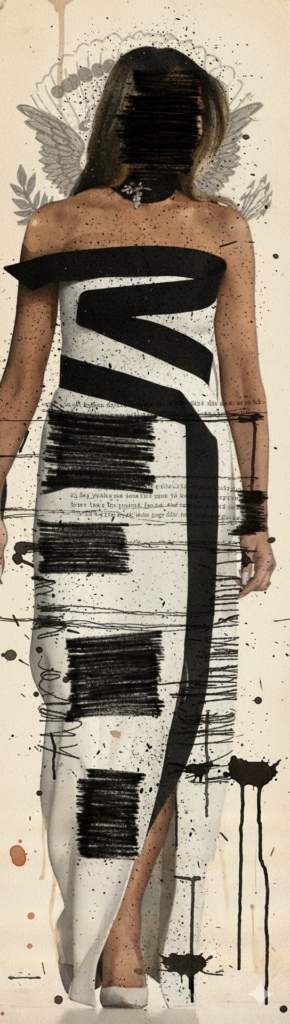
As she moved through the light from the projector, I could see it clearly: white. Stark white. And across it, horizontal bars of black fabric. Thick stripes running across the chest, the waist, the hem. Geometric. Precise. Like redaction marks on a document.
Like the black bars across declassified files.
Like the lines drawn through names in the Epstein files when they finally released them—hundreds of pages, thousands of pages, with whole paragraphs blacked out. Whole identities disappeared under bars of ink. Not erased, exactly. Just… obscured. Still there underneath. You knew something was there. You just weren’t allowed to see it.
The dress was exactly that pattern.
I don’t know if it was intentional. I don’t know if some designer thought it was clever or if Melania herself understood the symbolism or if it was just the kind of coincidence that stops being coincidence when it happens at this altitude of power and wealth.
But watching her move through Theater 14 in that dress—past the women who’d paid for the privilege of watching Triumph of the Will in community, past the Secret Service men who’d calculated the threat level of a room full of pearls and cardigans and found it acceptable—I couldn’t unsee it.
The redaction dress.
The I-was-never-here dress.
The dress that said: There are things you know, things you suspect, things you’ve read about in documents with half the words blacked out, and I don’t owe you an explanation. I don’t owe you anything. I’m just passing through, preserved in white and black bars, untouchable, un-deposable, a photograph with the important parts removed.
She paused for just a moment near the screen—Riefenstahl’s clouds and eagles projected behind her like a backdrop, like set dressing—and the bars across her dress aligned almost perfectly with the light and shadow of the film.
For a second, she was the redaction.
Standing there. Smiling. She said something I couldn’t hear. Her voice was low, accented, barely audible over the orchestral score still playing from the screen behind her.
Jennifer nodded vigorously. “Of course, of course. We’re just—we’re just about to start. Would you like to—”
One of the Secret Service men leaned in. Whispered something.
Melania’s smile didn’t change, but something in her posture shifted. She glanced at the screen—at the eagles, the columns, the torches—and for just a moment, I swear I saw something flicker across her face.
Not disapproval.
Not approval either.
Just… recognition.
The look of someone seeing their own reflection in a mirror they didn’t know was there.
Then she was moving. The Secret Service men flanked her, efficient and silent. They guided her toward the far exit—not the door I’d come through, but another one, deeper in the theater, one I hadn’t noticed before.
“Thank you so much for coming,” Jennifer called after her. “This means the world to our chapter—”
But Melania was already gone. Through the door. Into whatever hallway or passageway or alternate dimension existed beyond Theater 14.
The door closed.
The women in the audience sat down again, buzzing with excitement. Someone said, “Did you see her coat?” Someone else: “I got a picture—did anyone else get a picture?”
On screen: Nuremberg. Flags. Crowds moving in geometric precision.
I stood there, paralyzed, trying to process what I’d just seen.
A hand grabbed my wrist.
I jumped, turned.
The Diet Coke woman. She’d appeared out of nowhere—or maybe she’d been behind me the whole time and I was too high to notice.
“Wrong theater,” she hissed. “Come on. Now.”
She pulled me backward, out into the hallway, and shut the door firmly behind us.
We stood there in the mauve corridor, both of us breathing hard.
“What the fuck,” I said.
“That,” she said, “is a very good question with a very bad answer.”
“Was that—did I just see—”
“Yes.”
“And those women—”
“Yes.”
“And the movie—”
“Also yes.” She still had her Diet Coke. She took a long drink, like she needed the caffeine to deal with this conversation.
We didn’t speak again until we reached the lobby.
The marquee still blinked: MELANIA MELANIA MELANIA.
She finished her Diet Coke. Tossed it in the trash.
“Go home,” she said. “Write it down if you want. Tell someone if you think they’ll listen. Or don’t. But don’t come back here. And don’t pretend you didn’t see what you saw.”
“Where are you going?” I asked.
She smiled. Sad and tired and far too knowing.
Then she walked away, back toward the mauve hallway, back toward Theater 14.
I called after her: “Wait—what’s your name?”
She didn’t turn around.
My car was exactly where I’d left it.
I got in. Started the engine. Sat there with my hands on the wheel.
And I thought: This is how it happens.
Not with broken glass and jack boots.
But with programs printed on cardstock and coffee served in ceramic cups and special guest appearances that feel like validation instead of what they actually are.
A crossing. A threshold. A moment where culture and power and aesthetics all converge, and you don’t even realize you’ve chosen a side until you’re already in your seat, and the lights are down, and walking out would be rude.
I stood there for a long moment, hand on the door to the parking lot, trying to decide if I should follow her.
I didn’t.
I pushed through the doors. Into the night. Into the cold air that felt real and thin and provisional, like it could be edited at any moment.
Later, in the car, I’d try to Google it. “Melania white dress black stripes Culvert City.” “Melania redaction dress.” “Melania Epstein pattern.”
Nothing.
No photos. No gossip column mentions. No fashion blog breakdowns.
Like it never happened.
Like I’d imagined it.
But I hadn’t.
I’d seen it.
And the Diet Coke woman had seen it too.
And somewhere in that theater, at least one of those Republican Wives had taken a picture—I’d heard the phone camera click—and maybe that photo was already deleted, or maybe it was sitting in a private group chat with a caption like “You’ll never believe who stopped by!” followed by three American flag emojis.
Or maybe it was already being scrubbed. Reported. Disappeared under some provision of some agreement signed in some lawyer’s office with bars across every page that mattered.
The dress said it all.
You saw me. But you didn’t. And even if you did, who’s going to believe you?
I drove home in silence.
The whole way, I kept checking my rearview mirror.
Not for cars.
For black SUVs with tinted windows.
For Secret Service sedans.
For proof that what I’d seen was real and not just the drugs talking.
But the road behind me stayed empty.
And somehow, that was worse.
Somewhere out there, the movie I came to see was still playing. Maybe on a smaller screen. Maybe in a city I’d never heard of. Maybe only in my memory, which is the last theater they haven’t figured out how to buy.
Not yet.
But they’re working on it.
I could feel them working on it.
And the worst part—the part that kept me sweating all the way home—was that I couldn’t tell anymore if I was paranoid or just paying attention.
In 2026, those feel like the same thing.
Leave a Reply