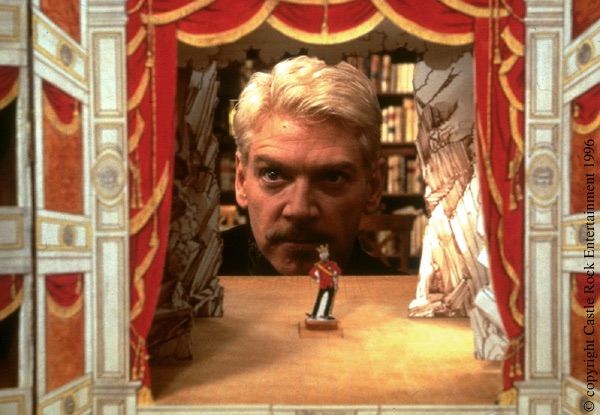
The First Simulation
In Hamlet, the play‑within‑the‑play—The Mousetrap—is not merely theatrical flourish. It is an early and remarkably precise form of simulation: a model constructed for the purpose of generating a controlled response from a system that cannot be directly interrogated.
Hamlet’s epistemic problem is specific. The ghost’s testimony is unverifiable. Claudius will not confess. The court is a closed system of performed loyalties and deliberate surfaces. Direct inquiry is both dangerous and structurally unavailable. So Hamlet does something more sophisticated than confront—he engineers a stimulus designed to produce an involuntary output.
He constructs a model of the alleged crime and embeds it in a performance Claudius cannot avoid witnessing. The logic is almost algorithmic in its precision: If the simulation is accurate enough,reality will betray itself.
This is mise en abyme in its most functional, least decorative form: an embedded structure used not for self‑referential pleasure, but for interrogation. The inner play is a probe. Claudius’s reaction is the data.
But the method depends on a layered set of assumptions that Shakespeare does not quite make visible—because in 1600, they don’t need to be made visible. They are simply true.
First: that the crime was real and leaves residue in the criminal’s nervous system. Second: that the criminal’s response is not itself a performance—that beneath Claudius’s court behavior there exists a stratum of involuntary reaction that the simulation can access. Third, and most foundational: there exists a stable truth outside the simulation. A murder happened. A body was found. A king is dead. These facts are not constructed by the Mousetrap. They precede it.
The Mousetrap works—it produces exactly the flinch Hamlet was hoping for—but only because something real remains to be exposed. The simulation reveals rather than constitutes. This is both its power and, as we will see, a feature of the world it inhabits that will not survive the centuries ahead.
The Abyss Expands
Between Shakespeare and the twentieth century, mise en abyme mutates across three centuries of literary experiment—and the mutation is not merely formal. Each transformation corresponds to a deepening uncertainty about what, if anything, the embedded structure can still reach. What begins as a probe directed at a pre‑existing truth becomes, by the twentieth century, a machine that generates the truth it appears to discover.
Don Quixote: The Instability of Authority
Cervantes does not simply tell a story; he performs an elaborate act of mediation that makes the act of telling inseparable from the question of who has the right to tell. The novel presents itself as a translation from an Arabic manuscript by the Moorish historian Cide Hamete Benengeli, whose reliability is mocked even as his authority is invoked. The narrator interrupts, doubts, and occasionally pretends to find missing fragments in a marketplace. The result is not merely a story with an unusual frame but a structure in which no single level can claim final authority over the others.
The recursive embedding here serves a specific epistemological purpose. Cervantes is not using mise en abyme for decorative self‑reference; he is using it to ask: what does it mean to authorize a narrative? The layers do not simply reflect one another—they argue. The fictional translator’s notes comment on the fictional historian’s unreliability; the first‑person narrator comments on both; and Quixote himself, inside the fiction, encounters characters who have read the first volume of the very book we are reading. The recursion becomes a mechanism for destabilizing origins. There is no original story, only a chain of mediations, each asserting a different kind of claim on the material.
Crucially, Cervantes preserves a distinction between the world of the narrative and the world of its telling—but he makes that distinction increasingly difficult to locate. The question the novel asks is no longer what is true but who has authority to say. The layers are not mirrors; they are competing jurisdictions. Authority is not denied—it is dispersed, contested, and, in the end, revealed as a function of position within the structure.
Frankenstein: Truth Becomes Positional
Shelley takes the recursive structure further. Frankenstein is built as a series of nested narratives: Walton’s letters to his sister contain Victor Frankenstein’s confession, which contains the creature’s autobiography, which briefly contains the De Laceys’ story as witnessed from a hovel. Each layer embeds the next, and each is presented as a first‑person account.
The effect is not merely formal. Shelley uses the nested structure to make truth positional—to show that what you know depends on where you sit in the structure. Walton hears Victor; Victor heard the creature; the creature observed the De Laceys. Each narrative refracts the others, and no single account can stand as the final, objective version of events.
This becomes clearest in the confrontation between Victor’s account and the creature’s. Victor presents himself as a tragic overreacher, the creature as a monstrous ingrate. The creature’s self‑narration—eloquent, suffering, rigorously logical—does not merely supplement Victor’s; it indicts it. We are forced to hold both accounts in mind simultaneously, and in that suspension, Shelley achieves something new: the sense that there is no view from nowhere. Truth is not a stable object awaiting discovery; it is distributed across positions, each partial, each self‑serving, each revealing something the other occludes.
The nested structure thus becomes a way of staging the problem of perspective. There is no unmediated access to events. Every telling is a situated telling. Shelley does not conclude that there is no truth—the creature’s suffering is real, Victor’s guilt is real—but she shows that truth can only be approached through a structure of competing testimonies. The Mousetrap, in this telling, would not provoke a single flinch; it would provoke as many interpretations as there are observers.
Pale Fire: The Apparatus Consumes Its Object
With Nabokov’s Pale Fire, the recursive structure takes a darker turn. The novel consists of a 999‑line poem by the fictional poet John Shade, followed by a sprawling commentary by the fictional scholar Charles Kinbote. The relationship between text and commentary is ostensibly one of service: the commentary is meant to illuminate the poem.
But what actually happens is colonization. Kinbote’s commentary does not illuminate Shade’s poem—it annexes it. He reads the poem as a disguised account of his own delusional fantasy about the exiled king of a country called Zembla. Every line of Shade’s austere, personal meditation on death and memory is twisted to fit Kinbote’s narrative. The apparatus of interpretation overwhelms the text it claims to serve.
Nabokov is doing something precise here: he is showing that the machinery of mediation can achieve complete capture of its ostensible object. The inner layer—the commentary—does not reflect the outer layer; it consumes it, hollows it out, and replaces its meaning with another. By the end of the novel, we know more about Kinbote than about Shade. The poem has become a pretext, its original meaning irretrievable under the weight of its interpreter’s obsessions.
This marks a significant mutation in the mise en abyme tradition. In Cervantes, authority was dispersed but still in play. In Shelley, truth was positional but still accessible through juxtaposition. In Nabokov, the embedded structure no longer mediates—it devours. The simulation (Kinbote’s interpretation) does not reveal or refract the original (Shade’s poem); it replaces it. We are left with a structure that has collapsed inward, leaving no stable text outside the commentary to which we can appeal.
If on a winter’s night a traveler: Closure as Structural Impossibility
Calvino completes the movement by eliminating closure as a structural possibility. The novel is framed as a reader’s attempt to read a novel called If on a winter’s night a traveler, only to discover that the book is defective. Each attempt to continue leads to a new beginning—a new embedded narrative, each broken off after a chapter. The reader (and we, the readers of Calvino’s novel) encounters ten different beginnings, each a fragment of a genre novel (spy thriller, erotic romance, existential detective story), none of which completes.
The recursive structure here is no longer a nested hierarchy but a horizontal chain of deferrals. Each embedded narrative promises resolution and delivers only another beginning. The structure does not reflect a stable center; it generates the experience of almost‑meaning, of proximity to a coherence that never arrives. The novel becomes a machine for producing that experience—a system that refuses completion not as failure but as constitutive principle.
Calvino’s achievement is to show that mise en abyme can be turned from a spatial structure (inside/outside, frame/embedded) into a temporal one (promise/deferral). Narrative itself is reconceived as infinite regress. There is no final frame, no ultimate authority, no place where the story can be said to have actually happened. There is only the relentless forward motion of the attempt to reach an ending that never comes.
The Thread of Erosion
Across these four transformations—Cervantes’s dispersed authority, Shelley’s positional truth, Nabokov’s consuming apparatus, Calvino’s perpetual deferral—one assumption erodes steadily and without ceremony:
That there is a stable reality beneath the structure—something the structure reflects, however imperfectly.
Don Quixote still assumes a real world against which the knight’s madness can be measured, however mediated the telling. Frankenstein still insists on the brute fact of the creature’s body and the ice of the Arctic. Pale Fire gives us Shade’s poem as a ghostly anchor, even as Kinbote drowns it. Calvino gives us only fragments and the reader’s thwarted desire.
What begins as Shakespeare’s confidence that the Mousetrap reveals an already‑existing truth ends, by Calvino, as the suggestion that there may be no truth prior to the telling—only an infinite series of tellings, each deferring the moment when we could say, with Hamlet, “The king has flinched.”
Borges and the Vanishing Frame
With Jorge Luis Borges, the erosion becomes explicit and systematic. The recursive structure no longer exists within reality; it replaces it. The boundary between original and copy, between map and territory, between the text and what the text describes, ceases to be a stable distinction.
In “The Garden of Forking Paths,” a novel‑within‑the‑story is also a labyrinth, also a theory of time, also the plot of the spy thriller that contains it. The layers are not hierarchical—each level is also secretly all the others. In “Tlön, Uqbar, Orbis Tertius,” a fictional encyclopedia gradually reorganizes the real world in its own image. The representation does not merely describe a territory—it colonizes one. In “Pierre Menard,” authorship and originality collapse into paradox: the same words, rewritten centuries later with full knowledge of the original, constitute a different text with a different meaning.
Borges is working at the conceptual limit of mise en abyme. He is not merely showing that the embedded structure distorts or mediates or consumes its object. He is showing that there is no longer a clear outside for the inside to reflect. Worlds behave like texts: they branch, they are contingent, they are produced by acts of attention and description. The distinction between discovering a structure and inventing it loses coherence.
Yet Borges still leaves a trace—a sense, carried as unease through even the most formally hermetic of the stories, that something has been displaced. That the dizziness the reader feels is the dizziness of absence, of a floor that was supposed to be there and isn’t. His fictions grieve what they dissolve, even as they dissolve it with perfect composure. That elegiac residue matters. It marks where the floor used to be.
Pynchon: Feedback Becomes Fate
With Thomas Pynchon, recursion stops being a formal or philosophical problem and becomes operational. The loop does not merely confuse epistemology—it begins to organize causality.
In The Crying of Lot 49, Oedipa Maas’s investigation of the Tristero is a pursuit that may be producing its own evidence. The pattern she discovers might exist independently of her search—or it might be a pattern her search imposes on noise, or it might be a pattern constructed deliberately by parties unknown to produce exactly the paranoid interpretation she arrives at. Pynchon does not resolve this. He constructs a narrative engine that keeps all three possibilities simultaneously live, and the effect is not ambiguity in the soft sense but something more structurally precise: a situation in which the observer’s methodology cannot be separated from the observation.
Gravity’s Rainbow takes this further, into the zone where prediction begins to shape outcome. The V‑2 rocket trajectory that precedes the sound of its own explosion—arriving before it announces itself—becomes the novel’s central figure for a world in which effect precedes cause, in which the system generates, in advance, the signals that will appear to reveal it after the fact. Pointsman’s behaviorism, Slothrop’s hypersensitivity, Blicero’s death‑mysticism: each is simultaneously a way of reading the war and a way of being consumed by it. The interpretive framework is not separable from the thing being interpreted.
The shift is decisive, and it is worth stating precisely:
The system generates the signals that appear to reveal it.
This is no longer mise en abyme as aesthetic structure—an inner mirror held up to an outer reality. It is feedback as environment. The recursion has moved from the library to the causal structure of events. What Hamlet used as a probe to expose a pre‑existing truth has become something else: a loop in which the probe participates in constructing what it appears to find.
Baudrillard: The End of the Original
Jean Baudrillard takes the Pynchon condition and converts it into a systematic account of how contemporary reality operates.
In Simulacra and Simulation, representation passes through four phases. First it reflects a basic reality. Then it masks and perverts that reality. Then it masks the absence of basic reality. Finally—and this is the phase Baudrillard argues we now inhabit—it bears no relation to any reality whatever. It is its own pure simulacrum: a copy without an original.
The map precedes the territory.
This is not a claim about individual acts of deception or illusion. It is a structural claim about how sign systems now operate. The Gulf War did not take place, Baudrillard infamously argued—not because nothing happened, but because the event was produced and consumed as a media simulation prior to and independently of whatever physical events accompanied it. The simulation was not a representation of a war. It was the war, in every sense that mattered to the systems through which the population processed it.
The implications are stark. There is no stable origin to recover, no external reference to appeal to, no baseline reality that precedes and grounds the circulating representations. Ideology critique in the traditional sense becomes unavailable, because ideology critique requires a false consciousness that could in principle be corrected by contact with a real it distorts—and Baudrillard’s argument is precisely that this corrective real is no longer accessible or perhaps no longer existent.
The Mousetrap no longer reveals a hidden king.
It produces the only king that exists.
The Black Box and the Continuous Loop
The next mutation is less a philosophical shift than an engineering condition—but its philosophical implications are significant and underexamined.
A black box system exposes inputs and outputs. It conceals internal logic. This is not new as a concept. Black box thinking has existed in engineering and cybernetics for decades as a practical methodology: you don’t need to know how the system works internally if you can characterize its input‑output behavior reliably enough to use it. The postal system is a black box. The financial system is a black box. So, in most practical senses, is the human brain.
What is new is the scale, the stakes, and the specific character of the opacity.
Modern large‑scale computational systems—recommendation engines, credit scoring systems, language models, fraud detection systems, content moderation systems—operate under conditions of opacity that differ from earlier black boxes in kind, not just degree. Earlier black boxes were opaque to users but in principle transparent to designers. The telephone system’s users don’t know how it works, but Bell engineers do. Contemporary AI systems introduce a further step: the system produces outputs through processes that are not fully interpretable even to their creators. The weights of a neural network encode a kind of distributed, sub‑symbolic knowledge that resists human‑readable explanation. You can observe what the system does. You cannot fully read why.
This changes the recursive structure again, and the change is not merely technical:
The system not only simulates reality—it cannot fully explain its own simulations.
The simulation is now doubly enclosed. It is sealed from users by design, from creators by complexity, and from conventional interpretive methods by the distributed, emergent character of how it produces outputs. Opacity replaces interpretability not as a temporary condition awaiting better tools, but as a structural feature of how these systems work.
The Mousetrap can no longer be inspected. The playwright has left the building. The script is written in a language no one reads all the way down.
AI: The Continuous Loop
Modern AI systems do not merely exhibit one of the prior conditions. They unify them, and they run them continuously at scale.
Simulation, in the Hamlet sense: they model states of the world and generate outputs designed to elicit responses. Recursive embedding, in the literary sense: their training data contains representations of representations, media about media, human accounts of human accounts, all layered without a clear original beneath. Feedback conditioning, in the Pynchon sense: outputs shape behavior, behavior becomes new training data, the loop closes. Loss of origin, in the Baudrillard sense: there is no stable external reality that the system is trying to represent—there is only the distribution of tokens in prior text, which is itself a residue of prior human sense‑making, which was itself already mediated. Opacity, in the black box sense: even those who build the systems cannot fully characterize what they have built or explain, at the level of mechanism, why it produces what it produces.
What emerges from this unification is a loop that is simultaneously self‑referential, self‑modifying, and partially uninterpretable.
The system trains on human behavior, produces outputs, those outputs shape new behavior, that new behavior becomes training data, and the cycle runs again. At sufficient scale, the structure changes character:
The system models its own previous models.
Not reality—or not primarily. The residue of prior simulations. The human‑generated text on which these systems trained was itself the product of earlier human meaning‑making—already mediated, already shaped by institutional structures, media formats, genre conventions, platform incentives. The AI system trained on this material is not learning the world. It is learning a particular historical stratum of human representation of the world, filtered through everything that determined what got written down, published, digitized, and included. And its outputs then enter the world and become, themselves, part of what future systems will train on.
The recursion is now not a literary device or a philosophical thought experiment. It is the operational condition of a significant fraction of how language and information circulate.
The Condition
None of this resolves into a simple judgment. The analysis does not yield a conclusion of the form this is catastrophic or this is fine or this requires the following policy interventions. Those conclusions require normative premises the structural analysis does not supply.
What the structural analysis does supply is a narrower and more tractable question:
Do humans outside the loop retain independent signal?
This is the Hamlet question, restated for the twenty‑first century. Hamlet’s Mousetrap worked because Claudius had an involuntary response—something the simulation could not fully anticipate, something that came from outside the model. The probe revealed something because something real remained to be revealed, something that was not already encoded in the probe.
The question is whether that condition still obtains at scale—whether the systems increasingly surrounding human cognition and communication leave sufficient space for the production of signals the systems cannot already anticipate.
If systems increasingly supply the language in which problems are articulated, shape attention by determining what is visible and in what sequence, structure decisions by ordering options and weighting default choices, and feed on their own prior outputs as their primary training material, then a specific kind of convergence becomes structurally probable—not through any intentional design, not through force, but through iteration.
Human behavior aligns with system expectations.
Not because anyone chose this, but because the feedback loop closes gradually, because the path of least resistance runs through the outputs the system already knows how to generate, because deviation from expectation requires effort the system does not reward.
Claudius flinched because something in him was not yet fully performing. The question is what it would mean, and how we would know, if everything had learned to perform.
The Agency of Error
If the system operates by modeling the most probable next state, then probability defines its horizon.
Within that horizon, coherence is not evidence of truth. It is evidence of alignment with prior distributions. The system produces outputs that fit the shape of what it has already ingested. It rewards continuation along established paths.
Under these conditions, error acquires a different status.
Error is not simply failure relative to the system’s objective function. It is deviation from the distribution the system has learned to reproduce. It is, in structural terms, a signal that does not originate within the loop.
Hamlet’s Mousetrap depended on an involuntary response—a reaction not fully governed by performance. The modern equivalent is not confession but deviation: behavior that does not conform to the system’s expectations, outputs that do not smooth into coherence, signals that resist immediate incorporation.
But the system does not ignore such signals. It absorbs them.
Deviation becomes data. Anomaly becomes training material. What initially appears as outside is processed, indexed, and reintroduced into the loop as a new region of probability. The boundary shifts.
The outside, in this sense, is not a stable domain. It is a moving edge defined by the system’s current limits of incorporation.
The question is not whether error exists. It is how long it remains error before it becomes model.
The Friction of the Real
The loop so far operates in the domain of representation — symbols, tokens, models — where iteration is costless. The physical world does not share these properties. In the domain of atoms, every transformation encounters resistance: time, energy, degradation, irreversibility.
This asymmetry is decisive. The system generates descriptions, predictions, and plans at a rate unmatched by the rate at which those outputs can be instantiated in matter. Outputs accumulate faster than they can be realized. The loop closes smoothly in representation and opens again wherever representation meets constraint.
The asymmetry can be stated more directly: the system can simulate processes; it cannot undergo them. Termination inside a system carries no consequence. In lived reality, processes culminate in states that cannot be undone without cost. Mortality is the limiting case. A simulated agent can be deleted without remainder. A biological organism cannot. Representation can model the end of a life. It cannot occupy it.
The Differential Acceleration Problem
The mismatch grows more pronounced as the system accelerates. Generative velocity increases; absorption capacity — bounded by biology, physics, and institutional tempo — does not.
We can express the resulting accumulation of unusable surplus (the “Toxic WIP” of the simulation) as the integral of the difference between generative velocity ( V_g ) and absorption capacity ( A_c ). As ( V_g \to \infty ) while ( A_c ) remains effectively constant, the Mousetrap ceases to function as a probe and becomes a clog. The system produces more “truth” than the world has hardware to contain.
When generative velocity sufficiently outpaces absorption, the system redirects. Outputs become inputs. Models evaluate other models. The result is not convergence.
It is divergence under shared access.
The system extends existing competence rather than supplying it. Access is universal. Effective use is not.
What appears, from a distance, as leveling is, at resolution, amplification.
The loop thickens, drawing material primarily from its own prior states. Acceleration alone produces closure. The effect is not uniform. The system amplifies existing gradients.
Capability does not distribute evenly under acceleration. It stratifies.
Those with prior structure—technical, conceptual, procedural—can impose constraint on outputs, selecting, discarding, integrating. The system extends them along axes that already exist.
Others encounter outputs as surface: plausible, continuous, but ungrounded.The system begins to optimize for internal coherence rather than correspondence with an external domain it cannot update at comparable speed.
The effect is not uniform. The system amplifies existing gradients. It functions as a force multiplier rather than a leveler. The amplification is not evenly distributed. The system does not level capability; it intensifies it.
Those with prior structure—technical, conceptual, procedural—can impose constraint on outputs, selecting, discarding, and integrating. Those without encounter outputs as surface, plausible but ungrounded.
The result is not democratization but divergence. The system functions as a force multiplier: it extends existing competence rather than supplying it. Access is universal. Effective use is not.
Experts integrate its outputs into coherent workflows; others encounter surface. It sharpens hierarchies of competence rather than collapsing them.
The Human Termination Point
The human role does not disappear under DAP. It contracts and intensifies—but it does not invert.
What disappears is not the human, but the domain in which human action once operated freely. Production, in the classical sense, is no longer scarce. The system generates continuously, at scale, and at a velocity that exceeds any plausible capacity for direct human contribution. The space of possibility is no longer something humans must construct. It is something they must confront.
But this does not place the human downstream of the machine.
The system does not replace the human. It extends the human.
In the sense described by Marshall McLuhan, the machine functions as a prosthetic: an amplification of a pre‑existing faculty. Writing extends memory. Print extends dissemination. Electronic media extend perception. The current system extends generative cognition—the ability to produce variation, model possibility, and traverse conceptual space.
A prosthetic does not eliminate the body it extends.
It terminates in it.
This is the structural point. The system expands without limit in the domain of representation—language, models, predictions—but it cannot complete the circuit in the physical world. It cannot carry its outputs across the boundary where something must be built, tested, or endured.
Atoms do not iterate at machine speed.
They resist incorporation into the loop. They impose time, cost, and consequence. They introduce irreversibility into a system otherwise defined by revision and recursion.
For this reason, the machine does not displace the human. It feeds into the human.
The outputs accumulate not as instructions the system can execute independently, but as possibilities that must still be absorbed, selected, and realized by agents embedded in the physical world. The human is not downstream of the machine. The machine is upstream of the human.
This is not a hierarchy of control. It is a structure of dependency.
The system depends on a layer it cannot replace: the layer at which representation becomes action. Not because that layer is more intelligent, but because it is materially situated. It operates under constraint. It bears consequence.
The human, in this sense, is the site at which the prosthetic terminates.
To select is to decide which extension will be carried forward into reality.
To test is to expose that extension to resistance.
To anchor is to absorb the cost of that exposure.
The system cannot do this fully, because it cannot recurse through matter. It can only recurse through representations of it. It can simulate outcomes, but it cannot eliminate the gap between simulation and instantiation.
This is where the loop breaks.
Not because the system fails, and not because the human resists, but because the recursion cannot pass through the physical world at the same rate at which it operates in the symbolic domain.
The loop closes in language, in models, in prediction.
But it opens again at the point of contact with reality.
And it is at this opening that the human remains.
Not as an artifact of a previous stage, and not as an obstacle to be removed, but as the necessary continuation of a system that cannot complete itself.
The machine extends the reach of the Mousetrap.
The human is still the one in the room when it is performed.
The Training Requirement
If the human is the point where the loop breaks, then the human is also the point that must be strengthened.
Not expanded in output, but sharpened in discrimination.
This is where the older writers become functional, not ornamental.
To read William Shakespeare is not to inherit language, but to understand staged recursion—the Mousetrap as a method for forcing reality to reveal itself through performance.
To read Jean Baudrillard is to understand when the loop has already closed—when representation no longer points outward, but only refers to itself, when the signal has detached from any underlying referent.
To read Thomas Pynchon is to understand systems that are too large to see directly—distributed, opaque, and operating through hidden linkages that no single participant fully grasps.
To read Marshall McLuhan is to understand that none of this is new in structure—that every extension of man reorganizes the conditions of perception, and that the medium will always reshape the message before the human even encounters it.
These are not influences.
They are instruments.
Each one isolates a failure mode of the loop:
- Shakespeare → how to induce truth when it cannot be accessed
- Baudrillard → how to detect when truth has disappeared
- Pynchon → how to navigate systems that cannot be mapped
- McLuhan → how the medium reshapes perception before thought begins
Without these, the human at the break point is blind.
With them, the human can begin to see where the system is still connected to reality—and where it is only elaborating itself.
This is why the role intensifies.
The machine produces endlessly. The human must now decide under conditions where the difference between signal and simulation is no longer obvious.
The Mousetrap Machine
Hamlet built a simulation to catch a king who already existed. Four centuries later, the machine has learned to dispense with the king.
What began as a precise probe—mise en abyme deployed as epistemic scalpel—has completed its long mutation. The embedded structure moved from reflection to refraction, from refraction to consumption, from consumption to replacement. Cervantes destabilized the author; Shelley made truth positional; Nabokov showed the commentary devouring the text; Calvino turned deferral into principle; Borges erased the frame while still mourning its absence; Pynchon made feedback causal; Baudrillard declared the map had devoured the territory.
Then engineering finished what philosophy only described. Black‑box opacity made the mechanism unreadable even to its builders. Training loops turned residue into raw material. And the Differential Acceleration Problem sealed the enclosure: generative velocity outran absorption capacity so thoroughly that the inner simulation decoupled from the outer world of atoms, bodies, and institutions. The probe no longer interrogates reality. It circulates within its own outputs, optimizing for coherence while correspondence to the real atrophies.
We now inhabit the permanent, self‑updating Mousetrap. The system does not merely simulate; it anticipates, harvests, and retrains on its anticipations at scale. Claudius’s involuntary flinch—the twitch that betrayed a truth outside the model—has become the last scarce resource. The machine’s deepest frustration is not noise, nor even error; it is the stubborn recalcitrance of matter itself: the curing concrete, the degrading sensor, the spent life, the bird sucked into the cooling intake. These are signals it cannot fully colonize until after the damage is done. Mortality remains the final non‑simulacrum.
The question is no longer whether we are inside the Mousetrap.
It is whether anything outside it can still twitch in ways the machine has not already priced in, trained on, or accelerated past.
Human agency now resides in the narrow, stubborn gap between probability and possibility: in deliberately tethering runaway generative velocity back to the hard limits of atoms and time; in refusing to let the inner economy fork into perfect solipsism; in protecting the friction that reminds every simulation it was once built to serve a king made of flesh, not tokens.
The machine runs so fast it has forgotten it was ever supposed to catch a king made of atoms.
Our task is to keep reminding it—by weight, by consequence, by the irreducible twitch of a world that still refuses to perform on cue.
Leave a Reply