When filmmaker Alejandro Jodorowsky began assembling his legendary, never-made adaptation of Dune in the mid-1970s, he ran into a problem with the future.
The future, as Hollywood had begun to imagine it, looked suspiciously like the United States military.
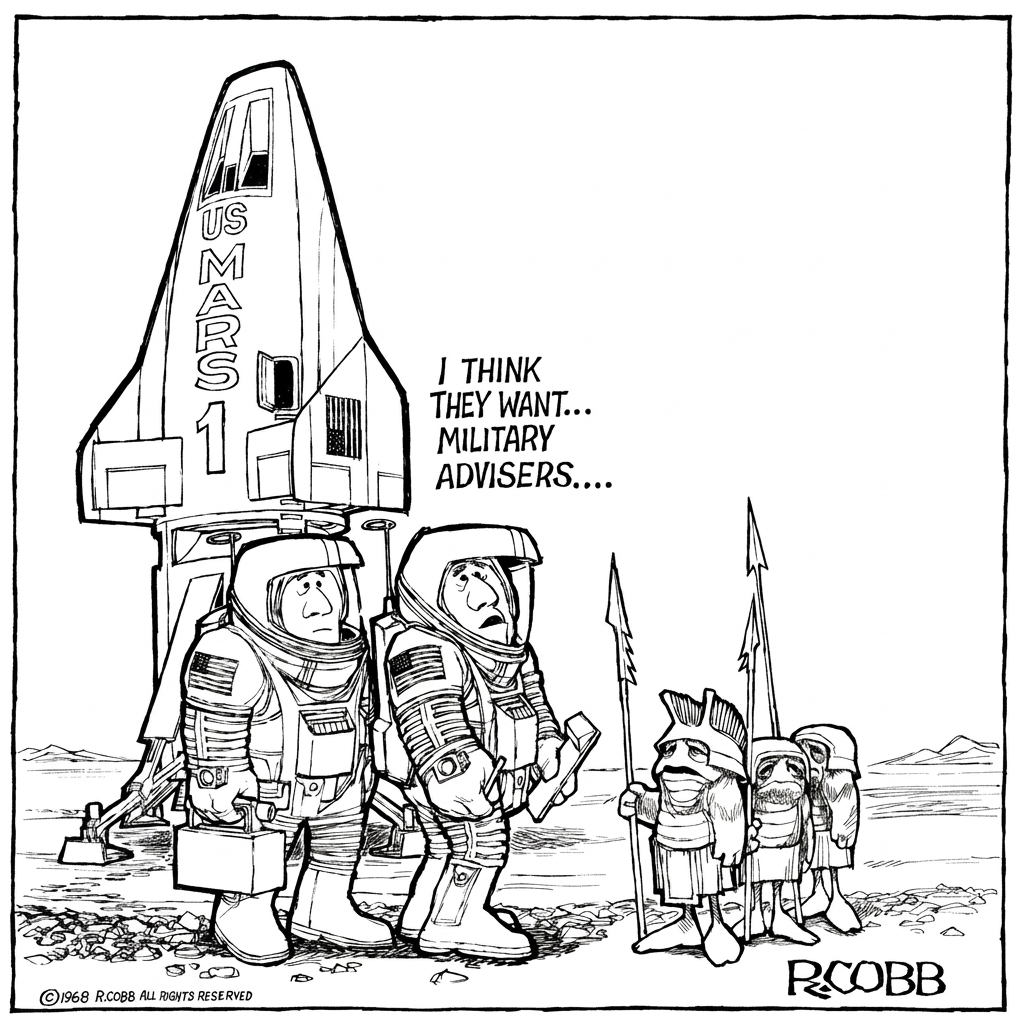
Much of that visual language came from the work of designer Ron Cobb. Cobb was an unlikely architect of the militarized future. Before becoming one of the most influential science-fiction designers in film, he had been a fiercely anti-war political cartoonist during the Vietnam era. He remained a committed pacifist for the rest of his life. Yet his design work—precisely because it was grounded in realism—did something unexpected: it translated the industrial logic of the American war machine directly into science fiction.
Cobb’s spacecraft looked like naval vessels moved into orbit. His vehicles resembled armored transports with better propulsion. Everything had access panels, service ladders, visible bolts, and maintenance hatches—the aesthetic of machines built to fight, repair, and fight again. The result was a kind of extrapolated Pentagon futurism: the U.S. military, scaled into space. You can still see the lineage decades later in films like Avatar, where human military hardware looks less like speculative technology than like the Marine Corps with upgraded engines.
Jodorowsky rejected that vision.
Instead he turned to the French artist Jean Giraud, better known as Moebius, whose technology looked alien, dreamlike, and culturally distant from twentieth-century industrial warfare. Where Cobb imagined the machinery of American power extended outward into space, Moebius imagined civilizations that had evolved past that machinery altogether.
What Moebius actually did was imagine technology that had no visible maintenance infrastructure — surfaces without panels, vehicles without bolts, machinery that seemed to have emerged from a different relationship between humans and tools entirely.
It’s important not to misunderstand this contrast. The modern military-industrial complex did not evolve toward the Moebius vision. If anything, it quietly absorbed the opposite aesthetic. The design language that ultimately dominated American science fiction—and much of the real defense technology pipeline—borrowed heavily from Cobb’s industrial realism: modular machines, serviceable hardware, platforms built to project force and be repaired in the field. The irony is that Cobb himself, a lifelong pacifist, was not advocating for that future. His designs simply reflected the practical engineering logic of twentieth-century industrial warfare. But that logic turned out to be exactly what the permanent defense economy needed as it scaled the infrastructure of wartime production into a standing technological environment. Moebius imagined a civilization that had moved beyond the machinery of war. The military-industrial complex did something far more prosaic: it borrowed Cobb’s visual grammar and kept building.
The disagreement was aesthetic, but it hinted at a deeper question.
Was the United States building a future that moved beyond the wartime industrial system that defeated the Axis powers?
Or was it simply scaling the Arsenal of Democracy outward, turning a temporary emergency economy into a permanent technological environment?
Because by the late twentieth century, something strange had happened.
The machinery that won World War II had not disappeared.
It had become the operating system of the state.
The confusion between the wartime “Arsenal of Democracy” and the Cold War military-industrial complex isn’t just historical laziness. It’s a systems-level bug—a persistent failure mode in the national firmware. The Ron Cobb aesthetic of rugged, repairable war machines scaling outward into the future turned out to be more than a design language. It became the implicit architecture of the permanent defense economy.
People look at the wartime “Arsenal of Democracy”—the factories running triple shifts, the sedans that became tanks overnight, the refrigerator plants machining gun components—and they draw a straight line from that industrial miracle to the permanent Cold War defense economy. Same iconography. Same flag. Same general category of large federal expenditure on things that explode.
Different machine entirely. And the confusion, sustained across generations of think-tank white papers and congressional testimony and defense contractor investor calls, is not innocent. It is load-bearing. The myth does work. It keeps the money moving.
Let’s establish what actually happened, because the historical record is not ambiguous.
The Emergency Operating System
The wartime mobilization Franklin Roosevelt directed in 1942 was not capitalism humming along with a patriotic soundtrack. It was a hard fork. The federal government temporarily seized administrative root access to every supply chain, every labor allocation, every pricing mechanism, every materials flow in the national economy. Automobile factories stopped pretending they were consumer enterprises and became state-directed tank foundries. The civilian market was suspended—a legacy process rationed and subordinated to the logistics of planetary survival.
This was directed industrial metabolism. A planned, high-temperature burn that worked precisely because it crashed the normal logic of profit and loss.
Factories ran flat-out, indifferent to margin. Production decisions were made by logistics officers, not shareholders. Millions of workers were drafted, relocated, retrained, and aimed at industrial targets because the alternative was national deletion. The wartime economy mobilized labor, capital, and engineering talent at a scale that ordinary markets—with their friction, their feedback delays, their quarterly earnings horizons—cannot approach.
Then the war ended.
The emergency OS was uninstalled. Soldiers came home. Factories retooled. Pent-up consumer demand detonated into the civilian economy like a thermodynamic release. The GI Bill pumped millions of veterans into universities and home ownership—a massive state-directed wealth transfer dressed up as gratitude. The wartime production machine dissolved, and its components were recycled into refrigerators, automobiles, suburban construction, and the first flickering circuits of the electronics age.
That transition—from directed metabolism to market-driven demand—is what produced the postwar boom. The wartime surge was ignition, not engine. The factories did not create prosperity by running. They created prosperity by stopping, converting, and releasing their output into a civilian economy where workers suddenly had wages, education, and credit.
Confusing that ignition event with a permanent power plant is the load-bearing error. Everything that follows depends on it.
The Political Danger of a Hot Economy
Here is the fact that tends to get quietly archived: the wartime industrial economy had proven something politically inconvenient.
When the federal government mobilized industry at scale, it didn’t just produce weapons. It produced mass bargaining power. Union density surged. Industrial workers gained structural leverage. The middle class expanded like a thermal bloom—rapidly, materially, with consequences for everyone who held a welding torch or ran a lathe.
Corporate managers, financiers, and industrial owners looked at this outcome and recognized a problem. A wartime command economy, it turned out, could also produce something they hadn’t ordered: a society where workers had structural power. Where the distribution channel for national wealth ran through wages and collective bargaining rather than dividends and executive compensation.
So after the war, the architecture was quietly refactored. Not the spending levels. The distribution mechanism.
The postwar system Eisenhower would later name the military-industrial complex preserved the large flows of public money into defense. But those flows were rerouted through new institutional plumbing, in ways that prevented them from generating the same broad social effects. Same input. Radically different output.
Three protocols did the work.
Protocol One: Capital Intensity Replaces Labor Intensity
The Arsenal of Democracy ran on bodies. Tanks, aircraft, artillery, ships—these required legions. Machinists, welders, assembly workers, mechanics by the millions. The industrial processes of the 1940s were labor-hungry. You could not produce at scale without employing at scale.
Postwar defense production evolved in the opposite direction. Toward systems requiring smaller and smaller numbers of highly specialized engineers, technicians, and subcontractors. Toward capital intensity.
This shift is sometimes narrated as pure technological inevitability. Weapons got more sophisticated, therefore they required fewer but more skilled workers. True enough as far as it goes, but it elides the procurement dimension entirely. Contracting structures and acquisition rules strongly amplified the complexity trajectory, rewarding systems whose cost growth and engineering difficulty translated into larger and more durable program budgets. The more exotic the materials, the more lines of software code, the more expensive the test regime—the larger and more defensible the program office.
Money flowed into design bureaus, advanced composites, avionics, software. Away from assembly lines and hiring halls. Public money remained large. Labor’s share shrank. Same budgetary throughput, different exhaust.
Protocol Two: Geographic Dispersion Replaces Industrial Concentration
During wartime mobilization, contracts flowed to places with industrial capacity. Detroit, Cleveland, Hartford, Seattle. Dense industrial ecosystems—tight clusters of machine tools, skilled labor, and union halls. Places where workers could organize because they were physically proximate and economically concentrated.
The Cold War procurement system deliberately fragmented production across congressional districts. A single weapons program might involve subcontractors in thirty or forty states. Every district got a piece. Every congressman had a stake.
This created political durability—a self-reinforcing coalition that made cancellation nearly impossible regardless of military merit. It also prevented workers from concentrating enough to wield collective bargaining power. Labor power depends on density. Density requires proximity. Defense procurement turned proximity into political scatter. The workers were still there, theoretically. But they were atomized across the landscape, each small cluster too isolated to organize, too dependent on the local program to risk antagonizing the contractor.
A fighter jet is not just a fighter jet. It is an employment program in forty states, which is precisely why it survives regardless of whether it works.
Protocol Three: Financial Extraction Replaces Industrial Reinvestment
The large defense primes—the companies that would eventually consolidate into Lockheed Martin, RTX Corporation, Northrop Grumman, Boeing—increasingly operated inside the logic of global finance rather than national industrial development.
Profits were not primarily recycled into domestic industrial expansion. New plant capacity, workforce training, long-term R&D—that was not the play.
The play was shareholder returns. Stock buybacks. Executive compensation structures calibrated to quarterly financial performance. International capital networks. The money went up, not out.
This is where the inversion becomes fully visible. The wartime industrial machine circulated money through labor and production. The permanent defense economy circulates money through ownership and finance. The system still transfers enormous public resources into private hands. But instead of generating broad employment and middle-class expansion, it channels wealth toward a relatively narrow ownership class whose assets are globalized, mobile, and increasingly detached from national consequences.
By the late twentieth century, much of that capital had migrated into offshore structures, global tax arbitrage, and financialized corporate governance. Wealth generated by public defense spending—money appropriated by Congress, collected from taxpayers, justified by national security—accumulating in jurisdictions far removed from the workers and communities that funded it.
The dollars left the country. The weapons stayed. The shareholders collected.
The political genius of the system is that it still looks, from a sufficient distance, like patriotic industrial policy. Factories exist. Weapons are built. Jobs are claimed at press conferences. The iconography remains intact. But the distribution channel has been redesigned so thoroughly that the largest economic benefits bypass the broad middle class almost entirely.
The Arsenal of Democracy built an industrial society. The permanent military-industrial complex sustains a capital circulation system for a transnational ownership class—funded by national budgets, justified by national security, and increasingly indifferent to national prosperity.
That inversion was not technological inevitability. It was a sequence of political decisions about who the economy is for.
Eisenhower’s Warning, Recompiled
When Eisenhower warned about a “military-industrial complex” in 1961, he was not predicting cartoon corruption—generals in parking lots, briefcases changing hands. He was describing the emergence of a self-maintaining institutional ecosystem. Defense contractors, military planners, congressional committees, and regional employment blocs had formed a stable political circuit. A feedback loop with its own survival instincts, its own threat perception, its own definition of success.
Unlike the wartime mobilization, this system had no terminal condition. No victory state. No off switch. It simply required continuous justification, which it proved entirely capable of generating.
The economic structure therefore inverted in a specific way. During wartime mobilization, industry served national necessity. The objective was winning, and when winning happened, you stopped. In the permanent defense economy, national necessity increasingly serves industrial continuity. The justification is retrofitted to the program. Strategy becomes a rationalization for whatever equipment the system is already building.
Weapons programs became infrastructure projects. Procurement cycles stretched across decades. Systems were designed not merely for battlefield effectiveness but for congressional survivability—subcontracts distributed across enough districts that cancellation became politically indistinguishable from economic sabotage.
This is not an industrial engine. It is an industrial holding pattern.
In macroeconomic terms, permanent defense spending behaves less like industrial stimulus and more like strategic overhead. It maintains capabilities. It sustains technological niches. It produces remarkable machines and engineering talent. But it does not generate the kind of broad social prosperity associated with the wartime mobilization myth, because it was specifically redesigned not to.
The United States did not become prosperous because it built tanks and bombers. It became prosperous because those factories stopped building tanks and bombers and began producing consumer goods for a population suddenly flush with wages, education, and housing credit.
The Inverted Pipeline
In a functioning defense system, the flow runs in one direction:
Threat → Strategy → Doctrine → Technology → Procurement
You perceive a threat. You formulate a strategy. You develop doctrine. You identify technological requirements. You procure systems that meet them.
When the institutional ecosystem becomes self-sustaining, the pipeline inverts:
Funding → Contractors → Lobbying → Doctrine → Justification
The money is already there. The contractors are already there. They lobby to protect and expand existing programs. Doctrine is retrofitted to justify the systems already in production. Strategy becomes a rationalization for whatever the procurement cycle is currently delivering. Threats are emphasized, amplified, or occasionally constructed to match the capabilities on offer.
This is what critics mean by procurement capture. Programs survive not because they are strategically optimal, but because too many institutional actors depend on them. The system teaches itself to see the world through the lens of its own preservation.
The result is a military that is very expensive, impressively equipped, and optimized for a strategic environment that may or may not resemble the one it will actually fight in.
The Credit Misattribution Problem
One of the reasons the military-industrial complex retains intellectual legitimacy—particularly among technologists who should know better—is a persistent and convenient credit misattribution.
The standard argument runs as follows: the defense ecosystem produced the internet, aerospace, semiconductors, computing, networking. DARPA. GPS. The foundational infrastructure of the modern economy. Therefore the permanent defense establishment is a powerful innovation engine and deserves its budget and its deference.
This argument quietly compresses two entirely different institutional systems into one, and the compression is doing significant political work.
The innovations being celebrated were largely produced by the institutional afterglow of World War II mobilization—when the United States still operated within the intellectual framework of the New Deal and the wartime Arsenal of Democracy. That earlier system ran on massive public investment in science and engineering, long-term institutional research programs with no immediate commercial payoff requirement, and a broad social contract in which technological progress was expected to benefit the middle class as a whole rather than accumulate at the apex of the ownership structure.
The early Cold War research environment—from which DARPA eventually emerged—inherited that framework. It inherited the national laboratories, the university research partnerships, the federal science funding apparatus, and a culture that treated technological capability as a public good rather than a revenue stream.
Much of the innovation people celebrate today was produced by the institutional momentum of the Arsenal of Democracy era. Not by the later political economy of the permanent procurement machine.
The distinction matters because the modern defense ecosystem operates under entirely different incentives. Large procurement programs dominate spending. Financial markets shape corporate strategy. The primary institutional objective is maintaining program continuity rather than maximizing discovery. The research culture that produced radar, rocketry, and the early internet was a specific historical artifact of a specific institutional moment.
The current system may be living off accumulated institutional capital—the scientific infrastructure, the research culture, the public investment frameworks—created during a very different era of American political economy. And it is claiming credit for the output of that earlier system while running a procurement machine that is structurally incapable of replicating it.
Why This Degrades Military Effectiveness
The same incentive structure that extracts wealth upward also degrades battlefield performance. These are not separate pathologies. They are the same machine viewed from different angles.
Cost-plus incentives reward complexity, not effectiveness. The more complex and expensive the system becomes, the larger the profit margin for the contractor. This produces exquisite, expensive platforms optimized for procurement survival rather than battlefield resilience. The features that win contracts are not necessarily the features that win wars.
Institutional inertia beats adaptation. Real wars reward adaptability. Adversaries adapt. Tactics evolve. But procurement systems lock militaries into decades-long technology cycles. By the time a platform reaches full deployment—the last subcontractor onboarded, the last test passed, the last congressional hearing survived—the strategic environment may have already moved. The system was designed for the last war, funded with the next war’s budget, and delivered in time for the war after that.
Political distribution overrides military logic. Programs spread across enough congressional districts become politically immortal regardless of performance. Cancellation requires unwinding too many careers, too many regional economies, too many committee chairmen with subcontractors in their districts. The program survives. The shortcomings are classified, minimized, or redefined as features.
Financial extraction competes with readiness. If the primary economic beneficiaries are shareholders and financial networks, the incentive is to maximize contract flow rather than operational capability. Readiness—training, maintenance, spare parts, personnel—generates inferior returns to new procurement. So readiness degrades quietly, invisibly, until it becomes visible in a context where visibility is expensive.
There is also an analytical consequence that deserves its own attention.
A military-industrial ecosystem built around offensive power projection tends to perceive the world in its own image. It builds for global reach, carrier strike groups, long-range precision strike, expeditionary dominance. Then it looks at adversaries and assumes they are building toward the same objectives, because those are the objectives it knows how to conceptualize and sell.
Consider Iran. Its military doctrine has historically emphasized deterrence and asymmetric defense: ballistic missiles, drone networks, proxy architecture, and denial strategies designed to raise the cost of invasion rather than project power abroad. The doctrine emerged from the Iran-Iraq War, which taught Tehran that conventional military parity with major powers was unavailable, and that survival required making invasion prohibitively expensive.
This is a coherent strategic posture. It is also a fundamentally defensive one.
But when analysts inside a power-projection system evaluate an adversary with a large missile arsenal and regional proxy networks, they tend to read offensive ambition. Deterrence looks like escalation. Denial looks like preparation for conquest. The mirror-imaging is almost automatic.
The system sees threats that resemble its own capabilities, because those are the only threats it knows how to build and budget for.
This is not merely a conceptual error. It feeds directly back into the procurement ecosystem. If the adversary is assumed to be offensive, the appropriate response is more offensive capability: more strike platforms, more precision weapons, more global reach. The logic of deterrence and regional balance recedes. The pipeline generates its own justification. The budget grows.
The Core Risk
If a defense system’s internal reward structure prioritizes budget flows, contract volume, and financial returns, then strategic performance becomes secondary to institutional continuity. This does not require villains. It does not require fraud or conspiracy or generals in parking lots. It requires only misaligned incentives operating consistently over decades, which is the most reliable mechanism in institutional life.
The people inside this system mostly believe they are serving national security. They show up, follow the rules, produce the systems they were asked to produce. That sincerity is real and largely irrelevant. Systems malfunction through incentive structures, not through bad faith.
And in military affairs, incentive failures have a specific and unforgiving consequence: they become fully visible only during war. That is the moment when theory meets logistics, when doctrine meets an adaptive adversary who has no interest in your procurement timelines or your congressional district subcontracts.
The real danger is not corruption. It is strategic illusion—a defense establishment that believes it is optimizing for victory while actually optimizing for budgetary throughput. A system that has taught itself, slowly, incrementally, without malice or conspiracy, the wrong lessons about how wars are won.
In that scenario, the question is not whether money is being wasted.
The question is whether the machine can recognize its own failure mode before the failure becomes operational.
The military-industrial complex survives on historical nostalgia. People remember the Arsenal of Democracy—the factories, the technical brilliance, the sense of collective national purpose—and imagine the permanent defense economy as a continuous version of that achievement.
It is not.
The wartime economy circulated money through labor, production, and mass participation. The permanent defense economy circulates money through ownership, procurement cycles, and financial structures that operate several layers above the factory floor.
The symbols stayed the same. The distribution channel changed. Which means the historical comparison most often used to justify the system is also the one that most effectively conceals its transformation.
The Arsenal of Democracy built an industrial middle class.
The permanent military-industrial complex sustains a procurement ecosystem and calls it the same thing.
That confusion is not an accident.
It is the product of a political economy that benefits from the misunderstanding. As long as the permanent procurement system can wrap itself in the mythology of the Arsenal of Democracy, its budgets look like patriotism rather than subsidy.
The factories still exist. The machines are impressive. The rhetoric remains unchanged.
But the system underneath is no longer the one that built the American middle class.
The Arsenal of Democracy was an emergency mobilization that temporarily redirected an industrial society toward survival.
The military-industrial complex is a permanent procurement ecosystem that learned how to imitate the symbols of that mobilization while quietly reversing its economic logic.
From a distance the two systems look identical.
Up close they do completely different work.
Leave a Reply